

You can have a product team running a clean sprint cadence, an ops team with a beautiful intake queue, and a data team with a dependency board that would make anyone jealous. Each one works. And the company still feels like it's dragging a parking brake.
That's the weird part nobody tells you about "operating systems." Local excellence doesn't add up to org-level flow. Three high-functioning team OSes often produce more friction than three mediocre ones, because each team optimizes hard against its own definition of "done," "urgent," and "ready." The seams between them—the handoffs, the shared calendars, the moments where one team's output becomes another team's input—are where the org actually lives or dies.
This is a piece about the seams. Not about building a better internal system for one team (you've probably read enough of those), but about the connective tissue that turns several independent operating rhythms into a single organizational operating cadence that's actually repeatable.
The real problem is translation loss, not disorganization
When leaders feel cross-team churn, the instinct is to assume somebody isn't organized. So they roll out a new tool, a new template, a new all-hands. But the teams are organized. The problem is that each team's OS speaks a slightly different dialect, and information degrades every time it crosses a boundary.
A few patterns show up over and over:
-
The product team's "committed for this sprint" means we'll try. The ops team hears it as it's guaranteed, and promises it to a customer.
-
Intake teams score requests by customer impact. Engineering scores by technical risk. Same request, two different priorities, and neither team knows the other's number.
-
A dependency board tracks what's blocked. But it doesn't track who agreed to unblock it by when, so the board is honest and useless at the same time.
None of these is a discipline failure. They're translation failures. And translation failures scale worse than disorganization does, because as you add teams, the number of boundaries grows faster than the number of teams. Four teams have six pairwise handoffs. Eight teams have twenty-eight. You don't feel the pain at three teams. You feel it hard at seven or eight, usually right around the time you've hired enough people that nobody can just walk over and ask.
What actually breaks as you scale
The failure isn't gradual. It arrives in clusters, and it tends to look like this.
Stop losing track of your priorities.
Workyly helps you organize, assign, and track every task efficiently.
- Centralized task management
- Real-time collaboration
- Intelligent workflow automation
No credit card required
Stage one: the shadow coordination layer appears. Around 30–50 people, you'll notice a handful of individuals who "just know how things connect." They sit in every meeting because they're the human API between teams. They're valuable and they're a bottleneck, and they'll usually be the first to burn out.
Stage two: cadences drift out of phase. Product plans in two-week sprints. Marketing plans in monthly campaigns. Finance plans in quarters. Support plans daily. When these rhythms aren't deliberately aligned, dependencies land at the worst possible time—engineering finishes a feature the week after the campaign it was meant to support already shipped.
Stage three: the calendar becomes the enemy. Every unresolved handoff turns into a recurring sync. Now you've got a "product/ops weekly," a "data/product weekly," a "cross-functional standup," and three of them are covering the same three blocked items. Meetings become the coordination mechanism because the system isn't one.
The observation that matters here: most cross-team churn is a symptom of missing contracts, not missing communication. People add more meetings to fix what should have been fixed with a clear handoff definition. More talking, same churn.
The three layers you're actually stitching together
Before the fix, it helps to name what's interlocking. Most orgs are running some version of these three OS types, whether they call them that or not.
| OS layer | What it manages | Its natural bias | Where it leaks into other teams |
|---|---|---|---|
| Productivity OS | A team's own work, sprints, priorities | Protecting focus and internal throughput | Commitments other teams depend on |
| Intake system | Incoming requests from other teams/customers | Fairness, triage, SLA | Requests that create hidden dependencies |
| Dependency board | Cross-team blockers and sequencing | Visibility of what's stuck | Ownership of who resolves what by when |
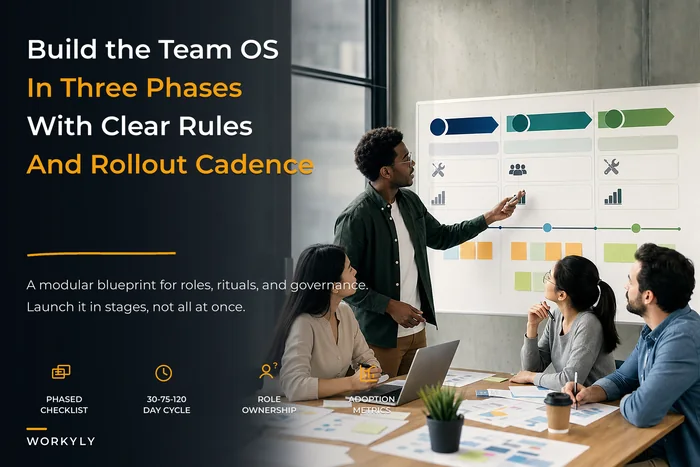
The failure mode is that each layer is usually owned and optimized in isolation. Someone builds a great team productivity operating system with governance and a rollout playbook, someone else builds a solid dependency governance model, and they never get formally connected. The connection is the whole job.
The concept that makes it click: the handoff contract
A handoff contract is the smallest unit of cross-team coordination. It's not a document you file away—it's a shared agreement about what "done and delivered" means between two teams, written down once so nobody re-litigates it in a meeting.
-
Trigger — the specific event that starts the handoff (e.g., "PR merged to staging," not "when it's ready").
-
Artifact — what physically moves across the boundary (a ticket, a spec, a dataset, a deployed endpoint).
-
Acceptance criteria — how the receiving team confirms it's usable, defined by the receiving team.
-
Owner on each side — one name per team, not a group.
-
Response window — how long the receiving team has to accept or reject before it escalates.
The magic is in part three. Acceptance criteria owned by the receiver eliminate the single most common source of churn: the sending team thinks they delivered, the receiving team thinks they got garbage, and both are technically right because "done" was never jointly defined.
Have the receiving team draft acceptance criteria before the sender begins work so acceptance is a validation, not a surprise.
A typical example looks like this. A data team "delivers" a dashboard to the finance team. Under the old model, finance opens it, finds three metrics defined differently than expected, and files a bug. Two weeks of back-and-forth. Under a handoff contract, finance had pre-written the acceptance criteria ("revenue must match the ledger definition to the dollar; refresh must complete before 6am ET"). The data team built to that spec the first time. The two-week loop becomes a one-day confirmation.
Mandatory touchpoints: fewer meetings, but the right ones
You don't align cadences by adding syncs. You align them by defining a small set of mandatory touchpoints—moments where cross-team information is required to change hands—and then deleting everything else.
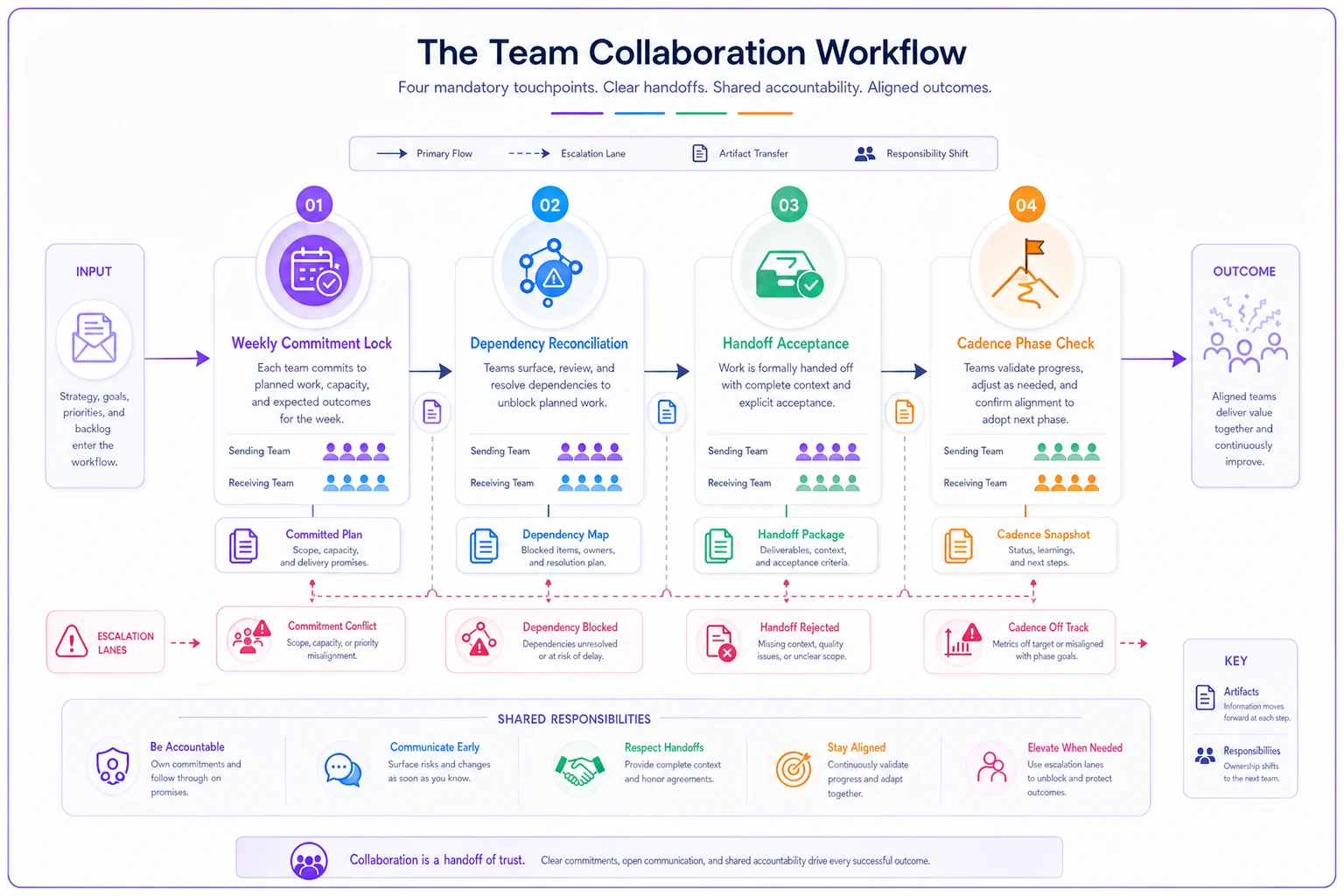
In practice, four touchpoints cover most orgs:
-
Weekly commitment lock. Each team publishes what it's committing to that has cross-team impact. Not everything—just the promises other teams will build on. This becomes the single source of "what's actually committed."
-
Dependency reconciliation. A short, async-first review of the dependency board where every blocked item must have an owner and a date, or it gets escalated. No owner, no date, no exceptions.
-
Handoff acceptance. The receiving team formally accepts or rejects deliverables against the pre-agreed criteria. This is where translation loss gets caught before it spreads.
-
Cadence phase check. Roughly monthly
are the team rhythms still in phase, or has one drifted? Adjust sprint boundaries or campaign timing so dependencies land in the right week.
Visualize how these touchpoints flow between teams.
The point of naming these as mandatory is that everything not on the list becomes optional and can be killed guilt-free. Once the mandatory touchpoints are real and trusted, half the recurring "sync" meetings tend to disappear within a month or two, because their only job was covering for the absence of a reliable touchpoint.
Calendar templates that keep rhythms in phase
Anchor everything to a shared week-zero. Pick a reference Monday. All two-week cadences align to it, so no team's sprint boundary lands mid-week for another team.
A repeatable weekly skeleton looks like:
-
Monday AM — commitment lock (async). Teams post cross-team commitments by 11am. No meeting unless something conflicts.
-
Tuesday — dependency reconciliation (30 min max, or async). Every board item gets owner + date or an escalation flag.
-
Wednesday/Thursday — deep work, no cross-team meetings. Protected. This is where the actual output happens.
-
Friday AM — handoff acceptance window. Receiving teams accept/reject against criteria before the weekend.
Then, at the cadence level:
-
Bi-weekly sprint boundaries align to week-zero.
-
Monthly phase check + retro on handoff contracts that failed.
-
Quarterly re-authorize the whole cadence—kill touchpoints that stopped earning their slot.
The mistake people make is treating the calendar as personal territory. If sprint boundaries and campaign starts aren't coordinated at the org level, no amount of individual time-blocking fixes the churn. The calendar is shared infrastructure, not private property.
Governance rules that prevent re-litigation
Cadences decay because rules get bent quietly until they're gone. A handful of governance rules keep the system honest:
-
No commitment without a contract. If a team promises something cross-team, it references a handoff contract. No contract, no dependency—it doesn't officially exist.
-
Silence is not acceptance. If a receiving team doesn't respond in the window, it escalates. It never defaults to "approved."
-
One owner per side. Groups don't own handoffs; people do. "The team will handle it" is where things die.
-
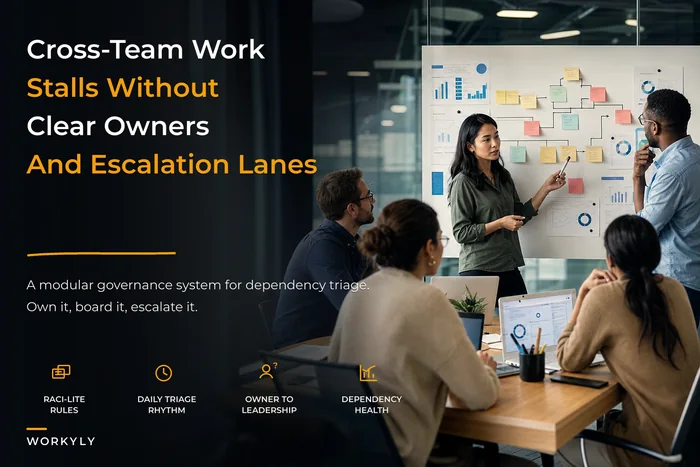
Escalation has a lane, not a person. Blocked items follow a defined escalation path so nobody has to figure out who to bug. This pairs directly with a structured approach to cross-team dependency governance with RACI-lite ownership and escalation lanes.
-
Quarterly sunset. Every recurring touchpoint expires unless someone re-authorizes it. Default is delete, not keep.
That last rule matters more than it looks. The reason orgs end up drowning in coordination overhead is that touchpoints are easy to add and nobody's job to remove. Make removal the default and the system stays lean on its own.
When this makes sense—and when it doesn't
This level of formality is a real cost, so be honest about whether you need it.
When it makes sense:
-
You've got four or more teams with genuine interdependencies.
-
Handoffs regularly slip or get rejected after the fact.
-
You've got shadow coordinators holding things together by memory.
-
Meetings are multiplying and none of them seem to reduce churn.
When it's a bad idea:
-
You're under ~20 people and can still coordinate by talking. Formal contracts will feel like bureaucracy because they are bureaucracy you don't need yet.
-
Your teams are genuinely independent—if they rarely hand off, don't manufacture process for it.
-
You're in a crisis sprint. Don't roll out new governance mid-fire; stabilize first.
Who should NOT do this: teams that will treat contracts as a compliance exercise rather than a translation tool. If the culture will fill out the template and ignore the intent, you'll add paperwork and keep the churn. Fix the intent first.
A real scenario
A ~60-person B2B software company had three solid teams: product, a customer-facing implementation team, and a small data/analytics group. Each ran well internally. But roughly a third of implementation projects were slipping their go-live dates, and the reason was always "waiting on data" or "the feature wasn't really done."
When they mapped it, there was no shared definition of "done" between product and implementation, and the data team was fielding somewhere around 15–20 ad-hoc requests a week with no real intake, so everything felt urgent. Three separate weekly syncs existed and none of them resolved the actual blockers.
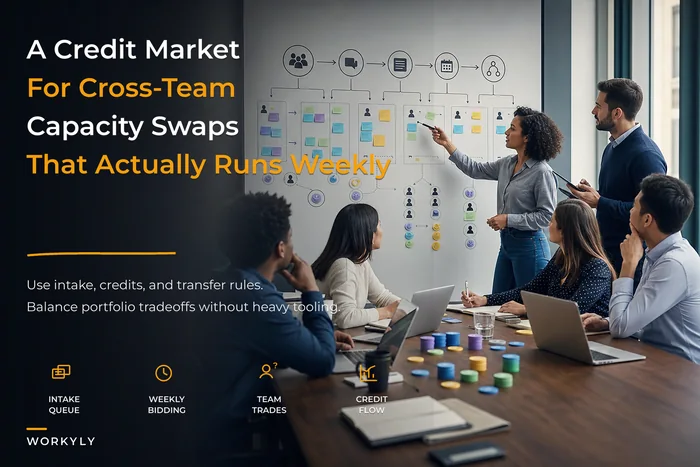
They didn't add anything. They defined handoff contracts for the two boundaries that broke most often, moved to an async Monday commitment lock, ran one Tuesday dependency reconciliation, and enforced the "silence is not acceptance" rule. They also stood up a lightweight version of a cross-team capacity marketplace so the data team's time was allocated deliberately instead of grabbed by whoever asked loudest.
Over the next quarter, on-time go-lives improved from roughly two-thirds to somewhere around 85–90%. Cross-team meeting hours dropped by close to a third. Nobody worked harder. The work just stopped getting lost in translation between three systems that had each, individually, been fine.
The mindset shift
An organizational operating cadence isn't a bigger version of a team OS. It's a different object entirely. A team OS optimizes throughput inside a boundary. An org cadence optimizes what happens at the boundaries—the triggers, the contracts, the acceptance moments, the escalation lanes.
Most companies over-invest in the first and never build the second. They keep polishing individual team systems and wonder why the org still feels chaotic. The leverage is in the seams. Define the handoffs, lock the calendar to a shared rhythm, make the governance rules boring and non-negotiable, and let the touchpoints earn their place quarter by quarter.
Do that, and you stop needing heroes to hold the org together. The cadence holds it together instead—which is the only version that survives you adding the next four teams.
Ready to boost your team's productivity?
Join 5,000+ teams using Workyly to streamline workflows, improve communication, and deliver projects faster.