

Portfolio resource leveling sounds like corporate jargon until you watch a mobile development team sit around waiting for API specs while the backend team drowns in work. Meanwhile, QA has nothing to test because features keep getting stuck in development.
The traditional fix involves elaborate resource management software, Gantt charts nobody updates, and meetings where managers negotiate team loans like feudal lords. Most organizations just absorb the waste — people underutilized in one corner while projects fail in another.
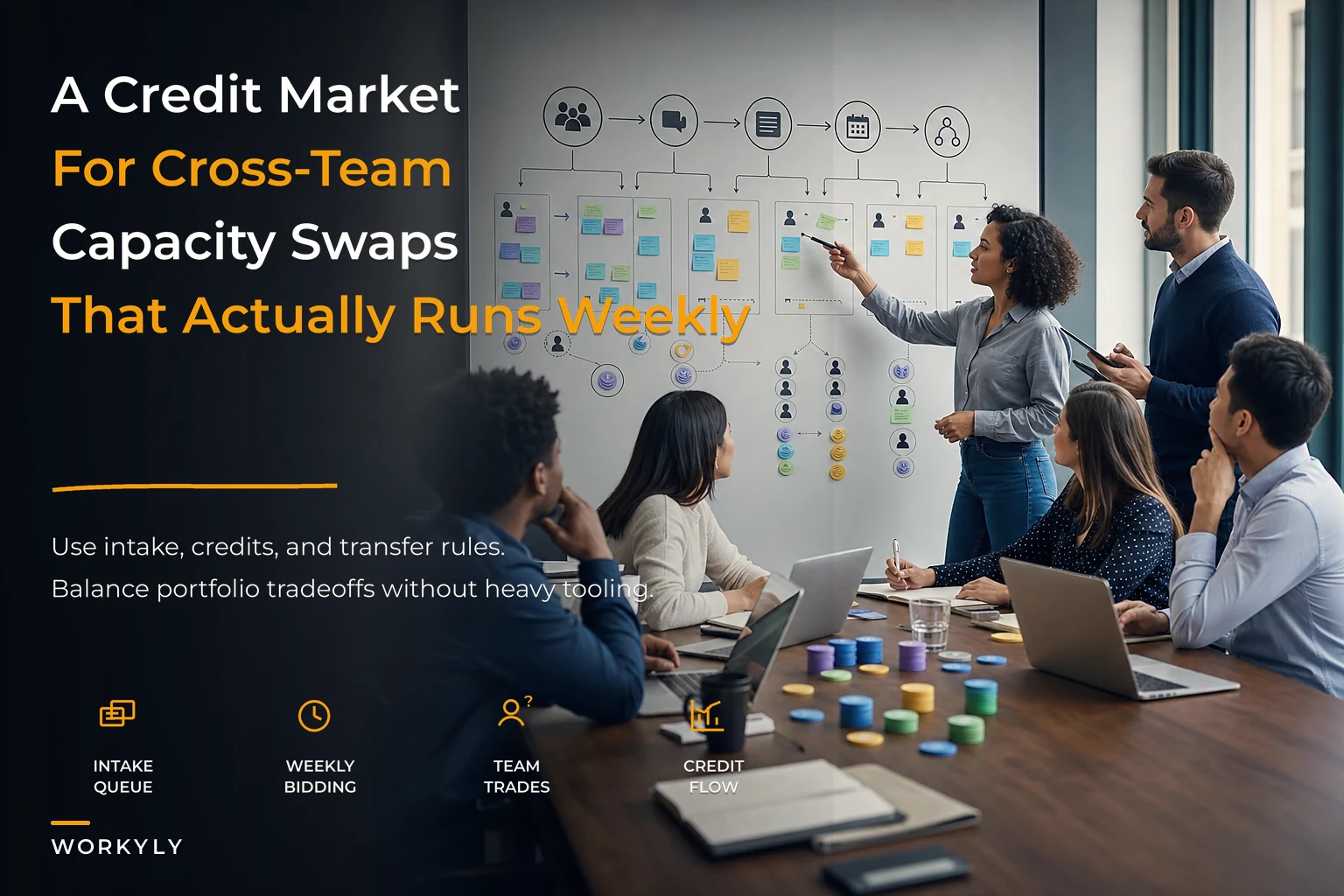
There's a different pattern worth paying attention to. A credit-based marketplace approach that treats team capacity like a tradeable commodity. Not in some complex financial sense, but through simple weekly auctions where teams trade surplus capacity for priority tokens.
The hidden geometry of resource imbalance
Resource imbalance follows predictable patterns. Marketing always needs more design work in Q4. Engineering always needs more QA during release cycles. Support always needs more dev help after major updates. These patterns repeat quarter after quarter.
Traditional resource planning pretends this isn't the case. It assumes steady-state demand, equal distribution of work, and reasonable forecasting. Every sprint planning session starts fresh, ignoring what everyone already knows about who needs what and when.
The real operational challenge isn't identifying imbalances — everyone already knows where they are. The challenge is moving resources without triggering territorial battles, approval chains, or the dreaded "resource allocation committee" that somehow takes three days to approve a two-hour task.
Small companies handle this informally. A developer helps customer support for a few hours. A designer jumps into a marketing project. But past 30 or 40 people, those informal trades break down. People don't know who has capacity. Managers protect their teams. Work gets stuck.
Why traditional leveling fails at scale
Resource leveling tools promise optimization and deliver complexity. They need accurate data about task duration, dependencies, and resource availability. They assume work can be precisely estimated and that people are interchangeable.
Stop losing track of your priorities.
Workyly helps you organize, assign, and track every task efficiently.
- Centralized task management
- Real-time collaboration
- Intelligent workflow automation
No credit card required
A software consultancy with around 85 developers tried implementing enterprise resource management. After six months, they had beautiful charts showing theoretical optimization. Their actual delivery metrics got worse. The tool showed balanced workloads while real projects sat blocked for weeks.
The failure points are consistent.
Teams spend more time updating the tool than the tool saves. Every task needs estimation. Every dependency needs mapping. Every skill needs categorizing. The overhead becomes its own bottleneck.
Portfolio resource leveling becomes a full-time job for someone — usually a project manager who becomes the single point of failure for all resource decisions. When they're out, the whole system freezes.
And the formality kills flexibility. Once resources are "officially" allocated, changing anything requires approvals and explanations. Teams learn to hoard capacity rather than share it.
The credit marketplace pattern
The marketplace approach flips the model. Instead of central planning, it creates a simple trading system. Each team gets monthly credits based on headcount and project criticality. They spend credits to "buy" time from other teams or earn them by making surplus capacity available.
The basic mechanism works like this:
-
Every Monday, teams post available capacity for the week — specific people, specific skills, specific time blocks. Not theoretical capacity. Real availability after accounting for planned work.
-
Teams that need help bid credits for open slots. Higher bids win.
-
The exchange runs through a lightweight tracking system — spreadsheet, Kanban board, or purpose-built software.
-
Credits reset monthly to prevent hoarding. Unused credits expire. Teams can't go into debt.
Simple auction mechanics, no drawn-out negotiations. What matters is visibility and simplicity, not sophistication. The monthly reset keeps things moving and reduces gaming.
How the marketplace flows week to week
MONDAY MARKETPLACE CYCLE Teams post available capacity (9:00 AM — skills, people, time blocks) ↓ Open bidding window (9:00 AM – 11:00 AM) ↓ Bids close, assignments confirmed (By 12:00 PM) ↓ Cross-team work begins (Rest of week) ↓ Exchange logged (Hours delivered, scope documented) ↓ Next Monday cycle starts
Here's a simple visual of the weekly marketplace cycle.
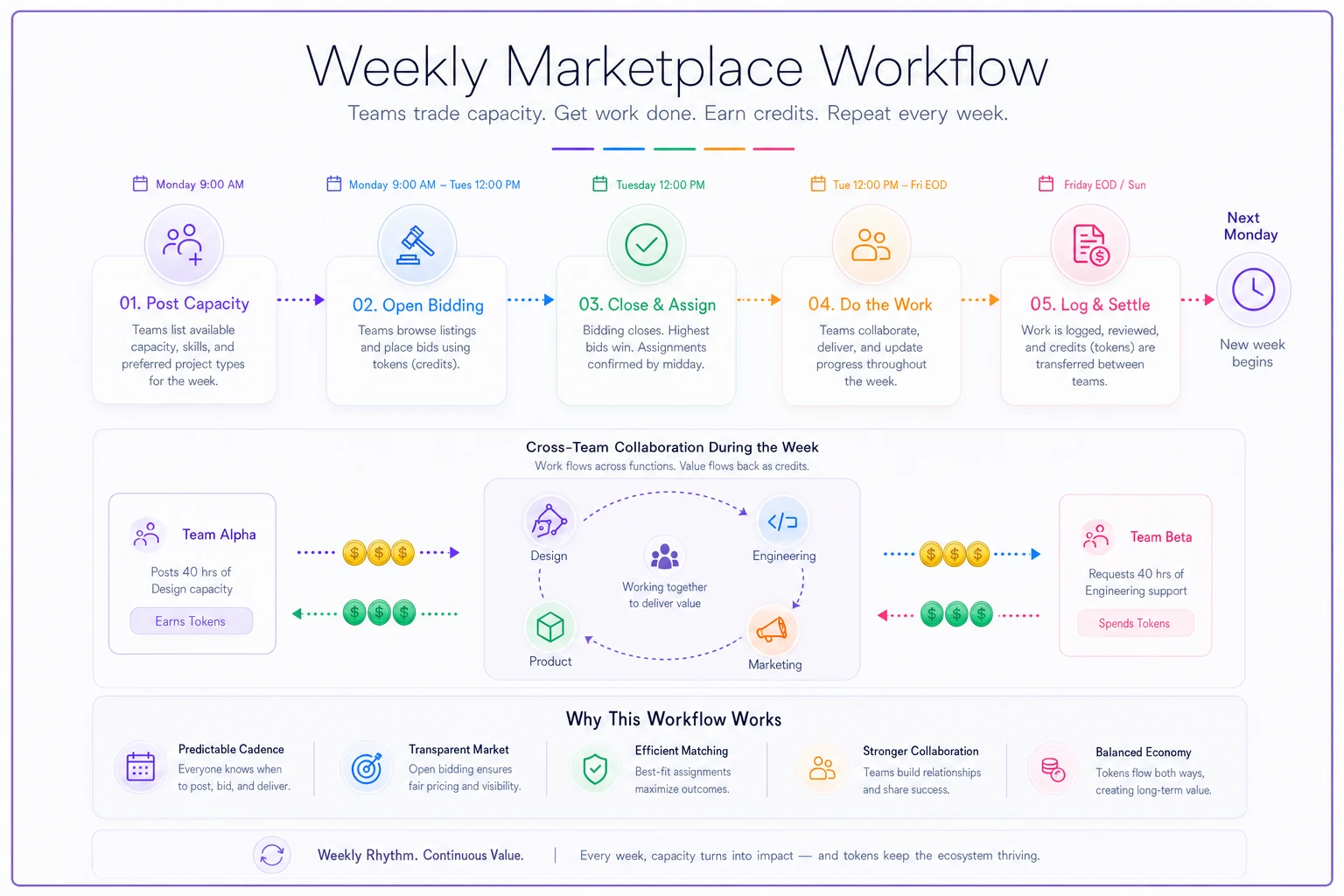
The three-hour window matters. It prevents overthinking and keeps decisions fast. Teams get better at separating what they actually need from what would be nice to have.
Setting up intake without bureaucracy
The intake process determines whether the marketplace works or becomes another abandoned system. Most organizations overcomplicate this immediately.
A marketing automation company with 55 employees kept it simple. One shared form, five fields: what you need, when you need it, how many hours, what skills are required, how many credits you're offering.
Requests go into a public queue. Everyone sees demand. That transparency alone reduces duplicate requests and helps teams anticipate what's coming.
The key is preventing scope creep. The marketplace handles small, defined chunks of work — five hours of React development, three hours of data analysis, two hours of design review. Not "help with Project X" or "support for Q4 initiatives."
Larger needs get handled through traditional planning with buffer bands. The marketplace handles the margins, not the core commitments.
Credit allocation that reflects reality
How you distribute credits shapes behavior more than anything else in the system. Equal distribution seems fair but ignores that some teams consistently need more help while others consistently have surplus.
Start with baseline credits tied to team size. A five-person team gets 50 credits per month — 10 per person. Then adjust for patterns.
| Team Type | Base Credits | Adjustment |
|---|---|---|
| Standard team (5 people) | 50/month | None |
| Revenue-critical project team | 50/month | +20% multiplier |
| Customer-facing team (high-contact period) | 50/month | +15 bonus credits |
| High-demand specialized team | 50/month | Charge premium rates (2–3x) |
One data platform team realized their SQL expertise was constantly in demand. They started charging 3x credits for database optimization work. Not profiteering — it reflected actual value and encouraged other teams to learn basic SQL rather than always outsourcing it to experts. The credit economy naturally surfaces skill gaps. When certain capabilities consistently command high prices, that's a signal to hire or invest in training.
Transfer rules that prevent chaos
Clear handoff rules determine whether cross-team work creates value or friction.
The borrowing team provides context, not training. If you need two hours of Python help, have the environment set up, the problem defined, and success criteria clear before the clock starts.
The lending team provides effort, not ownership. They're consultants on a short engagement. When the time block ends, they're done — no ongoing support, no maintenance responsibilities.
A 200-person fintech organization learned this the hard way. Early on, borrowed resources became de facto team members, pulled into meetings and follow-up work well beyond the original agreement. They introduced a "clean break" rule — when credited hours are done, the relationship ends unless new credits are exchanged.
Document each exchange with a simple template: what was requested, what was delivered, what wasn't completed. It prevents scope creep and creates useful history for future exchanges.
Some teams naturally develop preferred partnerships over time. The mobile team always borrows the same backend developer. Marketing always uses the same designer. That's fine as long as the credit exchange stays transparent.
Making portfolio resource leveling actually stick
Most resource optimization initiatives collapse within three months. The marketplace pattern survives because it requires minimal overhead and delivers visible value quickly.
Start with a pilot between two or three teams that already collaborate. Run it for a month with basic tracking — a shared spreadsheet works. Let them figure out credit values and transfer rules that fit their context.
Measure outcomes, not activity. Did blocked work get unblocked? Did project timelines improve? Did people feel their skills were put to better use? The credit numbers matter less than whether work actually flows better.
The system naturally evolves. Teams find optimal credit prices. Patterns emerge around which skills are scarce. The organization learns where to invest based on what the marketplace keeps signaling.
Where traditional planning still wins
The marketplace doesn't replace structured dependency governance for complex projects. It doesn't handle long-term resource commitments or strategic initiatives.
-
Multi-month projects requiring dedicated teams
-
Compliance-driven work with audit requirements
-
Highly specialized work requiring deep context
-
Crisis response requiring all-hands coordination
The marketplace handles roughly 20% of resource allocation that creates 80% of the friction — the small asks, quick helps, and temporary needs that clog formal processes.
Common failure patterns to avoid
Credit inflation happens when teams receive more credits without corresponding capacity increases. Suddenly everyone has credits but nobody has time. Keep total credits tied to actual availability.
Shadow exchanges emerge when teams trade outside the system to avoid credit costs. This usually means credits are too scarce or the system is too rigid. Adjust the system rather than policing behavior.
Hoarding behavior appears when teams bank credits "just in case" and never post availability. Monthly resets help, but some teams still try to protect capacity. Public participation metrics create enough visibility to discourage it.
Quality disputes arise when borrowed resources don't meet expectations. The temptation is to add reviews, ratings, and quality controls. Resist it. Keep the system lightweight. Teams quickly figure out who delivers and adjust their bidding accordingly.
Transitioning from chaos to marketplace
An e-commerce platform with around 120 employees had the typical resource mess. Frontend perpetually waited on backend APIs. The data team was constantly pulled into ad-hoc analytics requests. DevOps lived in reactive mode, fighting fires instead of building infrastructure.
They started with three teams and 20 credits per team per week. No fancy tools — a Slack channel and a Google Sheet.
Week 1 was messy. People didn't know how to price things. Some work was overvalued, some undervalued. But exchanges happened. A frontend developer got three hours of API help. A data analyst got two hours of React debugging. Small wins.
By week 4, patterns had emerged. Backend time consistently commanded premium credits. Thursday afternoon slots were cheap because everyone was protecting their Friday deadlines. The data team started batching requests to stretch credit efficiency.
After two months they expanded to all technical teams. Credits became a shared language for discussing resource needs. Instead of vague complaints about being understaffed, teams could point to market prices as actual evidence of gaps.
Six months in, velocity metrics improved by roughly 30%. The bigger shift was cultural. Teams stopped hoarding talent. People enjoyed working across contexts. The organization got better signal on where to invest in training and hiring.
The automation opportunity
This kind of resource marketplace fits naturally with operational software — not to replace human judgment, but to reduce friction in the mechanical parts.
AI-powered platforms can track availability patterns and suggest better posting times. They can analyze historical exchanges to recommend credit pricing. They can match requests with available skills without someone manually searching through a list.
Intake especially benefits. Natural language processing can parse requests and suggest appropriate credit amounts based on similar past exchanges. Historical data can flag requests that tend to expand beyond their original scope.
Smart notifications cut coordination overhead considerably. Instead of everyone monitoring the marketplace constantly, the system alerts relevant teams when high-value opportunities appear, reminds teams to post availability, confirms completed exchanges, and tracks balances. The human elements stay human — negotiation, relationship building, judgment calls. The software handles the bookkeeping.
Beyond individual contributors
The marketplace pattern extends beyond people. Teams can trade test environments, staging servers, software licenses, even meeting rooms. Anything scarce and valuable becomes tradeable.
A game development studio applied this to hardware. VR headsets, high-end graphics cards, motion capture equipment — all became marketplace items. Teams needing resources for specific sprints could bid for them rather than fighting over permanent assignments.
The same studio extended it to expertise access. One-hour architecture reviews, security audits, performance assessments — senior engineers posted office hours that teams could bid on.
This turns portfolio resource leveling from a planning exercise into an operational reality. Resources flow toward where they're most needed, driven by team-level decisions rather than top-down mandates.
Building your first marketplace prototype
Start next Monday. Pick two teams that regularly need each other's help. Give each 20 credits. Create a shared document with three columns: what's available, what's needed, current bids.
-
Week 2 — add a third team.
-
Week 3 — add basic tracking
who exchanged what, which requests went unfilled, how many credits were used.
-
Week 4 — review and adjust allocations based on what actually happened.
Run it for one week. No tools, no process documentation, no approval chains. Let the teams figure out what works. They'll find natural price points faster than any top-down system would.
The goal isn't a perfect system. It's creating just enough structure for resources to flow while keeping the flexibility that makes work happen. Portfolio resource leveling doesn't require enterprise software and consultants. It requires a simple mechanism that lets teams solve their own resource problems.
The credit marketplace isn't the only way to handle resource leveling, but it's one of the few approaches that actually works at scale without burying teams in process overhead. It acknowledges that resource allocation is inherently a negotiation — then gives teams a clean, transparent way to do that negotiating themselves. Most importantly, it puts resource decisions in the hands of the people doing the work. They know what they need, when they need it, and what they can offer in return. The marketplace just gives them a mechanism to make those trades without a three-day approval chain in the middle.
Ready to boost your team's productivity?
Join 5,000+ teams using Workyly to streamline workflows, improve communication, and deliver projects faster.