

Most strategy documents die in the gap between the quarterly planning meeting and the first sprint. Leadership walks out of a room feeling aligned. Teams walk into the next week with a vague sense of what "matters this quarter" and no real change to how they allocate hours. Six weeks later, someone runs a status update, discovers three of the top priorities have zero funded work behind them, and everyone acts surprised.
That gap isn't a communication problem. It's a plumbing problem. The connective tissue between what leadership decides and what teams actually fund with their time is missing or broken. And when it breaks, OKRs become a performance — something you write down, review once, and quietly abandon.
A strategy to execution operating model is the set of routines, gates, and enforcement rules that convert executive intent into funded, timeboxed delivery. Not a slide. A wiring diagram. This piece walks through how that wiring works when it's healthy, where it snaps under scale, and how to build it so quarterly intent reliably becomes team-week reality.
Where the intent-to-work chain actually breaks
Think of the chain as four handoffs: intent → funding → cadence → verification. Executives set intent. Someone funds it (assigns capacity and money). Teams schedule it into cadence (sprints, weeks). And a verification loop confirms the funded work is producing the outcome. Most orgs have all four concepts but no connective mechanism between them.
The pattern plays out the same way almost everywhere. Intent gets set clearly enough. Funding is where it falls apart — because "funding" in most companies isn't an explicit act. Nobody says "we are allocating 40% of Team A's capacity to Objective 2 for the next quarter." Instead, priorities get communicated, and teams are trusted to self-allocate. Self-allocation drifts toward whatever is loudest: the escalations, the exec's pet request, the customer who complained on Slack.
So you end up with a strategy that looks funded on paper and is completely unfunded in the calendar. The objective everyone agreed was #1 has three engineers assigned part-time between two firefights. Meanwhile a "nice to have" absorbed a full team because it had a vocal sponsor.
A typical example: a 60-person product org sets four quarterly objectives. When you audit where hours actually went at the end of the quarter, roughly half of engineering capacity landed on unplanned work and interrupts. The stated top objective got somewhere around 18% of real capacity. Nobody decided that. It just happened, one reprioritization at a time.
Why funding never becomes explicit
There are a few reasons this handoff stays broken across almost every company size.
Stop losing track of your priorities.
Workyly helps you organize, assign, and track every task efficiently.
- Centralized task management
- Real-time collaboration
- Intelligent workflow automation
No credit card required
The first is that funding feels like it happens elsewhere. Leadership assumes when they approve headcount, they're funding strategy. But headcount is a standing cost — it doesn't map to objectives. A team of eight can pursue any of a dozen directions with the same payroll. Approving the team is not the same as directing the team.
The second is that timeboxing and funding live in different tools and different conversations. Finance thinks in quarters and dollars. Teams think in sprints and story points. Nobody translates between the two units. So "we're investing in retention this quarter" never becomes "Team C dedicates sprints 1–4 to retention with a check-in at sprint 2."
The third is fear of commitment. Explicit funding forces trade-offs to be visible. If you say Objective 1 gets 40% and Objective 3 gets 10%, the sponsor of Objective 3 sees exactly how deprioritized they are. Vague allocation avoids that conflict — which is why leaders unconsciously prefer it. The cost is that the conflict just moves downstream, into the team's week, where it gets resolved by whoever escalates hardest.
What breaks specifically as you scale
At 10–15 people, none of this matters much. The founder or a lead holds the whole map in their head and rebalances in real time. Intent and execution are basically the same conversation.
The wiring starts failing around three transitions:
-
When one team becomes many. Cross-team dependencies mean funding Objective 1 now requires coordinated funding across three teams. If Team A funds it and Team B doesn't, the objective stalls at the handoff. This is where you need something like the ownership and escalation structure covered in the cross-team dependency governance blueprint — because uncoordinated funding produces beautifully staffed work that dies waiting on an unstaffed dependency.
-
When quarters get long enough to drift. A 13-week quarter has six or seven sprints. Intent set in week one erodes by week five. Without a gate that re-checks funding mid-quarter, you're steering by a decision that's already stale.
-
When the number of objectives exceeds working memory. Past four or five funded objectives, no single person tracks whether each still has real capacity behind it. The org needs an artifact that shows funded-vs-actual allocation, or it flies blind.
The failure mode at scale isn't dramatic. It's quiet. Work still happens, people stay busy, sprints still close. It just gradually decouples from strategy until the end-of-quarter review reveals that effort and intent went in completely different directions.
The operating model: gates, mappings, and enforcement
The fix is a small number of explicit routines that force funding to become a real, visible act — and keep it honest across the quarter. Four pieces.
1. Funding-rule templates
> Objective X receives [%] of [Team]'s delivery capacity for [time window], with a mandatory review at [gate].
A worked funding table for one team's quarter might look like this:
| Objective | Funded capacity | Time window | Gate |
|---|---|---|---|
| Reduce onboarding drop-off | 40% | Sprints 1–4 | Gate at sprint 2 |
| Billing reliability | 25% | Sprints 1–6 | Gate at sprint 3 |
| Partner API v2 | 20% | Sprints 3–6 | Gate at sprint 4 |
| Reserved (interrupts/unplanned) | 15% | Whole quarter | Continuous |
Notice the reserved band. Teams that fund objectives to 100% and leave nothing for interrupts always overrun, and the interrupts silently eat funded work. Naming a reserve makes the raid visible when it happens.
2. Quarter→sprint mapping routine
This is the translation layer between finance-language and team-language, and it's where most operating models are simply absent. The routine runs once at quarter start and gets refreshed at each gate:
-
Restate each objective as a measurable outcome — the thing that has to move, not the activity. "Cut onboarding drop-off from ~35% to under 25%," not "improve onboarding."
-
Assign a funding percentage using the template above. Force the numbers to sum to 100% including the reserve. If they don't sum, you haven't actually decided.
-
Convert percentages into sprint slots. If Objective 1 is 40% of a team's capacity across four sprints, that's roughly two engineers' worth of committed work per sprint. Write it into the sprint plan as named, owned work — not aspiration.
-
Place the gates on the calendar. Each objective gets a mid-window checkpoint where funding is re-authorized, adjusted, or cut. Gates go on the shared calendar as real events with a required decision, not a status readout.
-
Publish the map. One page, visible to leadership and teams. This is the document that gets audited at each gate.
The operational roadmap approach to mapping strategic outcomes into a repeatable cadence pairs directly with this — the roadmap gives you the outcomes; this routine attaches funded capacity to them.
3. Gate checklists
A gate is a scheduled decision point where funded work must justify its continued funding. It is not a demo. The whole point is that a gate can defund something. If your gates can't cut funding, they're just meetings.
-
Outcome movement Has the target metric moved in the expected direction? By roughly how much versus what was projected at funding time?
-
Actual vs funded capacity Did this objective actually receive its committed percentage, or did interrupts eat it? If it never got funded, don't judge it as if it did.
-
Blocking dependencies Is anything waiting on an unfunded cross-team dependency? If so, that's a funding gap upstream, not a delivery failure here.
-
Continue / adjust / cut decision An explicit, recorded call. Reduce funding, hold, boost, or stop. "Keep going" counts only if someone says it out loud and it's written down.
-
Reallocation If you cut or reduced, where does the freed capacity go? Freed capacity that isn't reassigned just evaporates into interrupts.
The dashboard that feeds these gates is worth building deliberately — the signals and thresholds in portfolio observability that actually drives funding are exactly what a gate needs to make a real cut instead of a polite nod.
4. Enforcement scripts
The operating model only holds if someone enforces the funding boundaries against the daily pull of escalations. Enforcement is mostly a set of scripts — short, repeatable responses that protect funded work without turning every request into a fight.
> "This is unfunded for this quarter. To fund it, we pull capacity from one of these objectives — which one comes down, and who signs off on that trade?"
That single sentence does most of the work. It converts a vague "can you also do this" into an explicit trade with a named owner. Nine times out of ten the request evaporates because nobody wants to own the trade. When it survives, it deserved the funding, and now it has it explicitly.
A visual of the funding-to-gates workflow:
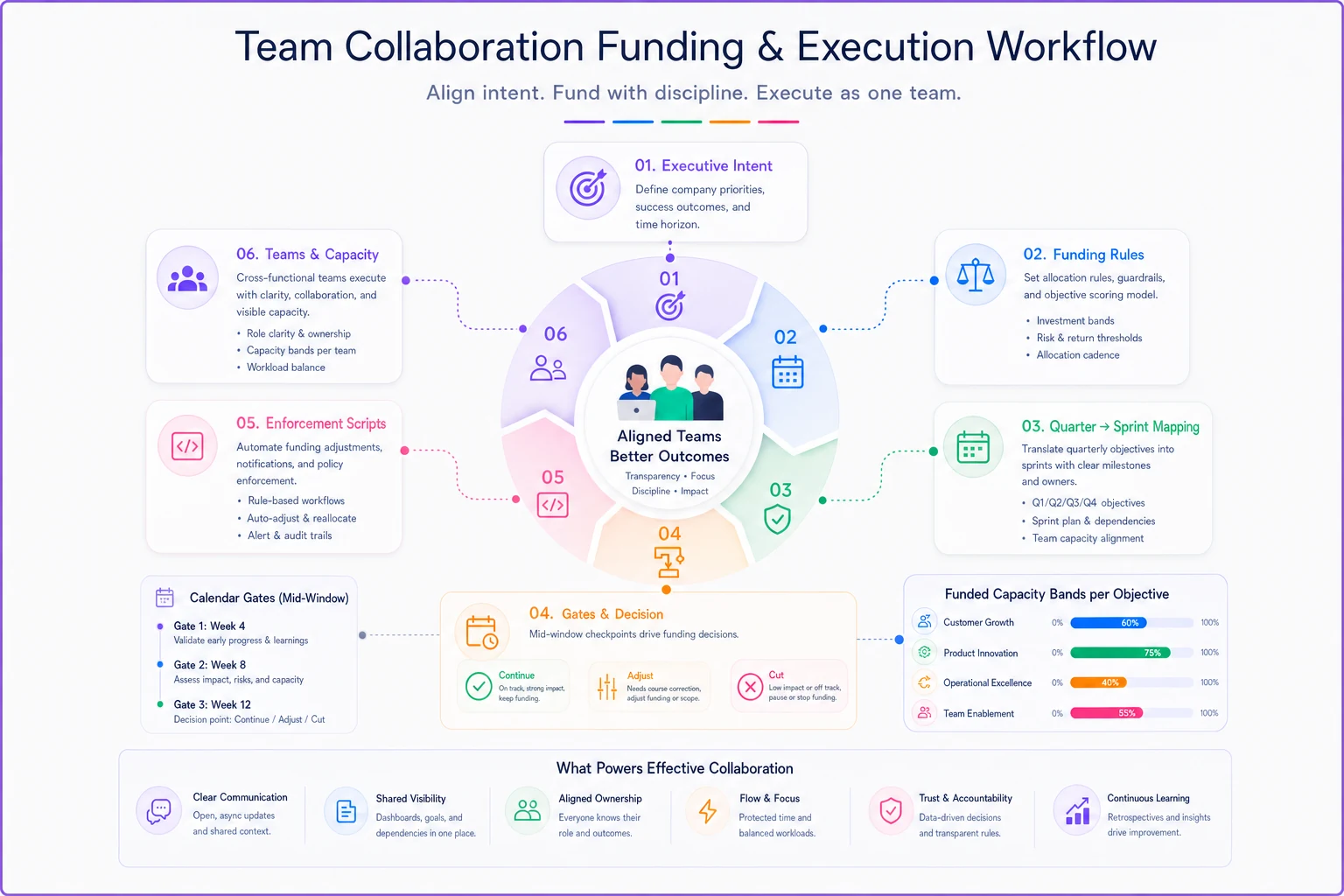
Use this to align teams, leadership, and the calendar so funding decisions are visible and actionable.
A real scenario
A mid-size B2B software company — around 45 people across five teams — kept ending quarters with the same complaint from leadership: "we set clear priorities and none of them moved." When they audited a completed quarter, the top objective — reducing enterprise churn — had received somewhere between 15–20% of real engineering capacity, despite being "the #1 priority." The rest disappeared into support escalations and two loud internal stakeholders.
They didn't add tools or headcount. They added the four routines above. Each of the three quarterly objectives got an explicit funded percentage per team, translated into named sprint work, with two gates per objective on the calendar. New requests hit the trade script.
The next quarter wasn't magically clean. Interrupts still happened — the reserved band got raided twice, and one objective got formally defunded at its first gate because the metric wasn't moving and the team was clearly better spent elsewhere. But the churn objective went from roughly 18% real capacity to something north of 35%, because it was funded on paper and protected in the calendar. Enterprise churn moved for the first time in three quarters. The bigger cultural shift was that "we should do X" stopped being a valid sentence unless it came with "instead of what."
When this operating model makes sense — and when it doesn't
When it's worth it:
-
You have three or more teams whose work has to coordinate around shared objectives.
-
Quarters routinely end with a gap between stated priorities and where hours actually went.
-
Escalations and loud stakeholders regularly override the plan without anyone deciding they should.
-
Leadership sets intent but has no visibility into whether it's funded until the quarter's over.
When it's a bad idea:
-
You're under 10–12 people and one person already holds the whole allocation map in their head. Adding gates and funding tables is pure overhead; you'll spend more time maintaining the model than steering with it.
-
Your work is genuinely reactive by nature — an incident-response or pure-support team — where "funding objectives in advance" fights the actual job. These teams need capacity buffers and triage discipline, not quarterly funding gates.
-
Leadership isn't willing to let gates actually cut things. If every gate is a rubber stamp, the whole model is theater and you're better off not pretending.
Who should NOT run this: an org where nobody has the authority to enforce trades. The trade script only works if the person saying it can make the trade stick. If enforcement gets overruled every time a VP escalates, the model erodes in a single quarter and you've taught everyone that funding is negotiable — which is worse than where you started.
Rolling it out without a big-bang launch
Don't convert the whole org at once. The rollout that tends to hold:
-
Pick one team and one quarter. Run the full model — funding table, sprint mapping, gates, trade script — on a single team as a pilot. Keep it visible.
-
Instrument funded-vs-actual from day one. The single most convincing artifact is the gap between what you funded and where capacity actually went. That number is what sells the model to the rest of the org.
-
Run the first two gates strictly. Actually cut or reduce something at a gate. If the first gates are toothless, the pilot proves nothing.
-
Debrief with the funded-vs-actual data, not opinions. Show leadership where their intent did and didn't translate. This is the moment the model earns its expansion.
-
Expand to teams that share dependencies with the pilot next — not random teams — so the coordinated-funding benefit shows up quickly.
The mistake is rolling out the artifacts (tables, gates, checklists) without the enforcement. Plenty of orgs adopt a funding template, publish it, and never protect it. Three weeks later it's a stale doc nobody looks at. The template is the easy part. The trade script and the willingness to defund things at a gate — that's what actually converts intent into delivery.
The real shift
The point of a strategy to execution operating model isn't more process. It's making one specific act — funding — explicit and visible, so that trade-offs get decided by people with authority instead of resolved by whoever escalates loudest in a given week.
When funding is implicit, strategy is a wish. When it's explicit, timeboxed, and protected by gates and trade scripts, strategy becomes a schedule. The teams that consistently ship against their objectives aren't the ones with better strategy documents — they're the ones where "this is our priority" reliably shows up as funded capacity in someone's actual sprint, and stays there because someone was willing to protect it.
When funding is implicit, strategy is a wish. When it's explicit, timeboxed, and protected by gates and trade scripts, strategy becomes a schedule. The teams that consistently ship against their objectives aren't the ones with better strategy documents — they're the ones where "this is our priority" reliably shows up as funded capacity in someone's actual sprint, and stays there because someone was willing to protect it.
Ready to boost your team's productivity?
Join 5,000+ teams using Workyly to streamline workflows, improve communication, and deliver projects faster.