

Most operational roadmaps die somewhere between the quarterly planning session and Tuesday's standup. Strategic vision gets translated into initiatives, initiatives become epics, epics turn into tickets, and by the time work hits someone's desk, nobody remembers why any of it matters.
Why strategy and daily work keep missing each other
The disconnect isn't bad strategy or lazy execution — it's a translation problem. Strategy speaks in outcomes and horizons. Teams work in sprints and tickets. Between those two languages sits a massive operational void where good intentions quietly become busy work.
The pattern holds pretty consistently across company sizes: teams need a mechanical process that connects "what we want to achieve" to "what I'm doing today." Not philosophy. Not framework theory. An actual operational roadmap with templates, checkpoints, and repeatable routines.
Why traditional roadmapping breaks at the operational level
Traditional roadmaps are fine for Gantt charts and stakeholder updates. They fail at operational execution because they're built for the wrong altitude.
Stop losing track of your priorities.
Workyly helps you organize, assign, and track every task efficiently.
- Centralized task management
- Real-time collaboration
- Intelligent workflow automation
No credit card required
Strategic roadmaps live at 10,000 feet — market positioning, competitive advantages, three-year trajectories. Useful for board decks, useless for sprint planning. Product roadmaps hover around 5,000 feet — features, releases, dependencies. Better, but still abstract when someone needs to know what to work on after lunch.
The missing piece is the operational roadmap, the 500-foot view that translates outcomes into actual work patterns. This is where milestone guardrails prevent disasters instead of just documenting them. Where a PM can look at next quarter's objective and immediately know what needs to be in next week's backlog.
Here's a scenario that plays out constantly: leadership decides the company needs to improve customer retention by 15% this quarter. Product translates this into "build better onboarding flow." Engineering breaks it into tickets. Three sprints later, the team has shipped a beautiful onboarding wizard with zero impact on retention because the real problem was support response times.
An operational roadmap would have caught this — not through more meetings, but through mechanical checkpoints that force outcome validation before work begins.
The one-page outcome-to-work mapping template
The most effective teams use a deceptively simple one-page template that forces clarity at every translation point. It's not elegant. It just works.
The template has four quadrants:
Top Left: Strategic Outcome What success looks like in business terms. Not features or deliverables — actual measurable business impact. "Reduce support ticket volume by 30%" not "implement chatbot."
Top Right: Work Hypothesis The specific operational change you believe will drive the outcome. This forces teams to articulate their theory of change before diving into execution. "If we add self-service password reset, we'll eliminate the 40% of tickets that are password-related."
Bottom Left: Milestone Markers Observable checkpoints that indicate you're on track. Not deliverables — evidence of progress toward the outcome. Week 1: Password tickets drop 10%. Week 2: Support team reports fewer escalations. Week 3: Customer satisfaction for account issues improves.
Bottom Right: Backlog Items The actual work, prioritized by impact on the hypothesis. Each item links directly to a milestone marker. No orphan tickets. No "nice to haves" that snuck in during grooming.
This template does something critical — it makes the implicit logic of roadmap-to-work translation explicit and testable. When work isn't moving the milestone markers, you know immediately. When milestone markers aren't tracking toward outcomes, you pivot before burning the whole quarter.
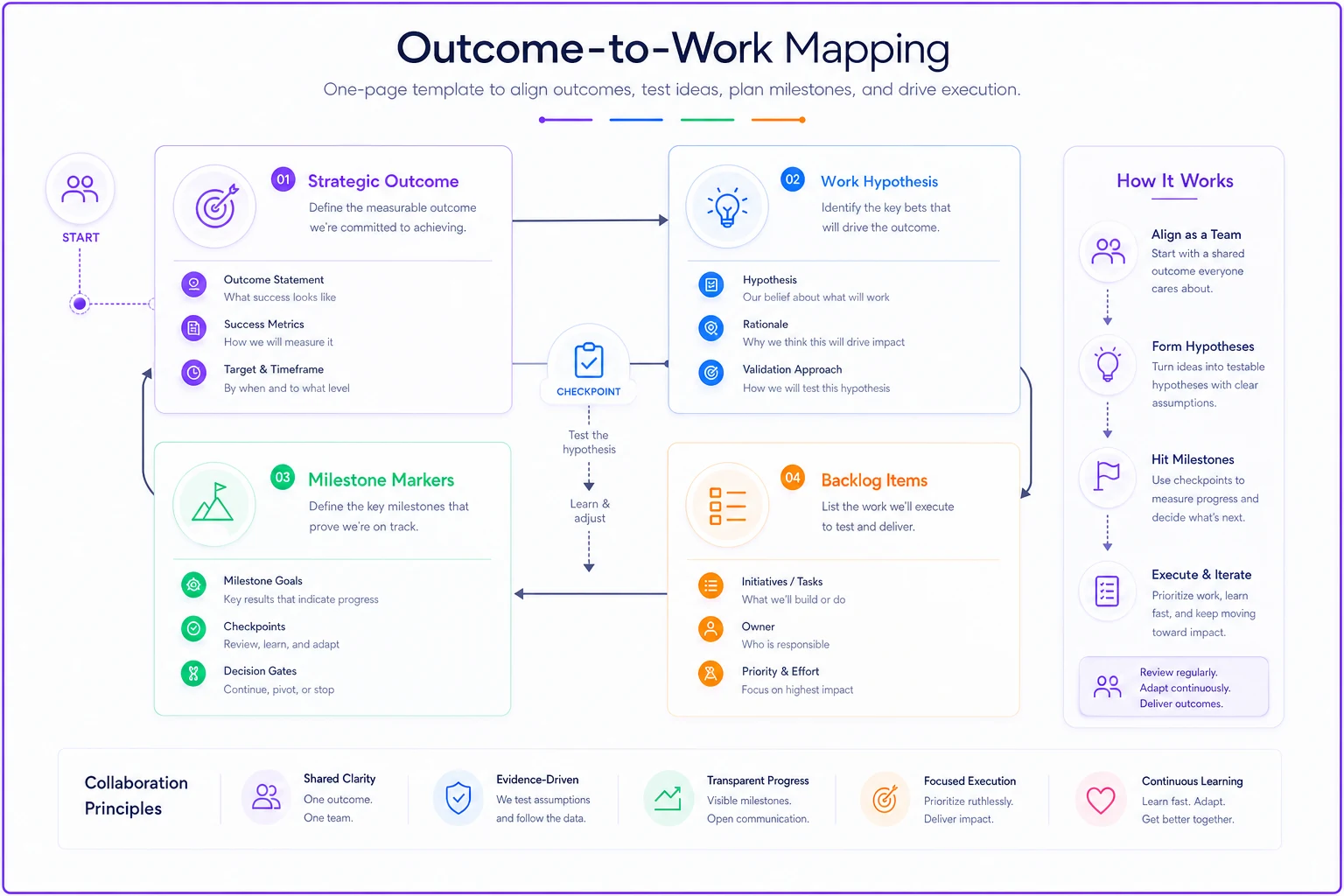
This image illustrates the flow from Strategic Outcome to Backlog Items and the checkpoints that validate hypotheses and milestone markers.
Milestone guardrails that actually guard
Most milestone planning is backward-looking. Did we ship the thing? Check. Moving on. Operational milestone guardrails are forward-looking — they ask whether the milestone is still the right target given what you've learned.
Effective guardrails have three components:
Assumption Validation Points Before committing to the next chunk of work, validate that your core assumptions still hold. A B2B SaaS company was three milestones into building an enterprise feature when a validation checkpoint revealed their target enterprises had started buying a competitor's all-in-one solution. They pivoted to SMB features and saved roughly four months of wasted development.
Effort Boundaries Each milestone gets a maximum investment threshold. If you can't hit it within that boundary, something is fundamentally wrong with either the milestone or the approach. This prevents the classic "we're 80% done" syndrome that somehow takes another 80% of effort to resolve.
Rollback Triggers Predetermined conditions that automatically trigger a strategy review — not a failure assessment, a circuit breaker. If customer complaints increase more than 15% after a milestone, stop. If team velocity drops below 60% for two consecutive sprints, stop. These aren't judgments, they're mechanical safeguards defined before emotions and sunk costs cloud the picture.
Before committing to the next chunk of work, validate that your core assumptions still hold.
A digital agency had a simple rule: if a client project exceeds budget by 20%, it triggers an automatic scope review. No negotiations, no heroics — just a checkpoint that saved them from a lot of death-march projects.
Governance checkpoints without the theater
Traditional governance checkpoints have turned into corporate theater. Steering committees that steer nothing. Review boards that evaluate PowerPoints instead of progress. Status meetings where everyone performs confidence while privately knowing the project is sideways.
Operational governance checkpoints serve a different purpose. They're not about oversight — they're about consistency. Circuit breakers, not judgment panels.
The checkpoint framework that actually works has four moments:
Translation Checkpoint When strategic intent becomes operational plan. Not a meeting — a structured review of the outcome-to-work mapping. Does the work hypothesis connect to the outcome? Are the milestone markers observable and measurable? Thirty minutes with a checklist, not a two-hour committee session.
Velocity Checkpoint Two weeks into execution. Are you moving at the pace required to hit the milestone? Not "are we trying hard" but mechanical measurement. If planned velocity was 20 points per sprint and you're delivering 12, something needs to adjust — scope or timeline.
Hypothesis Checkpoint Halfway to each milestone. Is the work hypothesis proving correct? Early indicators should be visible. If they're not, or if they're pointing the wrong direction, pivot now rather than completing work that won't drive outcomes.
Outcome Checkpoint After milestone completion. Did you get the business result you expected? Not "did we ship the feature" but "did the metric move?" This feeds back into the next planning cycle, making each iteration more accurate.
These checkpoints work because they're built into operational flow, not bolted on as oversight. They become part of how work happens, not interruptions to it.
The repeatable backlog translation routine
The biggest operational failure in roadmap execution is the weekly scramble to figure out what goes in the next sprint. PMs spend Sunday nights trying to connect tickets to strategic initiatives they half-remember. Teams grab whatever's "ready" regardless of strategic value.
A repeatable backlog translation routine makes strategic alignment mechanical. Every Thursday afternoon — or whatever day precedes your sprint planning — run the same routine:
-
Review Current Milestone Markers — Where are you against this sprint's milestone? Which markers are green, yellow, red? Five minutes with a decent operational dashboard, not a status meeting.
-
Identify Work That Moves Markers — Look at the backlog through one lens: what moves you toward the milestone markers? Everything else waits. This discipline prevents constant scope creep from "while we're in there" additions.
-
Size Against Remaining Capacity — Not theoretical capacity. Actual capacity based on the last three sprints. If the team delivered 18, 22, and 19 points, plan for 19 — not the theoretical 30 you wish they could do.
-
Create Contingency Branches — What work comes in if you finish early? What gets cut if you're behind? Decide now, not mid-sprint when pressure clouds judgment.
-
Document the Why — One sentence per ticket
"This moves [specific marker] toward [specific outcome]." When someone asks why they're working on something, the answer is immediately available.
This routine takes around 45 minutes once you've done it a few times. Compare that to the hours typically spent in planning meetings debating priorities without clear criteria.
Common failure patterns and their fixes
Even with good templates and processes, operational roadmaps fail in predictable ways.
The Strategy Drift Initial outcome: "Reduce customer churn 20%." Three months later: "Build the ultimate dashboard." This happens gradually — each sprint, work drifts slightly from the outcome. By month three, you're building features that sound related but don't move the original goal. Fix: mandatory outcome restatement at every checkpoint. If you can't explain how today's work reduces churn, stop.
The Milestone Mirage Teams hit every milestone but the outcome never materializes. Usually because milestones were deliverables in disguise. "Launch new feature" isn't a milestone toward reducing churn. "Early cohort shows 10% better retention" is. Milestones must reflect measurable changes in user or business behavior, not completion of tasks.
The Parallel Track Problem Multiple teams working toward the same outcome without coordination. Marketing launches a retention campaign. Product builds retention features. Success builds retention playbooks. None of them align, creating customer confusion rather than retention. Fix: one outcome owner per objective running a weekly 15-minute sync. Not a status meeting — a quick check that work hypotheses still align.
The Perpetual Planning Trap Teams spend so long perfecting the operational roadmap that execution never starts. Three weeks of planning for a four-week milestone. Time-box planning to roughly 5% of execution time. A four-week milestone gets two days of planning, maximum.
Making it stick: the 30-day implementation
Rolling out an operational roadmap system fails when it's treated as a big-bang transformation. Teams get trained, templates get distributed, everyone nods, and Monday morning looks exactly like it did before.
Days 1–3: Build Your First Map Take one strategic outcome already in flight — don't pick something new, pick something struggling. Fill out the one-page template. It will feel incomplete. That's fine. Version 1 just needs to exist.
Days 4–7: Set Up Checkpoints Define the four checkpoints for the next milestone. Calendar them as 30-minute blocks, not multi-hour meetings. Prepare the three questions each checkpoint will answer.
Days 8–14: Run First Translation Do the backlog translation routine. Track how long it takes. Document what information was missing. Note which tickets couldn't be connected to outcomes — there will be many.
Days 15–21: Hit First Checkpoint Run your first real governance checkpoint. It will be messy. You'll probably realize your milestone markers were too vague or your hypothesis was off. Good. Adjust and continue.
Days 22–28: Measure and Adjust Are you moving toward the outcome faster than before? Don't expect dramatic results — look for directional improvement. Survey the team: is work clearer? Are priorities more stable?
Days 29–30: Decide on Expansion If the pilot worked, expand to three teams. If it didn't, diagnose why. Usually it's because the outcome wasn't clear enough, or the team didn't actually have authority to drive it.
When operational roadmaps actually help
Operational roadmaps aren't universally useful. In some situations they're overhead that slows things down.
| Situation | Roadmap helps? |
|---|---|
| Teams larger than 8 people with coordination problems | Yes |
| Multiple teams working toward shared outcomes | Yes |
| Strategy shifts quarterly without communicating to teams | Yes |
| Scaling from ~50 to 200 people | Yes |
| Post-pivot situations needing rapid reorientation | Yes |
| Teams under 5 where everyone already knows the goal | No |
| Pure research or exploration phases | No |
| Crisis mode with one obvious problem | No |
| Organizations with fundamentally unclear strategy | No |
The diagnostic is simple: if your team spends more than a couple hours per week figuring out what to work on or why, you need better operational translation. If everyone already knows and agrees, don't add process for the sake of it.
Moving from ad-hoc to systematic execution
The shift from ad-hoc execution to systematic operational roadmapping doesn't happen overnight, but the impact compounds. Teams stop the weekly fire drill of figuring out priorities from ad-hoc requests. PMs stop playing telephone between strategy and engineering. Work starts connecting to outcomes in ways everyone can see and measure.
Start with the mechanical basics. Use the one-page template. Set up the four checkpoints. Run the weekly translation routine. Let the system handle the work of keeping strategy and execution connected, rather than relying on someone to hold it all in their head.
Treat the operational roadmap as operations, not strategy. It's not about having the perfect plan — it's about a repeatable process that translates plans into work, tracks whether that work drives outcomes, and adjusts quickly when it doesn't.
The companies that execute consistently don't necessarily have better strategies or smarter people. They've turned the fuzzy art of alignment into a mechanical process that runs regardless of whether the PM is having a good week or grinding through a rough quarter. Modern AI-powered operational platforms can support this — automatically connecting tickets to outcomes, flagging work that drifts from objectives, surfacing early indicators that milestones might slip. Not replacing judgment, but taking the tracking burden off PMs so they can focus on hypothesis validation instead. Worth exploring if you're managing this across multiple teams or navigating the team-specific configuration complexity that tends to appear at scale.
The tools help, but the discipline matters more. Start with the template. Run the checkpoints. Do the weekly translation. Without systematic translation between strategy and work, even strong teams end up building things nobody asked for while critical outcomes sit untouched — and that's the problem the operational roadmap actually solves.
The tools help, but the discipline matters more. Start with the template. Run the checkpoints. Do the weekly translation. Without systematic translation between strategy and work, even strong teams end up building things nobody asked for while critical outcomes sit untouched — and that's the problem the operational roadmap actually solves.
Ready to boost your team's productivity?
Join 5,000+ teams using Workyly to streamline workflows, improve communication, and deliver projects faster.