
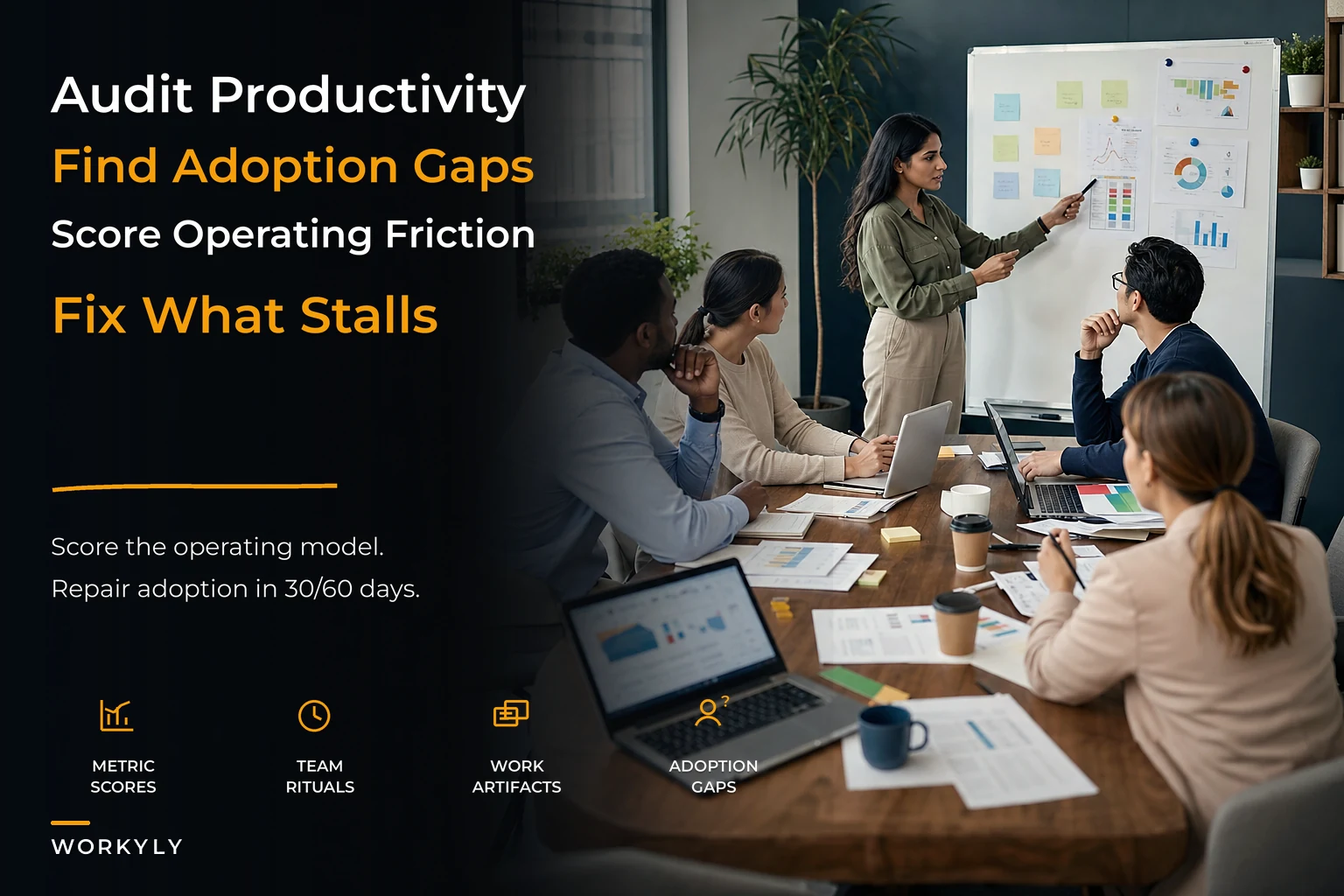

Most teams don't have a productivity problem. They have an adoption problem wearing a productivity costume.
You roll out a new intake process, a new planning cadence, a fresh set of templates. Six weeks later half the team is back on the old spreadsheet, the standup has quietly turned into a status meeting, and nobody can tell you whether the change did anything. The operating model on paper and the operating model in practice have split into two separate organizations that happen to share a Slack workspace.
A productivity operating model audit is how you find that split before it calcifies. Not by asking "are people happy with the new process" — they'll lie, politely — but by measuring the gap between the system you designed and the system people actually run, then figuring out which of four forces is causing the drift.
Why adoption gaps stay invisible until they're expensive
Adoption failures don't announce themselves. A process doesn't fail loudly on day one. It erodes.
The pattern is pretty predictable. Week one, adoption looks great — everyone's paying attention, leadership is watching, the new thing is fresh. By week three or four, exceptions start creeping in. "This ticket doesn't really fit the intake form, I'll just DM you." By week eight, the exceptions are the process. The new system exists in the tool but not in behavior.
It stays invisible because most teams measure the wrong layer. They track whether the tool was set up, whether training happened, whether the template exists. All green. Meanwhile nobody's checking whether the template gets filled in correctly, whether decisions actually route through the new lane, whether the ritual produces the artifact it's supposed to.
-
Metrics — what you measure and whether people trust the numbers
-
Rituals — the recurring meetings and cadences that are supposed to drive behavior
-
Artifacts — the documents, records, and templates the work produces
-
Incentives — what actually gets people promoted, praised, or left alone
The thing that trips everyone up: you can have perfect artifacts and broken incentives, and the artifacts will slowly rot because filling them in correctly earns nobody anything. Or perfect rituals and broken metrics, so the meeting happens every week but decides nothing because no one believes the dashboard. The layers aren't independent in effect, but they fail independently in cause. That's why single-dimension fixes almost never stick.
What breaks as you scale
At five people, the operating model is your group chat and shared memory. Everyone knows who owns what because everyone can see everyone. Adoption isn't really a concept — the process is just what the room does.
Stop losing track of your priorities.
Workyly helps you organize, assign, and track every task efficiently.
- Centralized task management
- Real-time collaboration
- Intelligent workflow automation
No credit card required
The first fracture usually shows up somewhere between 15 and 40 people, or when you go from one team to three. Suddenly the process has to survive being communicated rather than witnessed. Communicated processes lose fidelity at every hop.
A typical example: a company standardizes on a decision-record habit. At one team it works well because the person who invented it is in the room enforcing it. They add two more teams. Team two adopts a "lite" version that skips the context section. Team three writes records but never links them to the actual work, so they're orphaned notes. Now leadership thinks there's a company-wide decision hygiene practice, and there are actually three incompatible dialects of it. Nobody lied. The model just degraded across distance.
-
Local reinterpretation. Each team "adapts" the process to fit their context, which is reasonable individually and chaotic in aggregate. You end up unable to compare anything across teams.
-
Ritual inflation. The cadence multiplies. What was one weekly sync becomes a sync per team plus a sync-of-syncs, and actual decision-making gets diluted across more meetings than anyone can attend.
-
Artifact drift. The templates fork. Someone copies the doc, edits it for their needs, and suddenly there are eleven versions of "the" project brief with no source of truth.
The deeper you go, the more the incentive layer quietly decides everything. If the person who documents diligently and the person who wung it get the same review, the diligent behavior is on borrowed time. Scale doesn't create the incentive problem — it just removes the personal social pressure that was papering over it.
The four-dimension scoring model
The point of the audit is to score each layer separately so you can see where the drift is, not just that something feels off. Rate each dimension 0–3 based on evidence, not vibes.
| Dimension | 0 — Absent | 1 — Nominal | 2 — Functioning | 3 — Embedded |
|---|---|---|---|---|
| Metrics | No shared numbers; decisions by opinion | Dashboard exists but nobody trusts or checks it | Metrics reviewed in cadence, mostly trusted | Metrics drive real decisions; people notice when they're wrong |
| Rituals | No recurring cadence, or it's been abandoned | Meetings happen but produce no decisions/artifacts | Rituals produce outputs, occasionally skipped | Rituals are load-bearing; skipping one causes visible pain |
| Artifacts | Work leaves no trace | Templates exist but half-filled or forked | Artifacts created consistently, minor drift | Artifacts are the work; kept current, linked, reused |
| Incentives | Good process behavior is invisible or punished | Lip service, no follow-through in reviews | Process behavior loosely rewarded | Doing the work right is clearly connected to advancement |
The scoring reveals patterns a single number would hide. A team at 3-3-3-0 — great metrics, rituals, artifacts, zero incentive alignment — is living on borrowed enthusiasm. Everything works because a few committed people are carrying it, and it collapses the moment they leave or burn out. A team at 1-1-3-2 has beautiful documents that never influence any decision, which usually means the artifacts are theater.
The most common real-world profile is something like 2-1-1-1: decent metrics, weak everything else. That's the signature of a data-rich, execution-poor org where dashboards get admired and then ignored.
Resist the urge to average the four scores. A 2-2-2-2 and a 3-3-0-2 both average to "fine," but they need completely different remediations. The shape matters more than the total.
Interview scripts that surface the real behavior
Metrics and artifacts you can inspect directly. Rituals and incentives you have to ask about — and the trick is asking in a way that gets actual behavior instead of the sanctioned answer.
The core mistake in adoption interviews is asking "do you use the new process?" People say yes because saying no feels like admitting failure. Ask about the last concrete instance instead. Specifics are harder to fake than generalities.
For metrics:
-
"Walk me through the last decision you made using [the dashboard]. What did it actually tell you?"
-
"When was the last time a metric here surprised you or changed your mind?"
-
"If the number was wrong tomorrow, how long before someone noticed?"
For rituals:
-
"What happened in the last [standup / planning / review]? What got decided?"
-
"When's the last time this meeting got skipped, and what broke — or didn't?"
-
"If I killed this ritual tomorrow, who'd complain first and why?"
For artifacts:
-
"Show me the last [brief / decision record / intake] you filled out. Which parts did you actually complete?"
-
"Where do you go when you need to know why a past decision was made?"
-
"How many versions of this template have you seen floating around?"
For incentives:
-
"Think about who got promoted or praised recently. What did they actually do to earn it?"
-
"If you skipped the documentation to ship faster, would anyone notice or care?"
-
"What's the fastest way to look good on this team?"
That last question is the most honest signal you'll get. The gap between "the fastest way to look good" and "what the operating model rewards" is your incentive score. When those diverge, no amount of process design fixes adoption — you're asking people to do work the organization silently discourages.
Run six to ten of these across roles, not just leads. The people who quietly route around the process are your best informants, and they'll tell you exactly where the friction is if you make it clear you're auditing the system, not them.
The 30/60 remediation roadmap
Once you've scored the dimensions and interviewed across roles, you'll have a shape — a specific pattern of what's embedded and what's drifting. The remediation runs in two waves. The reason for two and not more is momentum: a 90-day plan gives everyone permission to defer, and adoption work dies in the deferral.
A simple visual helps keep the team aligned on sequence and focus.
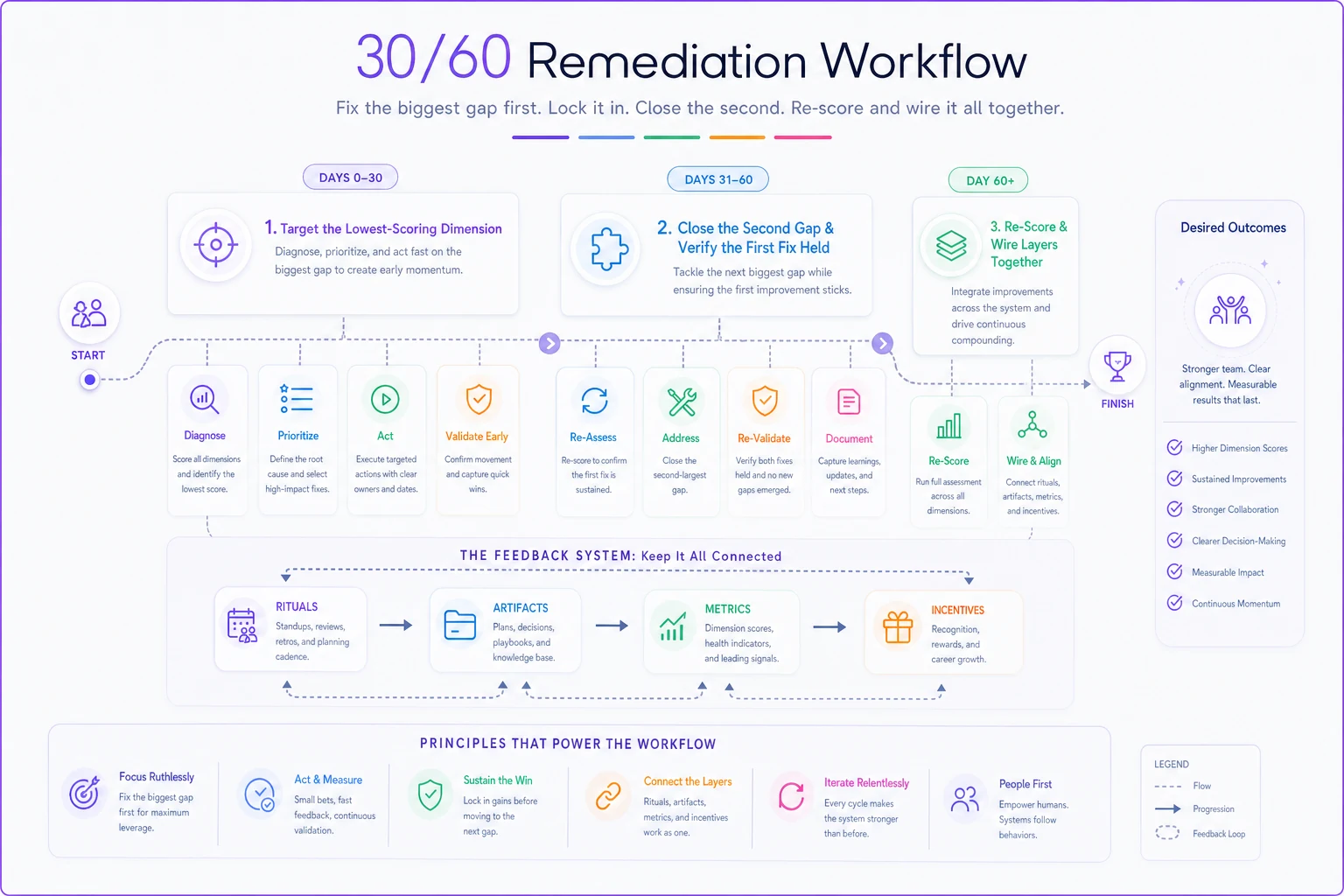
Days 0–30: Stop the bleeding on the lowest-scoring dimension
Fix the cause, not the symptom. Attack your weakest dimension first, because the layers reinforce each other and the weakest one is dragging the others down.
-
If incentives scored lowest make one visible change to what gets recognized. Name the behavior you want in the next review cycle or team recognition, publicly, with a real example. It's cheap, and it moves the whole system.
-
If rituals scored lowest kill or merge dead meetings first, then rebuild the one ritual that should be load-bearing. Give it a required output — a decision, an updated artifact — so it can't decay back into status theater.
-
If artifacts scored lowest collapse the forks. Pick one canonical template, archive the others, and make it genuinely faster to use than the workaround. People fork templates because the official one is annoying.
-
If metrics scored lowest don't add metrics. Fix trust in the two or three that matter. Track down where the numbers are wrong, fix the source, and do it publicly so people start believing again.
Run a lightweight before/after so you can show movement. If you're not already tracking whether the cadence produces its intended output, that instrumentation is step zero.
Days 31–60: Close the second gap and lock in the first
-
Re-score the dimension you fixed in the first 30 days. If it slipped, the fix was cosmetic — find the incentive underneath it.
-
Attack the second-lowest dimension using the same cause-first logic.
-
Wire the two fixed layers together. Rituals should produce the artifacts; artifacts should feed the metrics; metrics should surface in the ritual. Adoption sticks when the layers close a loop instead of standing alone.
-
Re-run three or four of the interview questions with the same people. If "the fastest way to look good" has moved even slightly toward the behavior you want, the incentive layer is shifting.
A useful companion here is a proper legacy-process audit that scores each process and decides keep, adapt, or retire — because half of adoption friction is people juggling old and new processes at once. And if your decisions still evaporate after the meeting, the decision-hygiene lifecycle patterns that link records to funding and monitoring close the loop between ritual and artifact.
A real scenario
A roughly 30-person agency had rolled out a new project-intake and weekly planning model about four months before we looked at it. Leadership's read was "adoption's fine, delivery still feels chaotic." The audit told a different story.
Scores came back roughly 2 / 1 / 2 / 0. Metrics were decent — they had a working dashboard. Artifacts were being created. But rituals scored a 1: the weekly planning meeting happened but decided almost nothing, because account leads showed up unprepared. Incentives scored a flat 0. The fastest way to look good at that agency was to personally rescue a client fire. Heroics got praised in every all-hands. Careful planning got nothing. So of course nobody planned.
The interviews made it obvious. When asked "what's the fastest way to look good here," four of six people described some version of a dramatic last-minute save. The new planning process was competing directly against what actually earned status — and losing.
The 30-day move wasn't process at all — it was incentive. Leadership started opening the weekly review by recognizing the projects that didn't catch fire, specifically because someone planned ahead. Boring competence got airtime for the first time. In the 31–60 window they gave the planning ritual a required output: each lead had to bring a one-line capacity read and top risk, or the meeting didn't cover their accounts.
Two months in, planning-meeting prep went from maybe a third of leads to nearly all of them. Fire-drill escalations dropped by roughly a third — not because fires stopped, but because more got caught in planning. Delivery still wasn't perfect, but the operating model on paper and the one in practice had started to converge. Chronic overcommitment was the next thing they went after, using capacity buffer bands to stop the overcommitment cycle.
When this audit makes sense — and when it doesn't
Do this when: you've rolled out a new operating model and can't tell if it's actually working, or you're scaling past 15–20 people and the process that "just happened" is starting to fork. It's also worth it when delivery feels chaotic despite everyone technically following the process — that gap is exactly what the audit surfaces.
Skip it when: the process is genuinely new, less than a few weeks old. You'll be measuring the awkward learning phase, not real adoption drift. Give it time to either settle or rot.
Who should NOT run this: anyone who owns the process and can't stay neutral about it. If you designed the intake form, you'll unconsciously interview toward the answer that says it's working. Have someone with no stake in the outcome run the interviews, or at minimum acknowledge the bias out loud. The whole value of the audit is honesty about the gap, and a defensive auditor produces a comfortable, useless report.
The pattern worth remembering
Adoption isn't a training issue and it isn't a discipline issue. It's a systems issue — four layers that drift independently and reinforce each other, for better or worse. When you only look at whether the tool got set up, you're inspecting the one layer that lies most convincingly.
The teams that keep their operating model intact as they scale aren't the ones with the most rigorous process. They're the ones who periodically check whether the process on paper still matches the process in the room — and who understand that when those two drift apart, the culprit is almost always the incentive layer nobody wanted to look at. Score the shape, ask the specific questions, fix the cause. The friction you can measure is the friction you can actually remove.
The teams that keep their operating model intact as they scale aren't the ones with the most rigorous process. They're the ones who periodically check whether the process on paper still matches the process in the room — and who understand that when those two drift apart, the culprit is almost always the incentive layer nobody wanted to look at. Score the shape, ask the specific questions, fix the cause. The friction you can measure is the friction you can actually remove.
Ready to boost your team's productivity?
Join 5,000+ teams using Workyly to streamline workflows, improve communication, and deliver projects faster.