

Most teams don't have a decision problem. They have a decision memory problem. The choice gets made, someone nods, a Slack thread scrolls past it, and three months later nobody can explain why the budget for the new onboarding flow doubled or who agreed to sunset the legacy export feature. The decision existed. It just never lived anywhere that connected to money, monitoring, or a way to undo it.
That gap is where decision hygiene governance actually matters — not as a documentation ritual, but as the connective tissue between what you chose, what you funded, and what happens when the choice turns out wrong.
Writing down decisions is table stakes at this point, and we've covered the mechanics of that in Decision records as operational artifacts. This piece is about the next layer: treating each decision as something with a lifecycle — propose, decide, execute, monitor, review — where each stage is wired to a real operational consequence. A decision that can't trigger a budget release or a rollback isn't governed. It's just archived.
Why static decision records quietly rot
There's a pattern that shows up in teams that adopt decision logs and then abandon them within two quarters: the record captures the moment of deciding but nothing downstream.
You get a well-formatted ADR or a solid decision doc. It has context, options considered, the chosen path, the date. And then nothing. The record is a snapshot. Reality keeps moving. The assumptions behind the decision drift. The metric that justified it gets worse. But the record just sits there, frozen at the moment of confidence.
This usually happens because the decision record and the execution of that decision live in different tools with no link between them. The decision is in Notion or Confluence. The work is in Jira or Linear. The budget is in a spreadsheet the finance person owns. The monitoring is in Datadog or a dashboard nobody opens. Five surfaces, zero connection.
When the decision goes sideways, there's no thread to pull. Nobody gets alerted. The person who'd want to reconsider doesn't even know the signal changed. That's the difference between a record and a live record — and it's the entire reason decision hygiene governance breaks down at scale.
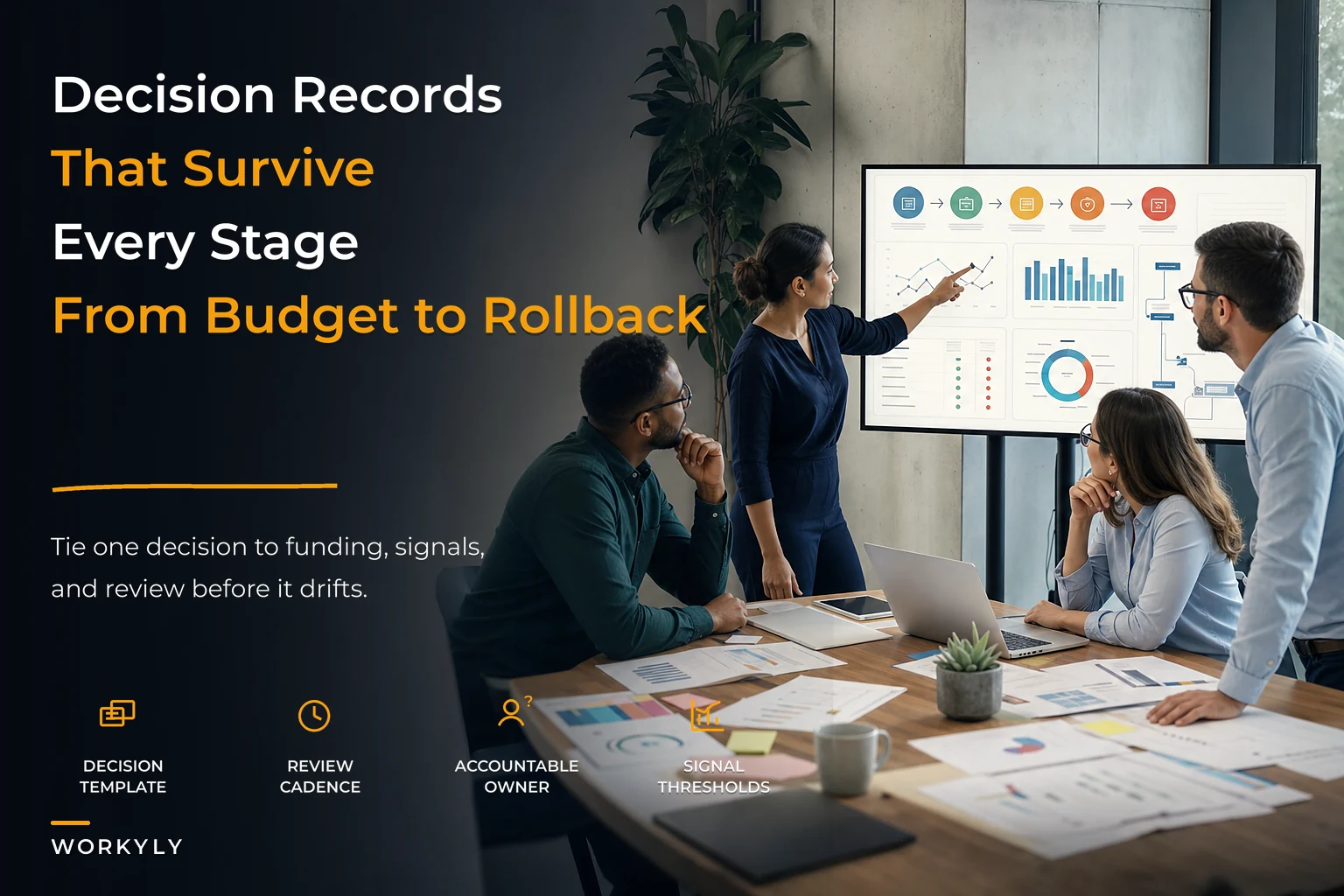
The five-stage lifecycle (and what has to be true at each stage)
Think of a decision less like a document and more like a ticket that moves through states. Each state has an owner, a required artifact, and — this is the part people skip — an exit condition that has to be met before it advances.
Stop losing track of your priorities.
Workyly helps you organize, assign, and track every task efficiently.
- Centralized task management
- Real-time collaboration
- Intelligent workflow automation
No credit card required
| Stage | Owner | Required artifact | What ties it to the rest of the business |
|---|---|---|---|
| Propose | Requester | Problem statement + options + rough cost | Estimated budget range, affected teams |
| Decide | Accountable lead | Chosen option + rejected alternatives + assumptions | Confirmed budget line, named funder |
| Execute | Delivery owner | Linked tickets, rollout plan | Budget actually released, work items linked |
| Monitor | Metric owner | Defined signals + thresholds | Live dashboard, alert routing |
| Review | Accountable lead | Outcome vs. assumptions | Rollback trigger or renewal decision |
The magic isn't the table. It's the exit conditions. A proposal shouldn't move to "decide" without a rough cost. A decision shouldn't move to "execute" until someone confirms the money exists. And nothing should sit in "monitor" without a named threshold that, if breached, forces a review.
Most teams have some version of the first three stages. Almost nobody wires up the last two. That's why decisions feel great for about six weeks and then quietly drift out of relevance.
Linking decisions to budgets without building a bureaucracy
The most common objection here is "we're not going to route every decision through finance." Fair — and you shouldn't. The point isn't approval theater. It's making the cost implication visible at the moment of deciding.
A lightweight way to do this: every decision record carries a budget band, not a precise figure.
-
Band A — under ~$2k or under a week of one person's time. Team-level decision, no funding gate.
-
Band B — roughly $2k–$15k, or work that pulls people off their committed roadmap. Needs a named funder to confirm.
-
Band C — above ~$15k, or anything with recurring cost. Needs an explicit funding line and a review date baked in.
Use budget bands to make cost visibility lightweight—only escalate decisions at the boundary where funding actually matters.
What this does is quiet but powerful. It stops the slow accumulation of "small" decisions that individually cost a few thousand dollars and collectively blow a quarter's budget. A typical pattern: a product team makes eight Band-A-ish decisions in a quarter, each "just a small tooling subscription" or "just a couple days of engineering." Add them up and it's somewhere around $30k–$40k of unplanned spend that nobody consciously approved, because each piece felt too small to flag.
The band forces a pause exactly at the boundary where cost starts to matter — and no earlier. That's the difference between governance and friction.
Monitoring signals: the part that makes decisions honest
A decision without a monitoring signal is just an opinion with a date on it.
When you decide something, you're implicitly making a prediction. "We think moving to the new checkout will reduce cart abandonment." "We believe consolidating these two services will cut on-call load." Those predictions are testable. But teams almost never write down the number that would prove them wrong.
So in the "monitor" stage, the required artifact is a specific, boring commitment:
-
The single metric this decision is supposed to move.
-
The current baseline value.
-
The threshold that says "this is working."
-
The threshold that says "this is failing — reconsider."
-
Where the signal lives and who gets the alert.
This overlaps heavily with what we laid out in measurement-first change rollouts, and honestly the two systems should share the same instrumentation. A change rollout is the execution of a decision. If your rollout already has pre/post instrumentation, you've done most of the monitoring work for the decision lifecycle — you just haven't connected it back to the decision record.
One thing worth sitting with: teams that define a failure threshold at decision time behave completely differently than teams that only define a success target. When you name the failure line up front, the eventual conversation stops being about ego. It's not "was I wrong" — it's "we agreed that if abandonment stayed above 68% we'd revisit, it's at 71%, so we're revisiting." The decision itself carries the permission to reverse it.
Automated rollback and review triggers
This is where the lifecycle stops being paperwork and starts being an actual safety system.
A review trigger is a rule that fires when a monitoring signal crosses a threshold, or when a time-box expires — and it automatically reopens the decision for review. Not a reminder someone might see. An actual state change on the record, routed to the accountable owner, with the original assumptions attached.
Hard rollback triggers — for reversible, technical decisions. If error rate exceeds X or latency crosses Y within the first 48 hours of a rollout, the change reverts automatically or gets flagged for immediate manual revert. This only works when the decision was genuinely reversible and the signal is fast and clean.
Soft review triggers — for decisions you can't just undo. You can't "roll back" hiring three people or migrating a database. But you can schedule a mandatory review at 30, 60, or 90 days, and wire a trigger so that if the justifying metric hasn't moved by the review date, the record surfaces for a real decision instead of quietly defaulting to "keep going."
The failure mode to watch for: over-automating rollback on decisions that aren't cleanly reversible. Someone reads about automated triggers and tries to bolt a hard revert onto an organizational change. It creates chaos. Rollback automation belongs where the blast radius is contained and the signal is trustworthy. Everywhere else, the trigger's job is to force a conversation, not to act on its own.
A real scenario
A mid-sized B2B software team — around 40 people, three product squads — kept running into the same problem. Decisions got made in planning, executed, and then never revisited. By their own later audit, roughly a third of their active initiatives were things nobody had consciously decided to continue. They were just still running, still consuming a couple engineers each, because no mechanism existed to question them.
They rebuilt around the lifecycle. Every Band-B-and-up decision got a monitoring signal and a review date. Nothing fancy — a shared decision board where each record carried its budget band, its metric, its failure threshold, and its next review date. Review dates auto-surfaced the record to the accountable lead.
The first review cycle was ugly, in a good way. Of roughly 20 decisions that came up for review in the first quarter, about six were killed or scaled back because the justifying metric had flatly not moved. That freed up something like two engineers' worth of capacity that had been quietly stuck maintaining decisions everyone had forgotten they'd made. Not a dramatic revenue story — but a real recovery of focus, and the reversal arguments were cleaner because the criteria had been agreed to upfront.
It also changed how planning conversations felt. Once people knew a decision would have a failure threshold attached before it was approved, they got more careful about what they actually committed to. That secondary effect was probably worth as much as the freed capacity.
Where the automation actually earns its keep
You can run this lifecycle manually with a spreadsheet and calendar reminders. Plenty of small teams should start there. But it strains once you cross a few dozen live decisions, because the connective work — linking a record to its budget line, watching a metric, firing a review at the right moment — becomes a job in itself.
The pattern that works: the decision record lives as a structured object, and automation handles the tedious linkage — pulling the current metric value into the record, comparing it against the stored threshold, firing a review trigger when the line is crossed or the date arrives. The routing, the surfacing, the "this decision's justifying number went red" nudge — that's exactly the kind of low-judgment, high-consistency work automation handles well, so people can focus on the actual decision rather than the bookkeeping around it.
A simple workflow visualization.
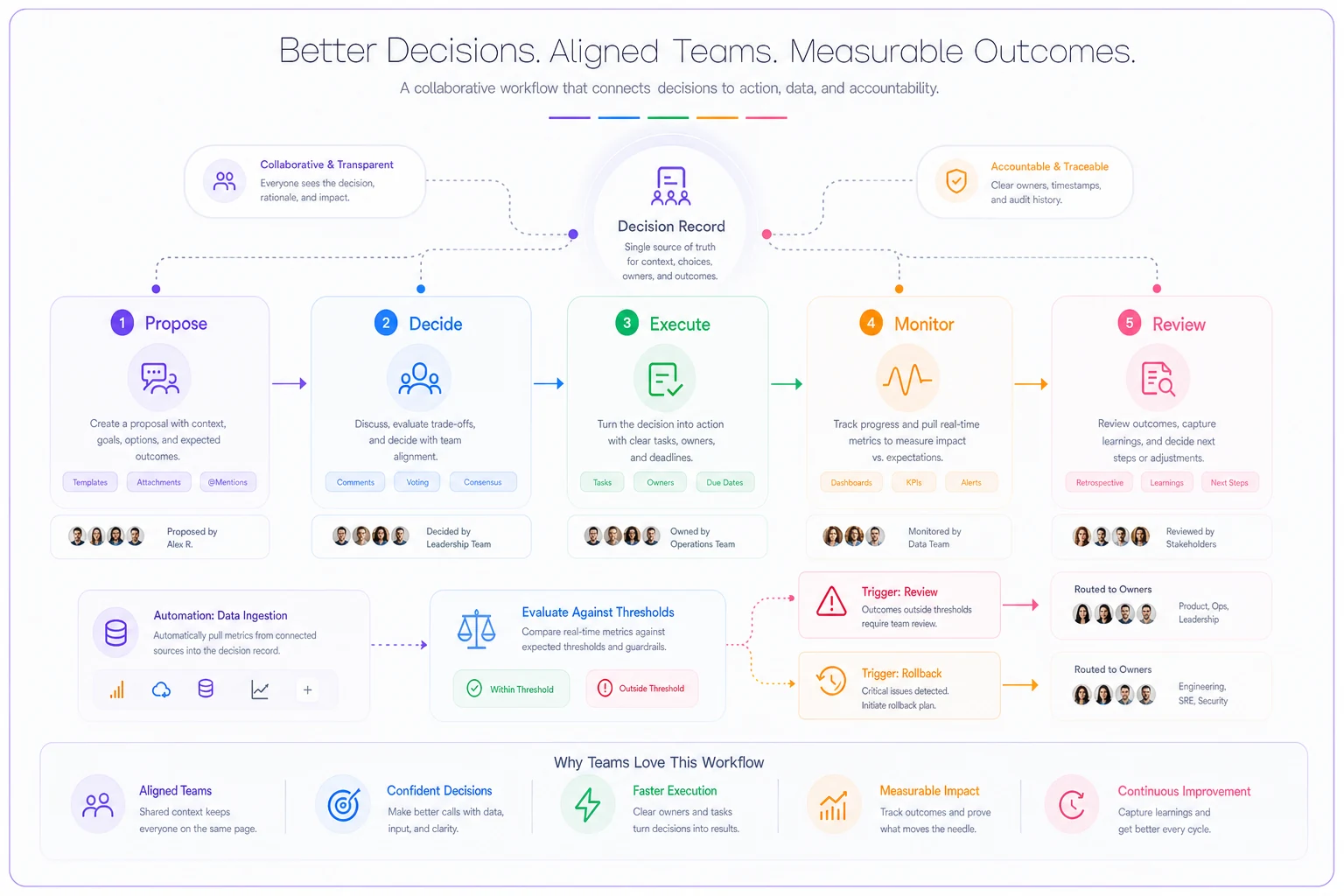
The same instinct applies to keeping the reasoning discoverable. A decision review is only as good as the context attached to it, which is why the record needs to link out to the docs and rationale — the same discipline behind treating knowledge as work with release-linked verification. A review that can't find the original assumptions just becomes a re-argument from scratch.
When this makes sense — and when it doesn't
When it's worth it:
-
You have enough concurrent decisions that you've lost track of a few.
-
Decisions carry real budget or capacity implications.
-
You've been burned by a call that went bad silently, with no early warning.
-
Multiple teams depend on choices made by other teams.
When it's overkill:
-
You're a team of five and every decision is visible in the same room.
-
Your decisions are mostly reversible in minutes and cheap to redo.
-
You'd spend more time maintaining the lifecycle than the decisions warrant.
Who should not do this yet: teams that don't already have basic decision records. If you're not writing decisions down at all, building a five-stage lifecycle with automated triggers is skipping several steps. Get the record habit first. The lifecycle is what you graduate into once the records exist but keep going stale.
The shift worth internalizing
The core move here is small but it changes a lot downstream: stop treating a decision as an event and start treating it as an object with a life. It gets funded. It gets watched. It gets a defined way to die.
When a decision carries its own failure threshold and its own review date from the moment it's made, you get something most organizations never quite build — the ability to be wrong on purpose, catch it early, and reverse without drama. That's not a process improvement. That's a change in how much confidence you can carry into a fast-moving call, because you know the system will surface the problem before the damage compounds.
That's really what decision hygiene governance buys you. Not more process for its own sake, but the confidence to move faster — because when a call goes bad, you already agreed, back when everyone was calm, what you'd do about it.
That's really what decision hygiene governance buys you. Not more process for its own sake, but the confidence to move faster — because when a call goes bad, you already agreed, back when everyone was calm, what you'd do about it.
Ready to boost your team's productivity?
Join 5,000+ teams using Workyly to streamline workflows, improve communication, and deliver projects faster.