

Most teams don't lose deep work to one big thing. They lose it to a thousand small permissions they never meant to grant. A Slack ping here, a "quick sync" there, a drive-by question that pulls someone out of a two-hour engineering problem they'll now need forty minutes to re-enter. Everyone agrees focus matters. Almost nobody has rules protecting it. And when you dig into why, it usually comes down to the same thing: focus gets treated as a personal discipline problem instead of an organizational design problem.
That framing is the root failure. You can hand someone noise-canceling headphones and a time-blocking app, but if the org still rewards instant responses, schedules meetings on top of anything that isn't already booked, and has no shared agreement about what counts as an emergency, that person will still get shredded by context switching. The question isn't "how do I focus more?" It's "what routines does the whole organization run so that focus is the default and interruption is the exception?"
That's what this article is about. Not productivity tips — the structural policies and rituals that make organizational routines reduce context switching reliably, at the level of the org, not the individual.
Why context switching is a coordination failure, not a willpower failure
The pattern shows up across teams of almost every size. Individuals protect their own focus as best they can, but their protection methods are invisible to everyone else. One engineer puts a "focus" status up. A designer silences notifications. A PM blocks their mornings. None of this is coordinated, so they constantly collide. The PM's blocked morning is exactly when the engineer needs an answer, and because there's no shared rule about what happens next, the engineer just pings anyway — or sits blocked for hours.
What you've got is a pile of local optimizations with no org-level protocol holding them together. And local optimizations without coordination produce the worst of both worlds: people feel constantly interrupted and feel like they can never get answers from anyone else.
The cost compounds in a way that's genuinely easy to underestimate. The research on attention residue is well-known at this point, but the operational version is more concrete. When a task gets interrupted mid-stream, it doesn't just cost the interruption itself — it costs the re-entry. For shallow work, re-entry is cheap. For deep work — debugging, writing a spec, designing a flow, analyzing data — re-entry can run twenty to forty minutes before someone is actually back inside the problem. A person interrupted five or six times across a morning may have technically worked four hours and produced maybe ninety minutes of real deep output.
Multiply that across a team of twelve and you're not looking at a productivity annoyance. You're looking at a structural leak where a meaningful chunk of your most expensive labor hours never convert into deep work at all.
What actually breaks as the team grows
Small teams get away with no policy because coordination happens through proximity and familiarity. Five people know each other's rhythms. You can read the room. You know not to bug Dana when she's heads-down because you can literally see it.
Stop losing track of your priorities.
Workyly helps you organize, assign, and track every task efficiently.
- Centralized task management
- Real-time collaboration
- Intelligent workflow automation
No credit card required
-
The "read the room" signal disappears. Remote and hybrid work killed physical cues, and even co-located teams lose them past a certain size. Nobody can track everyone's state anymore.
-
Interrupt volume grows faster than headcount. More people means more cross-dependencies, which means more reasons to interrupt each other. The interruption graph scales roughly with connections, not people — which is why a 2x headcount increase can feel like a 4x increase in chaos.
-
Meetings fill every gap. As more people have "visibility needs," calendar-driven scheduling finds every open slot. Focus time becomes whatever's left over, which is usually nothing good.
-
Emergencies inflate. Without a shared definition of urgency, everything becomes urgent, because marking something urgent is the only reliable way to get a fast response.
That last one is the quiet killer. When there's no agreed interrupt SLA, people learn that the only way to get a fast response is to escalate the perceived urgency. So routine questions get dressed up as fires. Then the fires stop meaning anything, and real fires get ignored. The whole signaling system degrades.
A team that worked well at eight people can feel almost ungovernable at thirty — not because the people got worse, but because they outgrew the informal coordination that was holding everything together. That's the moment you need explicit routines.
The four building blocks of a focus-protecting system
A real system has four interlocking parts. Any one of them alone fails. Together they hold.
1. Org-level protected focus windows
Not individual focus time — shared focus windows. The difference matters enormously.
When one person blocks focus time, they're fighting the org. When the whole org blocks the same window, the org is doing the protecting. A common version: no-meeting mornings, or two or three protected blocks per week where meetings simply aren't allowed and the expectation is async-first communication.
The reason shared windows work and individual ones don't is straightforward. If my focus time is 9–11 and yours is 2–4, we still collide — I interrupt you in the afternoon, you interrupt me in the morning, and neither of us is ever both free and focused at the same time. When the window is shared, interruptions during it drop close to zero because everyone's in the same mode. You're not the weird one who's unavailable. Everyone is.
A realistic target is somewhere around 40–60% of the work week carved into protected windows, not 100%. Teams that try to protect everything create a different problem: coordination work piles up with nowhere to land, and people start violating the windows out of necessity. Leave deliberate collaboration time. Protect the deep-work time inside hard boundaries.
2. Role-based interrupt SLAs
This is the piece most teams skip, and it's the one that makes the rest work. An interrupt SLA is a simple agreement: if I need something from you, how fast should I expect a response, based on the channel and the urgency?
Without it, every message is implicitly "respond now," because the sender has no idea when they'll hear back and defaults to anxiety. With it, people can confidently leave things async because they know the response window.
| Interrupt type | Channel | Expected response | Can it break a focus window? |
|---|---|---|---|
| Production incident / customer-down | Dedicated alert channel + page | Minutes | Yes, always |
| Blocking dependency (someone can't proceed) | Direct message, flagged | Within ~2 hours | No — wait for next collab window |
| Standard question / review request | Async thread or ticket | Same day | No |
| FYI / non-blocking context | Doc comment, channel post | No response expected | No |
The table isn't the point — the agreement is. When a team genuinely agrees that a "blocking dependency" gets a two-hour response and does not justify breaking someone's focus window, you've just eliminated a huge category of interruptions. The person who's blocked knows to wait or route around it, and nobody feels ignored because the SLA set the expectation.
3. Meeting-eligibility rules
Most teams have no criteria for what deserves a meeting. So anything can become a meeting, which means everything does. Meeting-eligibility rules flip the default: a meeting has to earn its place on the calendar.
A workable rule set tends to look like this. A meeting only gets scheduled if it clears a few gates — there's a decision to make or a genuine discussion that can't resolve async, the right people (and only them) are required, there's a stated outcome, and it can't reasonably be handled in a thread or a doc. If it fails any gate, it becomes an async thread, a decision doc, or a quick written update.
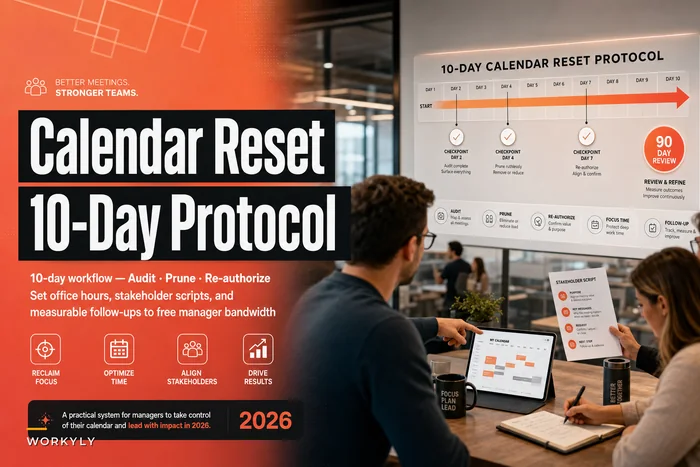
This connects directly to work covered elsewhere. If you're drowning in recurring meetings specifically, the manager calendar reset protocol is a sharper, more surgical tool for clawing those back and re-authorizing only the ones that earn it. And when meetings are genuinely blocking delivery, the operational playbook on institutionalizing asynchronous work goes deeper on the cultural mechanics of making async the default rather than the exception.
The subtle failure here: teams set eligibility rules and then never enforce them, because the person who'd enforce them is usually the one calling the meeting. Eligibility rules need a neutral owner or a lightweight standing review — otherwise they decay in about three weeks.
4. Measurement plans and trial templates
This is where good intentions usually die. A team announces "no-meeting Wednesdays," everyone's enthusiastic for two weeks, and then it quietly erodes because nobody measured whether it worked or tracked the violations. By month two it's gone, and everyone concludes "focus policies just don't stick here."
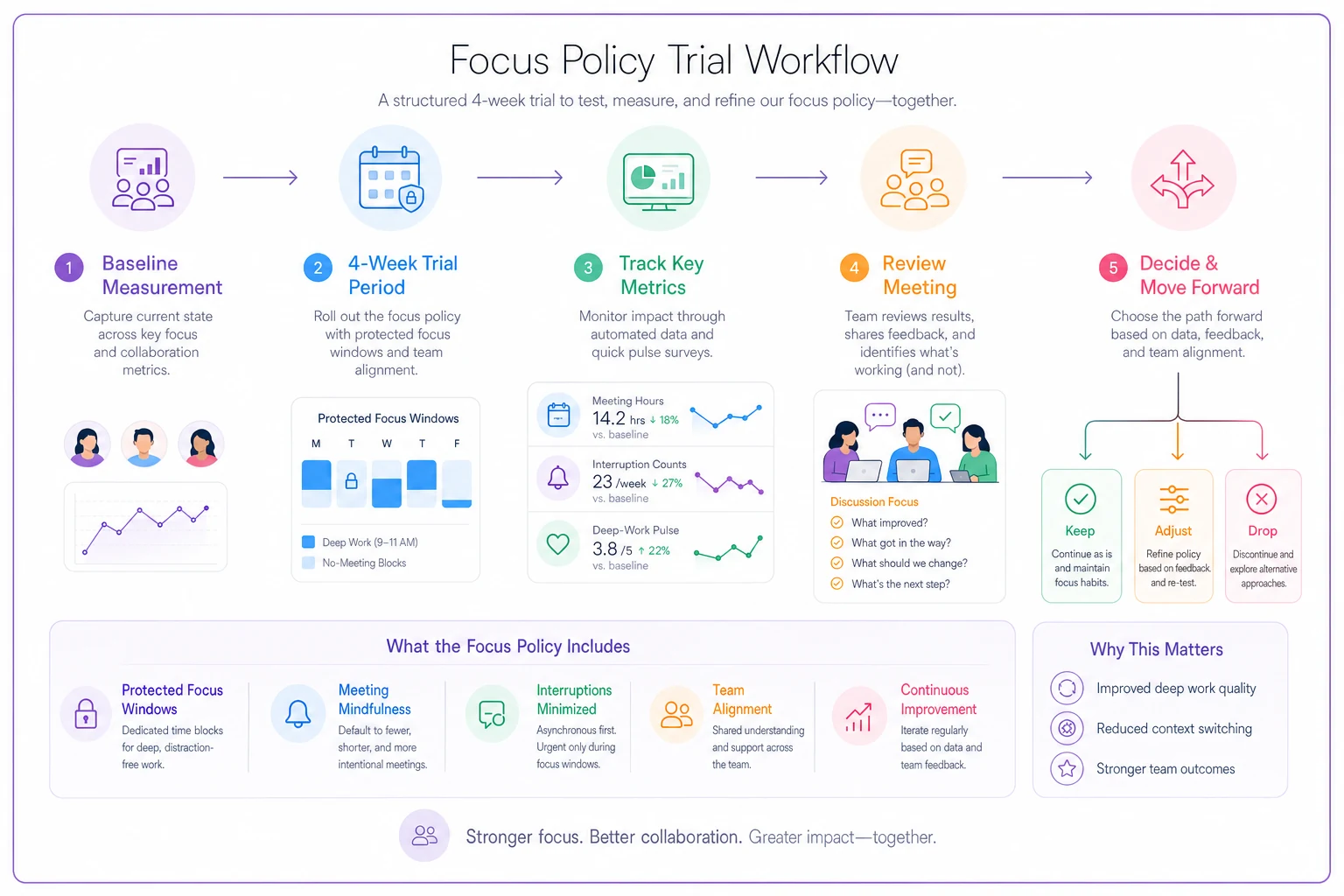
They stick when you treat them as instrumented experiments, not announcements. That means running each policy as a time-boxed trial with a defined baseline, a few metrics, and a clear decision point.
A trial template that actually holds
Rolling out focus policies as experiments beats rolling them out as mandates for one reason: experiments have exit criteria, so people trust them enough to actually try. Here's a process that works:
-
Pick one policy, not four. Start with protected focus windows or interrupt SLAs — not a full overhaul. Combined rollouts fail because you can't tell which part worked.
-
Baseline for one to two weeks. Capture rough numbers before you change anything: meeting hours per person per week, self-reported interruptions during intended focus time, and a simple weekly "could you do deep work this week?" pulse (1–5).
-
Run the trial for four weeks. Long enough to get past the awkward first week where everyone forgets the new rule, short enough that people commit to trying.
-
Measure the same things. Compare meeting hours, interruption counts, and the deep-work pulse against baseline. Also track violations — how many times the policy got broken and why. The why is often more useful than the number.
-
Decide explicitly
keep, adjust, or drop.
Make the decision out loud, with the data. If you adjust, change one variable and run again.
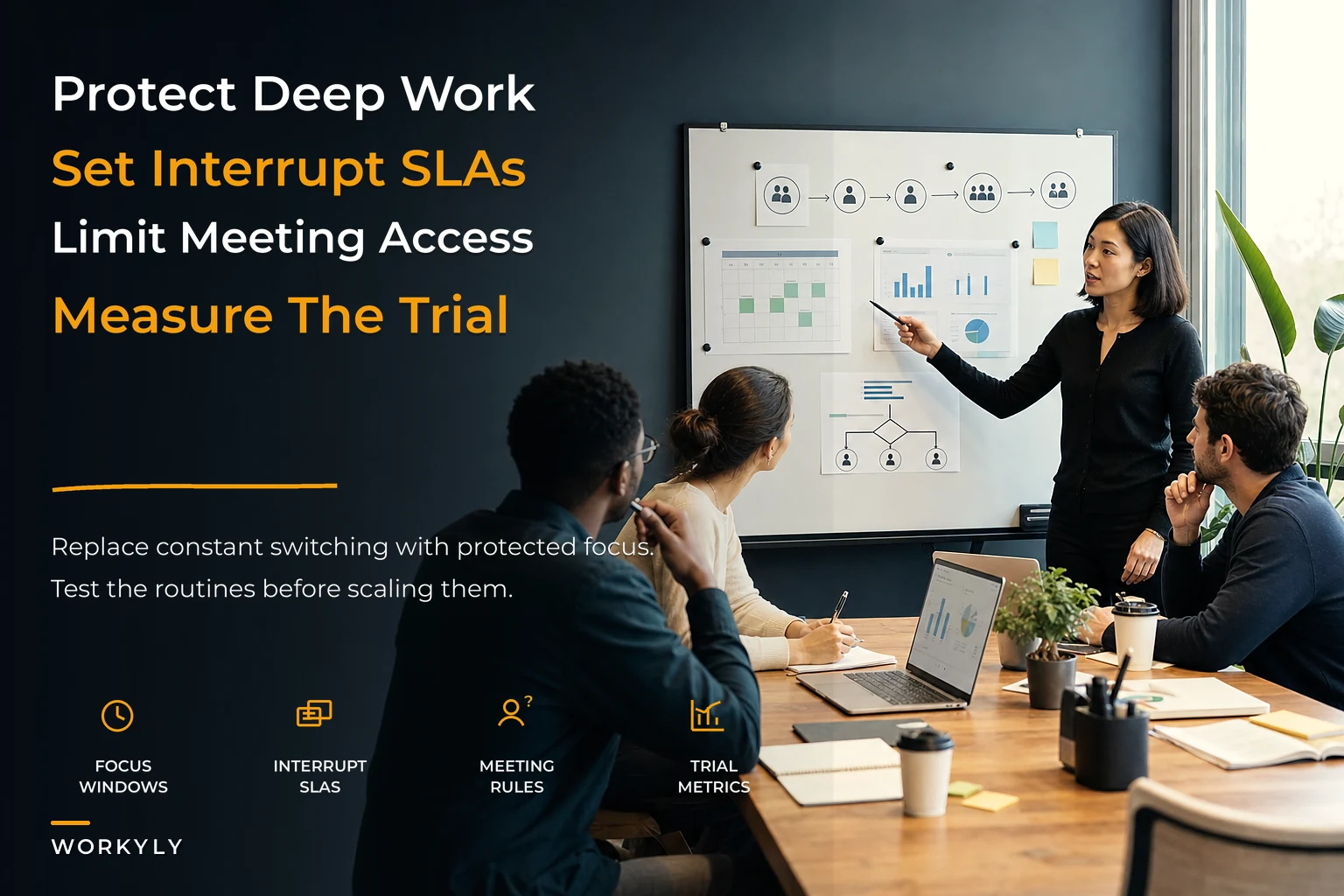
Visual workflow for running a trial:
A quick checklist before you launch any focus-policy trial:
-
[ ] One clearly defined policy with a one-sentence description anyone can repeat
-
[ ] A named owner who's responsible for the trial (not a committee)
-
[ ] 2–4 metrics, including at least one qualitative pulse
-
[ ] A baseline captured before the change
-
[ ] A fixed end date and a scheduled review
-
[ ] An agreed definition of what "break the window" emergencies look like
-
[ ] A fallback
what people do when they're blocked during a protected window
That last item prevents the most common failure mode — people quietly abandoning the policy the first time they get genuinely stuck and have no sanctioned alternative.
A real scenario
A roughly 20-person product team at a B2B software company had the classic version of this problem. Engineers said solid blocks of uninterrupted time were rare — most days fragmented into 30–45 minute chunks between meetings and Slack. Meeting load sat somewhere around 12–15 hours a week per engineer, and the deep-work pulse was hovering around a 2 out of 5.
They didn't do a big transformation. They ran one trial: protected focus mornings, 9 to 12, Tuesday through Thursday, paired with a simple interrupt SLA — blocking issues get a flag and a two-hour response; everything non-urgent waits for the afternoon. They baselined for two weeks, ran it for a month, and tracked meeting hours plus the weekly pulse.
By the end, meeting hours per engineer had dropped to roughly 8–9 a week, mostly because the protected mornings forced meetings to compress into the afternoons and several recurring syncs got cut when there was nowhere to fit them. The deep-work pulse moved to around a 4. Not everything was clean — there were violations, mostly from one cross-functional stakeholder who kept booking over the window until it got escalated. But the direction was clear, and the team kept the policy.
The interesting part wasn't the meeting-hour drop. It was that the afternoons got better too. Because people trusted the mornings to be protected, they stopped treating every afternoon message as something to answer instantly. The SLA gave them permission to batch. The focus window changed behavior outside the window.
When this makes sense — and when it doesn't
This makes sense when your team is past the "read the room" size (roughly ten-plus people), does meaningful deep work that's expensive to re-enter, and has a culture where interruptions have crept toward the default. It makes sense when people are clearly busy but output feels thinner than the hours suggest — a classic sign of fragmentation.
This is a bad idea when your team's actual work is primarily reactive and interrupt-driven by nature. A support team, an ops desk, a sales floor fielding inbound — forcing protected deep-work windows onto roles whose job is responsiveness creates friction and resentment. These roles need a different model: rotations, coverage schedules, and shift-based focus time, not blanket no-interrupt windows.
Who should NOT do this: anyone trying to use focus policies as a disguised control mechanism. If protected windows become a way to monitor compliance or punish people for being "unavailable," you've inverted the entire purpose. These routines work because they give people permission and predictability. The moment they become surveillance, trust collapses and people route around them.
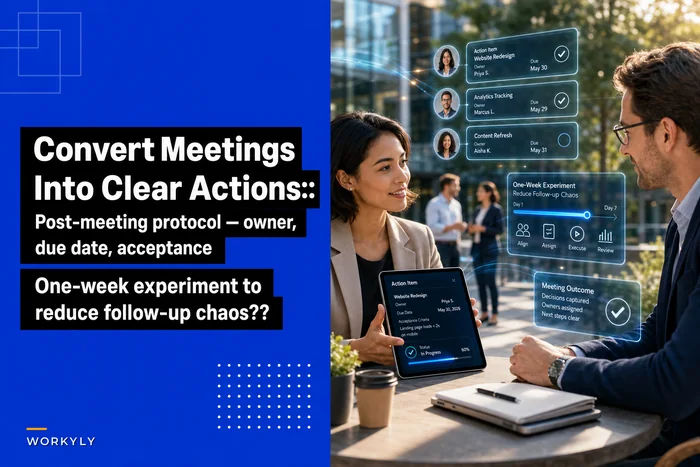
There's also a sequencing trap worth naming. Teams that are already buried in reactive work sometimes try to install focus windows before fixing the thing generating the reactive work. If your interruptions are mostly people chasing status updates that should live in a shared system, or re-asking questions because decisions aren't written down, the better first move is to convert that noise into structured async work — turning meetings and pings into clear asynchronous action items first, then protecting the focus time you've freed up.
How the parts reinforce each other
The reason these four building blocks form a system rather than a menu is that each one covers for a weakness in the others.
Focus windows without interrupt SLAs collapse the first time someone's genuinely blocked, because there's no sanctioned alternative to interrupting. Interrupt SLAs without focus windows help a little but leave the calendar free to fill with meetings. Meeting-eligibility rules without measurement decay quietly because nobody's watching. And measurement without any actual policy to measure is just surveillance of a problem you're not solving.
Run together, they form a loop. The focus windows create protected time. The interrupt SLAs make it safe to leave things async during that time. The meeting-eligibility rules stop the calendar from eating the windows. And the measurement plan tells you whether any of it is working — and gives you data to defend it when someone wants to book over your Tuesday morning "just this once."
The teams that get this right stop treating focus as a personal virtue that disciplined people have and distracted people lack. They treat it as infrastructure — something the organization builds and maintains, like a deployment pipeline or an on-call rotation. You wouldn't ask each engineer to personally invent their own deployment process and hope for the best. Deep work deserves the same respect: shared rules, clear defaults, and enough measurement to know it's actually holding.
Start with one window and one SLA. Baseline it, run it for a month, and look at the numbers. The first trial almost never delivers the final policy — but it almost always reveals how much deep work your team was quietly leaking all along.
Ready to boost your team's productivity?
Join 5,000+ teams using Workyly to streamline workflows, improve communication, and deliver projects faster.