


The marketing team says they'll have the campaign ready by Friday. Engineering promises the feature will ship next week. Sales commits to following up with those three enterprise leads. Then Monday rolls around and everyone's scrambling to remember who owns what.
Sound familiar? Most teams waste hours every week just figuring out what was actually decided in meetings.
The post-meeting action protocol breakdown
After running operational software for hundreds of small businesses, we noticed something interesting. The teams that never drop the ball don't have better project management tools or more disciplined people. They have a dead-simple protocol that runs after every meeting ends.
Here's what separates teams that execute from teams that forget:
The 15-minute protocol window
Within 15 minutes of any meeting ending, one person — usually whoever called the meeting — documents four things:
-
Owner - The single person responsible for delivery
-
Due date - Specific date and time, not "ASAP" or "next week"
-
Acceptance criteria - What "done" actually looks like
-
Check-in schedule - When you'll verify progress
No elaborate project plans. No complex tracking systems. Just these four elements captured while everyone's memory is fresh.
Why most action item tracking fails
Teams typically try three approaches that sound logical but create more problems:
Stop losing track of your priorities.
Workyly helps you organize, assign, and track every task efficiently.
- Centralized task management
- Real-time collaboration
- Intelligent workflow automation
No credit card required
The collaborative notes approach — Everyone adds their own interpretation to a shared doc. By Thursday, you've got five different versions of what was decided, none matching what people actually remember.
The recording trap — "Let's just record everything and review later." Except nobody reviews a 47-minute recording to find that one commitment buried at minute 23.
The project manager dependency — One person becomes the bottleneck for all follow-ups. They burn out, things slip through, and the team never learns to self-organize.
The real issue? These approaches treat action items like administrative tasks instead of operational commitments. There's a difference between writing something down and creating accountability.
The actual protocol that works
A small architecture firm was losing projects because follow-ups kept falling through the cracks. Client meetings would end with vague commitments like "we'll get you those renderings soon" or "the team will review and get back to you."
Meeting ends at 2:00 PM
2:05 PM — Meeting owner opens their tracking doc (can be as simple as a spreadsheet)
2:08 PM — Lists each commitment with:
-
Owner
Sarah Chen
-
Due
Thursday 4 PM
-
Acceptance
3D rendering uploaded to client folder, email sent with preview link
-
Check-in
Wednesday 2 PM status update in Slack
Here's the post-meeting protocol workflow.
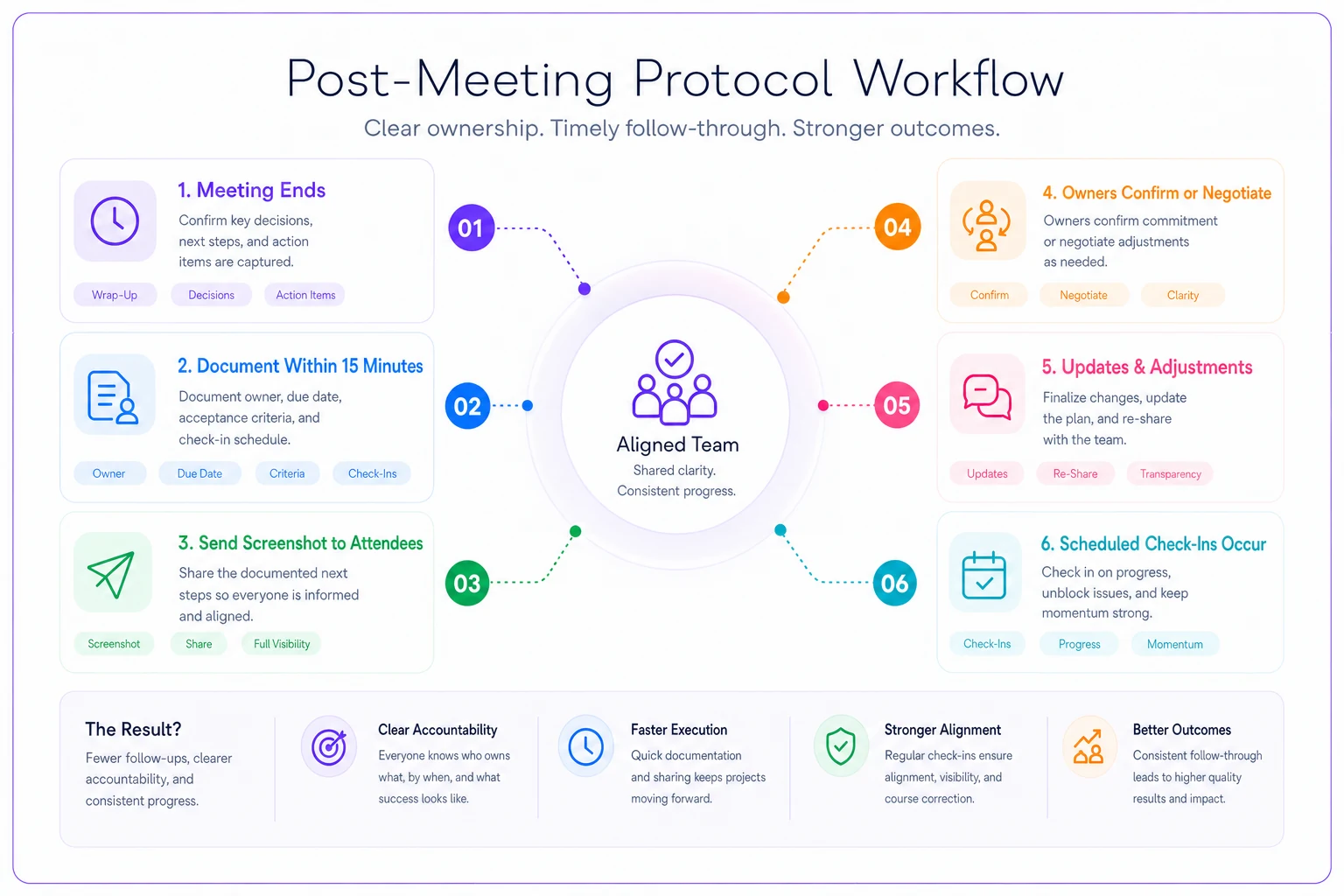
Require an explicit confirmation from the owner (Slack or email) to finalize assignment.
2:10 PM — Sends screenshot to everyone who attended
2:15 PM — Each owner confirms or negotiates their items
The part most teams miss? The confirmation step. If Sarah doesn't actively confirm she owns that rendering task, it doesn't count as assigned.
Setting up monitoring without micromanaging
Teams usually mess up the check-in piece in one of two ways — either they create surveillance-level oversight that annoys everyone, or they wait until the due date to discover nothing got done.
For 1-3 day tasks:
-
One midpoint check ("How's the rendering looking?")
-
Due date confirmation
For 4-7 day tasks:
-
25% progress check
-
75% progress check
-
Due date confirmation
For 8+ day tasks:
-
Weekly touchpoint
-
48-hour warning
-
Due date confirmation
Notice what's missing? Daily standups about every tiny task. Hourly status updates. Constant Slack messages asking "how's it going?"
Monitoring serves one purpose: catching problems early enough to actually fix them.
Your one-week experiment setup
Want to prove this works? Here's a contained experiment that won't disrupt your entire operation.
Week 0 (Baseline):
-
Items promised in meetings
-
Items delivered on time
-
Items that required reminder chasing
-
Hours spent on follow-up clarification
Week 1 (Protocol implementation):
Monday morning: Pick 3-5 recurring meetings to test with. Don't try to transform everything at once.
For each test meeting:
-
Assign the protocol owner (whoever runs the meeting)
-
Set up a simple tracking sheet with the four columns
-
Add a 15-minute calendar block after each meeting for documentation
-
Create a daily 5-minute review slot at 4 PM
What to measure:
| Metric | Week 0 | Week 1 | Change |
|---|---|---|---|
| Action items captured | |||
| Items with clear owners | |||
| On-time delivery rate | |||
| Follow-up messages sent | |||
| "What did we decide?" questions |
The protocol is working when people start asking "who owns this?" during the meeting, not after. Due dates become specific times rather than vague windows. Follow-up emails drop noticeably. The Thursday scramble disappears.
Common failure patterns to avoid
The "everything is urgent" trap
When you first implement this, teams often mark everything as due tomorrow. A manufacturing client tried this and burned out their team within two weeks.
Real urgency distribution should look something like:
-
10-15% truly urgent (24-48 hours)
-
40-50% standard (3-7 days)
-
35-45% planned work (1-3 weeks)
The acceptance criteria black hole
"Get it done" isn't acceptance criteria. Neither is "make it good." You need observable completion states.
Bad: "Update the proposal" Good: "Proposal doc includes new pricing table, reviewed by finance, PDF sent to client"
Protocol owner rotation chaos
Some teams try rotating who owns the protocol each meeting. This creates confusion fast. Pick one approach:
-
Meeting organizer always owns it
-
Designated role owns it (project manager, coordinator)
-
Most senior person owns it
Pick one and stick with it for at least a month.
Making this sustainable long-term
The protocol only survives if it takes less energy than the chaos it replaces.
For creative agencies: Build the protocol into your creative brief process. Every client meeting ends with the four-point capture before anyone leaves the room.
For consulting firms: Add a "commitment summary" slide to your meeting deck template. Fill it out live during the meeting wrap-up.
For small product teams: Integrate the protocol into sprint planning. Every planning session ends with the owner/date/criteria/check-in capture.
The businesses that make this stick don't treat it as extra work. They replace their existing scattered follow-up process with this cleaner approach.
Why AI-powered operational software changes the game here
Traditional project management tools focus on tasks and timelines. Post-meeting action items aren't really tasks though — they're commitments that need context, ownership, and follow-up that actually happens.
Modern operational platforms with AI automation handle the tedious parts that make protocols fall apart in practice. They can automatically parse meeting notes for commitments, suggest reasonable due dates based on existing workload, and trigger check-ins without anyone having to remember to send a Slack message.
The difference shows up quickly. Teams using AI-enhanced tracking tend to see on-time delivery rates climb from around 60% to the mid-80s within the first month. Not because the AI does the work, but because it handles the administrative overhead that usually kills good intentions.
The AI doesn't replace human judgment about what matters. It just makes sure nothing disappears between the meeting ending and the work getting done.
The reality check: when this doesn't work
Exploratory meetings without clear outcomes — When you're brainstorming or exploring ideas, forcing action items creates fake commitments nobody really owns.
Crisis mode operations — If your business is constantly fighting fires, you need to fix the underlying operational issues first. Adding tracking to chaos just documents the chaos.
Teams under 3 people — With tiny teams, the overhead might exceed the benefit. A simple shared checklist might work better.
External stakeholder meetings — You can't force clients or vendors into your protocol. You'll need a modified approach for external commitments.
Making the experiment decision
Before running this experiment, answer these questions:
-
Do you have at least 3 meetings per week with action items?
-
Does your team regularly miss commitments from meetings?
-
Can you dedicate 15 minutes after each meeting to documentation?
-
Will leadership support the protocol even when it reveals uncomfortable truths?
If you answered yes to at least three, the experiment is worth running. If not, you might need to address more fundamental operational issues first. No protocol fixes a team that doesn't want to deliver.
Getting started Monday morning
The protocol works because it's simple enough to start immediately. No training sessions. No software rollouts. No committee decisions.
Monday morning, pick your three test meetings. Create a basic spreadsheet with four columns. Set your 15-minute timer after each meeting ends. Document, confirm, and watch what happens.
By Friday, you'll know whether this solves your follow-up chaos or whether you need something different. Either way, you'll have actual data instead of opinions about what your team needs to execute better.
Teams that are good at execution don't have perfect systems. They have simple protocols that everyone actually follows. This one takes 15 minutes per meeting to save hours of confusion later. That's a trade most operations can afford to make.
Ready to boost your team's productivity?
Join 5,000+ teams using Workyly to streamline workflows, improve communication, and deliver projects faster.