


Most managers don't have a meeting problem. They have a recurring meeting problem.
The one-off sync you agreed to eight months ago is still on the calendar every Tuesday at 10. Nobody remembers why it started. Half the attendees mute themselves and work on other things. But nobody cancels it, because canceling feels like a decision, and defending your calendar always loses to the polite inertia of "let's just keep it for now."
The result is predictable. A frontline manager or team lead ends up with something like 22–28 hours of meetings a week, and the actual thinking work — planning, reviewing, unblocking people — gets crammed into evenings or the tiny gaps between calls. Busy all day, somehow behind on everything that matters.
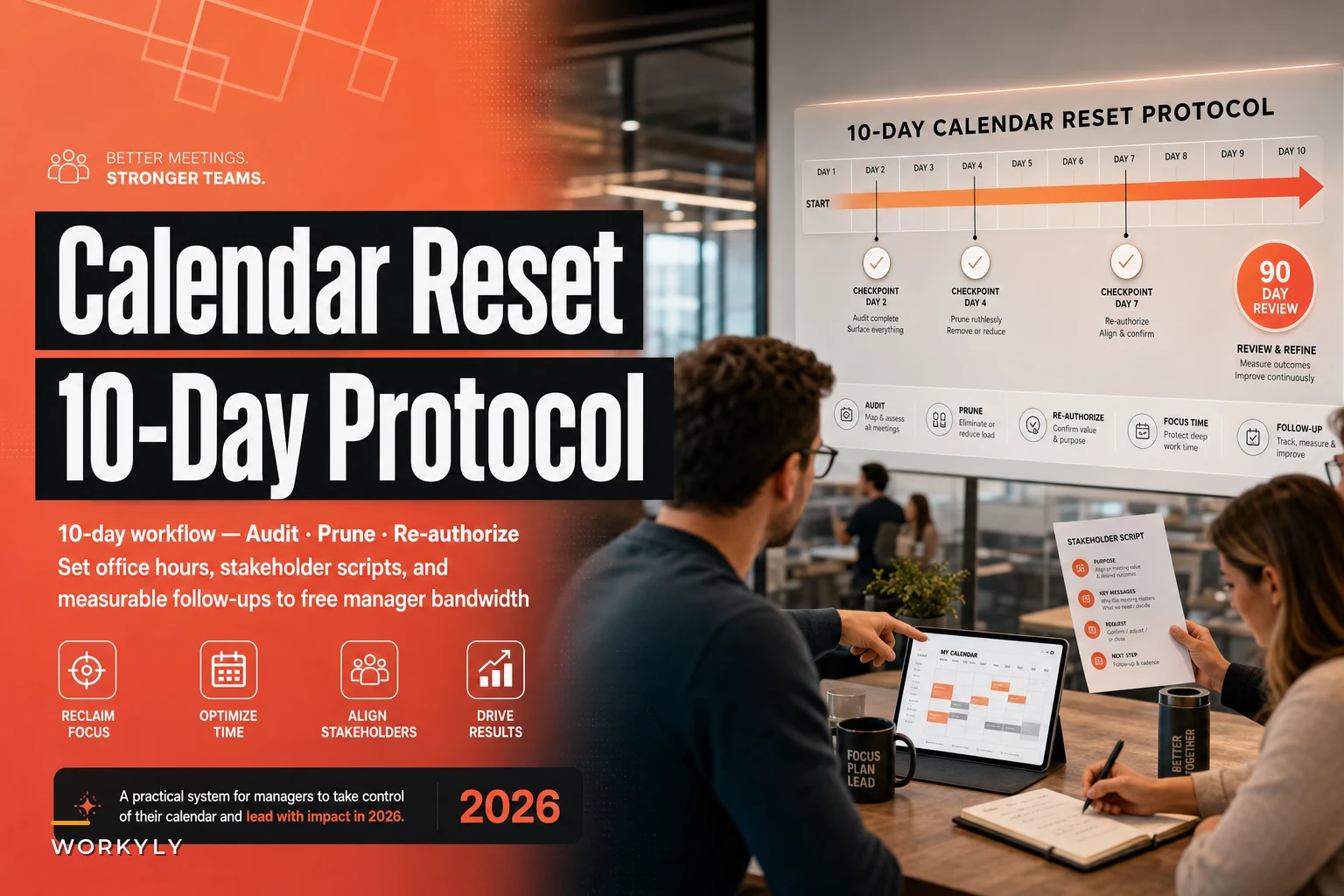
This is a 10-day protocol to fix that. Not "have fewer meetings" as a vague resolution, but an actual sequence: audit, prune, re-authorize what survives, and lock in office hours so the calendar doesn't refill itself two weeks later. It comes with the stakeholder messages you'll need to send and the follow-up checks that keep it from unraveling.
Why the calendar refills itself (and why willpower doesn't fix it)
The reason your calendar creeps back to full isn't weak will. It's that recurring meetings have no expiration date and no owner accountable for their value.
A one-time meeting is self-limiting — it happens and it's gone. A recurring meeting is a standing claim on everyone's time that renews automatically until someone actively kills it. Killing a meeting has social cost. Keeping it has none. So the default always tilts toward accumulation.
There's a second pattern worth naming. Recurring meetings tend to outlive their purpose by months. The Tuesday status call made sense during a launch. The launch ended in March. It's now October and the call is still running, except now it's a slightly awkward gathering where people report on unrelated work because the original reason evaporated.
The meeting stopped being a coordination tool and became a ritual. Rituals feel productive. That's the trap.
The 10-day protocol
Ten days is deliberate. Long enough to do this carefully, short enough that you don't lose momentum or let "I'll get to it" swallow the whole thing. Here's the shape before the details:
Stop losing track of your priorities.
Workyly helps you organize, assign, and track every task efficiently.
- Centralized task management
- Real-time collaboration
- Intelligent workflow automation
No credit card required
| Days | Phase | Goal |
|---|---|---|
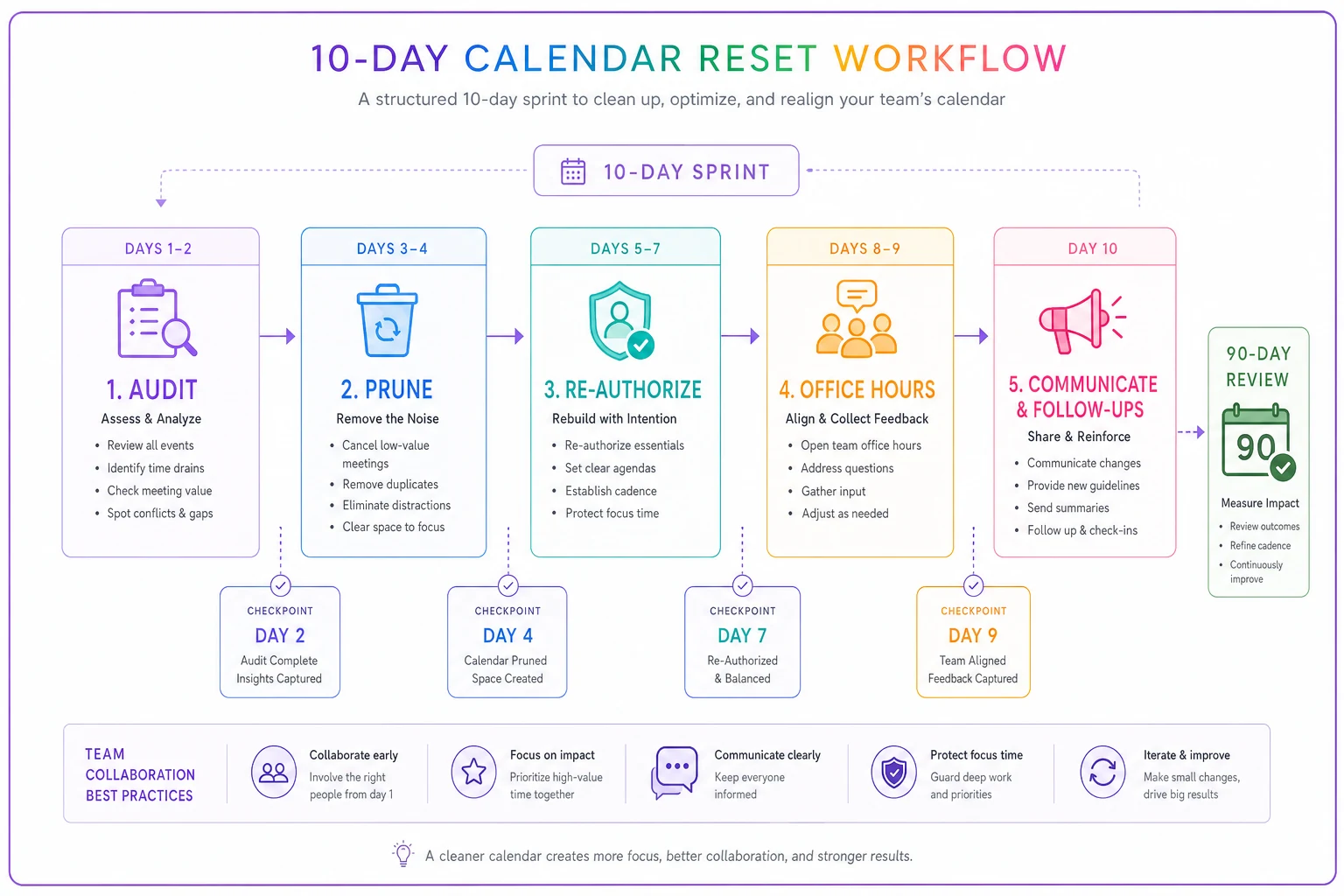
| 1–2 | Audit | Pull every recurring meeting into one list with real data |
| 3–4 | Prune | Cut the obvious dead weight, no negotiation needed |
| 5–7 | Re-authorize | Force surviving meetings to justify themselves |
| 8–9 | Set office hours | Replace ad-hoc interruptions with defended blocks |
| 10 | Communicate & schedule follow-ups | Tell stakeholders, set measurable checks |
Here's a quick visual of the 10-day workflow.
Days 1–2: Audit — get the real picture
Open your calendar and list every recurring meeting. Not "the ones that come to mind" — every single one, including the biweekly and monthly ones that hide because they don't show up every day.
For each, capture five things:
-
Name and cadence (weekly, biweekly, etc.)
-
Duration and attendee count — this is your cost signal
-
Original purpose — write down why it started, or "unknown" if you genuinely don't know
-
Who owns it — who would notice if it disappeared
-
Last time it produced a decision or unblocked something
That last column is the one people skip, and it's the whole point. Multiply duration × attendees to get a rough hours-per-occurrence cost. A 60-minute meeting with 9 people is 9 person-hours every week — somewhere around 400 person-hours a year. When you write that number next to "last produced a decision: can't remember," the pruning gets a lot easier.
A typical audit surfaces somewhere around 12–18 recurring meetings on a busy manager's calendar. Most people guess low by half before they actually count.
Days 3–4: Prune the obvious dead weight
Some meetings don't need a debate. You already know they're gone the moment you see them on the list. Cut these without ceremony:
-
Meetings where attendance has quietly dropped below half and nobody's chased it
-
Standing calls whose original project ended and never got repurposed
-
Duplicate syncs — two meetings covering roughly the same ground with overlapping attendees
-
Recurring 1
1s that could be biweekly instead of weekly based on how often you actually have something to discuss
-
Any meeting where your honest answer to "what breaks if I cancel this?" is "nothing"
The mistake here is trying to be fair to every meeting. You're not running a court. Prune the clear cases fast so you have energy for the genuinely ambiguous ones — that's what days 5–7 are for.
Days 5–7: Re-authorize what survives
This is the part almost everyone skips, and it's why the calendar refills. Cutting meetings once isn't enough — survivors need to earn re-authorization, which sets the precedent that meetings expire by default.
For every meeting still standing after the prune, work through this:
-
State the specific outcome. Not "stay aligned" — an actual thing this meeting exists to produce. "Decide the week's deploy order." "Surface blockers before they hit the customer."
-
Confirm it can't be async. If the meeting is people reading updates aloud, it's a document, not a meeting. A lot of what survives the prune is still fundamentally a status broadcast.
-
Right-size attendees. Anyone who's optional should be optional in writing. Cut the "just in case" invites.
-
Right-size duration and cadence. A 60-minute weekly that consistently ends in 25 minutes should be a 30-minute weekly, or a 45-minute biweekly.
-
Assign an owner and an expiration date. Every recurring meeting gets a review date — 90 days out — where it has to justify itself again or die automatically.
That last point is the mechanism that makes this stick. When meetings have an expiration date, keeping them requires a small active decision, which reverses the default that caused the mess in the first place.
If step 2 keeps flagging meetings that are really just verbal status updates, it's worth reworking how those updates flow. The approach in converting meetings into clear asynchronous action items pairs well here — it gives the survivors a cleaner handoff into written follow-through so you're not re-litigating the same points next week.
Days 8–9: Set office hours
If you prune and re-authorize but stop there, the freed time gets eaten by ad-hoc interruptions. Someone grabs 15 minutes here, a "quick question" there, and within two weeks your calendar looks scattered even if it's technically less full.
Office hours fix this. You declare two or three blocks a week — say, Tuesday and Thursday 2–4pm — where anyone can grab time for the small stuff that used to become impromptu meetings. Outside those windows, you protect focus blocks.
Block your focus time on the calendar as actual events — labeled blocks survive better than empty gaps.
The goal isn't to be unavailable. It's to batch the interruptions. Instead of a dozen random 10-minute context switches scattered across the week, people learn to bring their questions to a predictable window. Context switching is the hidden tax — every interruption costs more than its duration because of the re-focus time on either side.
Block your focus time on the calendar as actual events, not empty space. Empty space gets booked. A block labeled "Focus — deep work" survives longer than a gap, even if it's not perfectly respected.
Day 10: Communicate and set follow-ups
You've made changes that affect other people's calendars. Without clear communication, half of it reverts within a month because someone re-adds a meeting or quietly ignores your office hours.
Send clear, short messages. Here are templates that work.
For a meeting you're canceling:
> Hey team — I'm retiring the [meeting name] recurring call. It started for [original reason], which has wrapped up. Anything still needing coordination we'll handle async in [channel/doc]. If you think we still need a live sync for something specific, reply and tell me the outcome you'd want from it — happy to reconsider with a clear purpose.
For a meeting you're re-authorizing with changes:
> Quick update on [meeting name]: I'm trimming it to [new duration] and moving [optional attendees] to optional. The goal each week is [specific outcome]. We'll review whether it's still earning its place in 90 days.
For announcing office hours:
> Setting up office hours: [days/times]. For quick questions, sync needs, or anything that used to become a one-off meeting, grab me then. Outside those windows I'm heads-down and slow to respond — not ignoring you, just protecting focus time so I can actually get to the bigger things.
Then set the measurable follow-ups so this isn't a one-time cleanup:
-
Week 2 check Did any canceled meeting get re-added? If so, did it come back with a real stated purpose, or just quietly reappear?
-
Week 4 check Recount total weekly meeting hours. Compare to your day-1 baseline.
-
Day 90 check The re-authorization expiration dates hit. Run the survivors through the same five-point test again.
The week-4 recount is the honest scorecard. If you started at 24 hours of meetings and you're at 15, that's roughly 9 hours a week back — close to a full workday recovered.
A realistic before-and-after
A regional operations manager at a mid-sized logistics company ran this after realizing she was routinely working until 7pm just to catch up on actual work.
Her day-1 audit turned up 16 recurring meetings — she'd have guessed 9 or 10. Weekly meeting load was around 26 hours. The prune killed 5 outright, including a "cross-team sync" that had lost its purpose when a project shipped four months earlier, and a weekly 1:1 that everyone agreed worked better biweekly.
Re-authorization trimmed three more meetings from 60 to 30 minutes and moved a pile of optional attendees off two calls. Office hours consolidated what she estimated as a dozen weekly interruptions into two predictable blocks.
By the week-4 recount she was at about 15 hours of meetings — down roughly 40%. The bigger change wasn't the number, though. She had two genuine multi-hour focus blocks a week for the first time in over a year, and she stopped doing planning work at night. One canceled meeting did try to creep back in week 3; it returned at 30 minutes with an actual stated outcome, which is exactly the result you want — meetings only coming back when they can justify themselves.
When this makes sense — and when it doesn't
This protocol fits a manager or team lead whose calendar has quietly filled with recurring commitments and who has the authority to cancel or reshape at least some of them. If that's you, the payoff is fast.
When it's a bad idea: if you're brand new to the role, don't start day-one by torching meetings you don't yet understand. Sit in them for a few weeks first. Some low-value-looking meetings are load-bearing in ways that aren't obvious to a newcomer.
Who should probably skip it: if you genuinely have very few recurring meetings and your problem is something else — reactive firefighting, unclear priorities — this won't help much. The calendar isn't your bottleneck. Fix the intake and prioritization first.
And if your core issue is that meetings themselves are chronically unproductive rather than merely too numerous, the calendar reset only gets you halfway. The deeper fix is changing how work gets coordinated. It's worth reading through the operational playbook for when meetings derail progress alongside this, because pruning a broken meeting culture just gives you fewer broken meetings.
Keeping the reset from unraveling
The single biggest failure mode isn't the initial cleanup — it's month three, when the expiration dates get ignored and everything quietly slides back to where it started.
The fix is treating the day-90 review as non-negotiable as the audit itself. Put it on the calendar as a recurring event (ironic, yes) with a hard rule: any meeting that can't restate a specific outcome and pass the five-point test dies on that date. No debate, no "let's give it another quarter." The expiration mechanism only works if you actually enforce it.
Track your baseline meeting hours somewhere visible so drift is measurable. When you can see the number climbing back toward 24, you catch it early instead of waking up six months later buried again. A shared calendar or a simple tracking board that logs recurring commitments and their review dates keeps this honest without much overhead — the goal is just to make the invisible accumulation visible before it costs you another year of evenings.
The reset isn't a one-time event. It's the habit of making meetings expire by default and earn their renewal — and that's the only version of calendar discipline that actually survives a busy quarter.
The reset isn't a one-time event. It's the habit of making meetings expire by default and earn their renewal — and that's the only version of calendar discipline that actually survives a busy quarter.
Ready to boost your team's productivity?
Join 5,000+ teams using Workyly to streamline workflows, improve communication, and deliver projects faster.