


Picture a Tuesday morning. Your product team has 14 days until launch. Instead of building, testing, or fixing critical bugs, eight people sit around a conference table discussing whether the submit button should say "Get Started" or "Start Now."
Forty-three minutes later, no decision. The meeting ends with "let's circle back on this tomorrow."
This isn't about bad meetings. It's about something much worse—when synchronous rituals become the default operating system for work that doesn't need them. A 50-person marketing agency I worked with nearly collapsed under the weight of their own meeting culture. They averaged 31 hours of meetings per person each week. Their actual creative output? Down 40% year over year.
The problem runs deeper than wasted time. When everything requires real-time coordination, your entire operation becomes fragile. One person gets sick, three projects stall. Someone's in a different timezone, decisions pile up for days. A key stakeholder has back-to-back meetings, and suddenly your critical path stretches another week.
Most teams know meetings are broken. What they don't know is how to systematically replace them with something that actually works. You can't just cancel all meetings and hope for the best. You need operational infrastructure that makes asynchronous work the path of least resistance.
Why synchronous work creates operational quicksand
Every business starts lean. Three people, quick decisions, fast execution. Then you hire employee number ten, and suddenly everything takes twice as long. By employee thirty, simple decisions require multiple meetings across multiple days.
The math is brutal. A 10-person team doing daily standups burns 2.5 hours of collective time for 15 minutes of updates. Scale that across project kickoffs, status checks, decision meetings, and reviews—you're looking at 35-40% of total capacity consumed by coordination overhead.
But here's what really breaks: synchronous dependency chains. When work can only move forward during meetings, everything becomes sequential. Design waits for product. Product waits for engineering. Engineering waits for design. Each handoff requires a meeting. Each meeting requires scheduling. Each scheduling conflict adds days to your timeline.
I tracked this at a software consultancy with 22 employees. Their average feature went through 11 synchronous checkpoints before shipping. Total calendar time from concept to deployment? 47 days. Actual working time? 8 days. The other 39 days? Waiting for meetings.
As teams grow, they add more meetings to "improve communication." More meetings create more scheduling complexity, which creates more delays, which creates pressure for even more meetings to "get aligned." It's organizational quicksand—the harder you try to escape, the deeper you sink.
Your best people quit first. They recognize the pattern and leave for companies that respect their time. What remains is a culture where looking busy in meetings matters more than actual output.
The hidden architecture of async-first operations
Switching to asynchronous work isn't about using Slack instead of meetings. It's about building an entirely different operational architecture—one where information flows without requiring everyone to be present at the same time.
Stop losing track of your priorities.
Workyly helps you organize, assign, and track every task efficiently.
- Centralized task management
- Real-time collaboration
- Intelligent workflow automation
No credit card required
The foundation starts with decision records. Not meeting notes—actual structured documents that capture context, options considered, rationale, and outcomes. When decisions live in searchable, linkable artifacts instead of people's memories, you eliminate the single biggest source of repeat meetings: "Wait, why did we decide that again?"
Decision Record Structure:
-
Context (2-3 sentences max)
-
Options evaluated (bullet points)
-
Recommendation with rationale
-
Open questions requiring input
-
Decision deadline
-
Final decision and owner
The magic happens when you standardize this across all decisions. Product features, hiring choices, vendor selections, process changes—everything follows the same template. New team members can understand past decisions without scheduling knowledge transfer meetings. Stakeholders can review and comment asynchronously. Decisions move forward even when key people are unavailable.
But decision records alone don't fix the problem. You need supporting infrastructure that makes async collaboration natural rather than forced.
Think of it like building a highway system. Meetings are like city streets—they work fine for local traffic, but terrible for moving large volumes efficiently. Async infrastructure is your highway—purpose-built for high throughput with minimal friction.
Converting synchronous rituals to async equivalents (the patterns that actually work)
Most teams fail at async because they try to eliminate meetings without replacing their function. Every synchronous ritual serves a purpose—you need async equivalents that serve the same purpose better.
The Daily Standup → Async Check-in
-
What shipped yesterday (with links)
-
What's shipping today (specific deliverables)
-
Blockers needing help (tagged to relevant people)
Post by 10am local time. People read and respond throughout their optimal working hours. Blockers get resolved faster because the right person can jump in immediately, not wait for tomorrow's standup.
Results get better over time. People start linking to actual work instead of vague status updates. Cross-team dependencies surface earlier. Remote workers contribute equally instead of being half-asleep during early morning calls.
The Brainstorm Meeting → Staged Ideation
-
Stage 1 (24 hrs)
Problem statement posted, individuals add ideas privately
-
Stage 2 (24 hrs)
All ideas revealed, people build on others' concepts
-
Stage 3 (24 hrs)
Voting and prioritization, top ideas refined
Results: 3x more ideas generated, better geographic diversity, introverts contribute equally. Plus ideas that seem terrible in a room often spark brilliant follow-ups when people have time to think.
The Review Meeting → Commenting Workflows
-
Reviewer deadline clearly stated
-
Specific questions highlighted
-
Comments must include
observation + impact + suggestion
-
Author processes feedback in batches, posts resolution summary
This isn't just more efficient—it produces better outcomes. Written feedback is more thoughtful. Authors can process criticism without performative pressure. Reviews happen in parallel rather than sequentially. Design changes get implemented faster because there's no second meeting to "approve revisions."
The Planning Meeting → Cascade Planning
-
Day 1
Leadership posts context, goals, constraints
-
Day 2-3
Teams propose initiatives with resource requirements
-
Day 4
Cross-team dependencies identified and negotiated
-
Day 5
Final plan assembled and published
Teams actually read the context. Proposals are thoughtful rather than reactive. Dependencies get surfaced before they become problems. And people don't burn vacation days recovering from planning marathons.
Building your async conversion pipeline (with actual experiments)
You can't flip a switch and go fully async. The transition needs to be systematic, measured, and reversible if something breaks. Here's the operational pipeline tested across multiple teams:
Week 1-2: Baseline Measurement
-
Meeting type and purpose
-
Attendee count and roles
-
Decisions made vs discussions had
-
Follow-up actions generated
-
Could this have been async? (yes/no/maybe)
Most teams discover 60-70% of their meetings are pure information transfer—perfect candidates for async conversion.
Week 3-4: Single Ritual Experiment
Pick ONE recurring meeting. Usually standups work best—low risk, high frequency, clear structure. Convert it using the pattern above. Run for two weeks. Measure:
-
Time saved (obvious metric)
-
Blocker resolution speed (usually improves 40-50%)
-
Team satisfaction (survey at week 2)
-
Information retention (quiz people on what teammates are working on)
Don't get fancy with tools yet. Use whatever platform your team already knows. The point is testing the behavior change, not the technology.
Week 5-6: Expand Based on Success
If the first experiment works, add a second ritual. If it fails, debug before expanding. Common failure modes:
-
Unclear expectations (people don't know when/how to post)
-
Wrong tools (trying to do async in email = disaster)
-
Missing accountability (no consequences for not participating)
-
Leader doesn't model behavior (if the boss doesn't post, nobody posts)
Fix these systematically. Most failures aren't about async being impossible—they're about implementation gaps.
Week 7-8: Document and Institutionalize
Create your Async Playbook. Not a philosophy document—an operational manual:
-
Which meetings stay synchronous (usually 20-30%)
-
Templates for each async ritual
-
Response time expectations by communication type
-
Escalation paths when async breaks down
Make it searchable and update it regularly. This becomes your training material for new hires and your reference guide when things go wrong.
Visualize this pipeline to share with stakeholders and align experiments across teams.
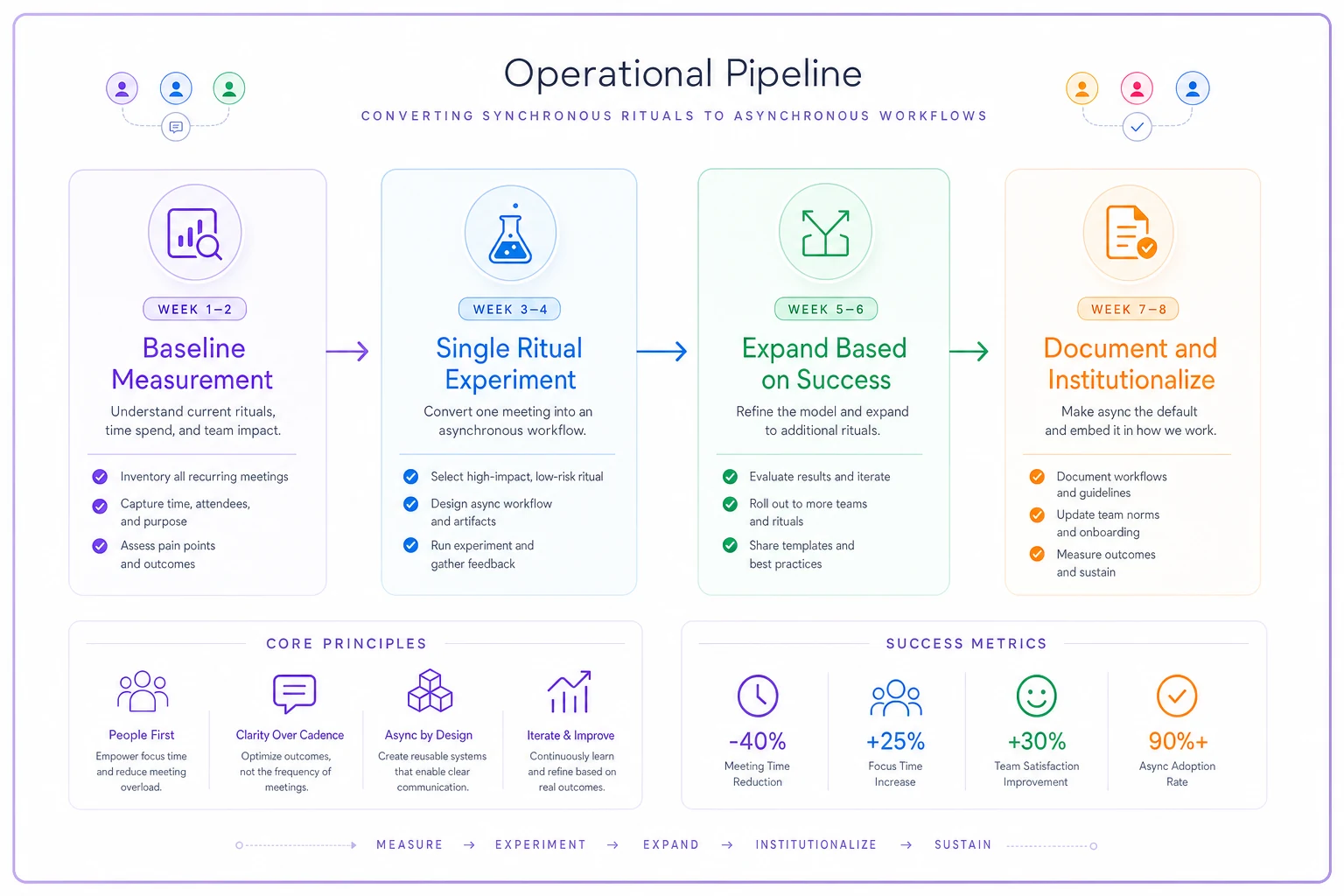
This workflow helps teams follow a repeatable path from measurement to institutionalization without skipping the testing phase.
The artifacts that make async sustainable
Async work generates artifacts. Without proper organization, these artifacts become a graveyard of forgotten decisions and outdated documentation. You need systems that keep information alive and findable.
The Decision Log
Single source of truth for all decisions. Not a document—a database.
| Date | Decision | Type | Owner | Status | Link to Record |
|---|---|---|---|---|---|
| Oct 2 | Switch to PostgreSQL | Technical | Sarah K | Implemented | [Link] |
| Oct 5 | Q4 hiring freeze | Business | Marcus T | Active | [Link] |
| Oct 8 | Rebrand color palette | Product | Design Team | In Progress | [Link] |
| Oct 12 | Cancel vendor contract | Operations | Julia M | Pending | [Link] |
Searchable. Filterable. Updated weekly. When someone asks "Why did we...?" the answer is one search away.
This prevents the most common meeting request: "Can we have a quick sync to understand the background here?" No sync needed. Just send the decision record link.
The Context Repository
-
Product principles (why we build what we build)
-
Technical constraints (why we can't do certain things)
-
Customer research (who we serve and why)
-
Competitive analysis (how we position ourselves)
-
Financial model (what drives our economics)
These documents get linked constantly. Instead of explaining why we don't support Internet Explorer in every design review, link to the technical constraints doc. Saves hundreds of explanation-hours annually.
Keep these documents short. Long documents don't get read. Better to have five focused one-pagers than one comprehensive guide that nobody uses.
The Ritual Registry
-
Purpose and expected outcomes
-
Participant responsibilities
-
Timing and deadlines
-
Templates and examples
-
Success metrics
-
Troubleshooting guide
Without this, async rituals decay. People forget the format. New hires don't know expectations. Gradually, everything drifts back to meetings.
Update the registry quarterly. What works changes as teams evolve. A ritual that worked for 8 people might break at 15 people.
When async breaks down (and when that's actually fine)
Some situations require synchronous coordination. Forcing async where it doesn't belong creates more problems than meetings ever did.
Keep These Synchronous:
-
Crisis response—when the site is down, don't open a comment thread. Get on a call.
-
High-stakes negotiations—reading body language matters when millions are on the line.
-
Relationship building—especially with new team members. Trust builds faster face-to-face.
-
Complex conflict resolution—written words escalate. Voices de-escalate.
-
Creative jamming—sometimes magic happens when people riff together in real-time.
The 24-Hour Rule
If an async thread hasn't resolved after 24 hours, schedule a meeting. But that meeting has ALL the context from the async discussion. No starting from zero. Jump straight to the unresolved issues.
This hybrid approach prevents both problems: endless async threads that go nowhere, and meetings that could have been emails.
Some teams panic when they need to schedule a meeting after going async-first. Don't. The goal isn't zero meetings. The goal is intentional meetings that accomplish things async cannot.
Measuring async impact (beyond the obvious time savings)
Everyone measures meeting time saved. That's table stakes. The real operational improvements show up in unexpected places.
Decision Velocity
Track time from problem identified to decision implemented. In synchronous cultures, this averages 11-14 days for non-critical decisions. Async-first teams average 3-4 days. Not because they decide faster, but because they eliminate scheduling delays.
Document this pattern:
-
Problem surfaces in async channel
-
Decision template gets created within 4 hours
-
Stakeholders comment over 24-48 hours
-
Decision gets made and implemented
Versus the old way:
-
Problem surfaces
-
Someone schedules a meeting (2-3 days out)
-
Meeting happens, maybe decides something
-
Follow-up meeting to finalize (another 2-3 days)
-
Decision finally gets implemented
Geographic Flexibility
One analytics startup tracked this: after going async-first, they successfully hired across 8 timezones without adding coordination overhead. Their deployment frequency actually increased 40% because deploys could happen anytime, not just when everyone was online.
Remote hiring became easier too. Candidates didn't need to navigate timezone coordination for every interview round. They could contribute to async discussions and demonstrate their communication skills naturally.
Knowledge Retention
Six months after decisions, quiz people on the rationale. Synchronous teams remember roughly 20% of context. Async teams with good artifacts? 70-80%. This matters when you need to revisit decisions or onboard new people.
New hires especially benefit. Instead of weeks of coffee chats to understand "how we do things here," they can read decision records and understand the actual reasoning behind current processes.
Cognitive Load Distribution
Instead of cramming thinking into meeting windows, async spreads cognitive work across optimal times. People tackle complex problems when their minds are sharpest, not just when the calendar says to.
Developers write better code reviews at 2pm than 9am. Designers give better feedback after they've walked away and come back. Executives make better strategic decisions when they're not rushing between back-to-back meetings.
The competitive advantage nobody talks about
Companies that nail async work don't just save time. They fundamentally change their operational metabolism.
Synchronous companies move in spurts—fast during meetings, dead between them. Async companies maintain constant, sustainable velocity. Work progresses around the clock. Decisions don't wait for schedules to align. Information flows continuously rather than in batches.
A 30-person product company tracked their feature throughput before and after institutionalizing async work. Same team, same quarter, same product roadmap. The difference? 2.7x more features shipped. Not because people worked harder, but because work never stopped moving.
Customer support became more responsive too. Instead of waiting for the weekly support meeting to escalate issues, problems got routed immediately to the right people through documented workflows.
This isn't about eliminating human connection. The best async cultures actually have stronger relationships because their limited synchronous time focuses on what matters—building trust, solving complex problems, celebrating wins. They don't waste precious face-time on status updates.
Teams report higher job satisfaction. People control their own schedules. Deep work becomes possible again. Burnout decreases because coordination stops feeling like chaos.
Building your async transformation roadmap
Start small. Pick one team, one ritual, one experiment. Success builds momentum. Failure stays contained.
Document everything. Every converted ritual, every failed experiment, every lesson learned. Your second team learns from your first team's experience. Don't make the same implementation mistakes twice.
Invest in writing skills. Async work is written work. Bad writers create bad async experiences. Budget for training. It pays back 10x in clearer communication and faster decision-making.
Choose tools that support threading, searching, and linking. Email doesn't work. Slack barely works for complex discussions. You need platforms built for persistent, structured information.
Leadership has to model the behavior. If executives keep calling meetings, everyone else will too. The CEO's first async decision record matters more than any policy document.
Expect resistance. People confuse face time with productivity. They worry about losing influence if they can't dominate meetings. Address these concerns directly through training and clear success metrics.
Budget 6-12 months for full transformation. Cultural change takes time. The first quarter feels slow as people learn new patterns. The second quarter shows improvement. By the third quarter, most teams can't imagine going back.
Companies that master async work don't just operate more efficiently. They build fundamentally different organizations—ones that scale without slowdown, adapt without chaos, and execute without exhaustion. In a world where operational excellence determines survival, the ability to institutionalize asynchronous work isn't just an improvement. It's a competitive moat that compounds every single day.
Ready to boost your team's productivity?
Join 5,000+ teams using Workyly to streamline workflows, improve communication, and deliver projects faster.