


Most teams are drowning in learning they never use. Someone ran an A/B test in Q1 that shifted conversion by a few points, and by Q3 nobody can find the result, let alone the config that produced it. A support lead figured out a triage tweak that cut response time noticeably — it lived in a Slack thread that's now buried under six months of noise. The knowledge existed. The organization never learned anything.
That gap — between individual insight and institutional capability — is where an organizational learning system earns its keep. Not a wiki. Not a retro template. A lifecycle: capture → experiment → verify → catalog → reuse, with governance thresholds deciding what advances, ownership assigned at each stage, and a promotion path that turns a validated result into a funded line item on someone's roadmap.
Here's how the whole thing actually works, and — more usefully — where it breaks.
Why learning evaporates in the first place
The default failure isn't laziness. It's that experiments and delivery live in two different economies.
Delivery has funding, owners, deadlines, and a backlog everyone stares at. Experiments have curiosity, a spare afternoon, and no home. So when an experiment produces a result, there's no receiving dock for it. It doesn't become work automatically. Someone has to manually translate "this seems to help" into "here's a scoped, estimated, prioritized backlog item with an owner." That translation step is unpaid labor, and unpaid labor doesn't happen consistently.
A predictable decay curve shows up across a lot of teams. An experiment finishes. For about two weeks the result is warm — people reference it in standups. By week four it's a memory. By week eight, someone re-runs a nearly identical experiment because nobody remembered the first one. That duplicated effort is the quiet tax. A mid-size product team can easily burn a couple of sprints a year re-learning things it already knew.
The deeper issue is verification. Half the "learnings" floating around a company aren't learnings at all — they're hunches that got repeated until they sounded true. Without a verification gate, the catalog fills with noise, people stop trusting it, and the whole system dies of credibility loss. So the lifecycle has to be strict about what counts as validated.
The five stages, and what has to be true at each one
Each stage has an owner, an artifact, and a threshold that decides whether the thing advances or dies.
Stop losing track of your priorities.
Workyly helps you organize, assign, and track every task efficiently.
- Centralized task management
- Real-time collaboration
- Intelligent workflow automation
No credit card required
| Stage | Owner | Artifact produced | Threshold to advance |
|---|---|---|---|
| Capture | Anyone | Hypothesis card | Clear hypothesis + expected signal + rough cost |
| Experiment | Experiment owner | Run log + raw results | Ran as designed, data collected cleanly |
| Verify | Reviewer (not the runner) | Verification memo | Result meets pre-declared success bar, no fatal confounds |
| Catalog | Librarian / ops lead | Cataloged pattern | Reproducible, tagged, linked to evidence |
| Reuse | Backlog owner | Funded backlog item | Estimated, prioritized, sponsor assigned |
The important design choice: the person who ran the experiment is not the person who verifies it. That single separation kills most of the motivated reasoning that inflates results. You want fresh eyes checking whether the number actually means what the runner thinks it means.
Capture
Capture should be nearly frictionless or people won't do it. A hypothesis card is enough: "We believe [change] will cause [effect] measured by [signal], costing roughly [effort]. If it works, it's worth [outcome]." Five sentences. If someone can't fill that out, the idea isn't ready — that's a feature, not a bug.
Keep capture frictionless: a five-sentence hypothesis card is enough.
The mistake here is over-engineering capture. Teams build a 14-field intake form and capture volume drops to near zero. Keep it small. The governance happens later.
Experiment
The experiment stage needs one thing capture doesn't: a declared success bar before the experiment runs. "We'll consider this validated if response time drops by at least 15% over two weeks." Declaring the bar upfront is what prevents the classic move where a mediocre result gets retroactively reframed as a win.
This is also where good instrumentation pays off. If you don't have clean pre/post measurement, the verify stage will choke. The discipline of measurement-first change rollouts with pre/post instrumentation is basically the same muscle — you're deciding how you'll know it worked before you touch anything.
Verify
Verification is the stage everyone wants to skip and the one that makes the system trustworthy. The reviewer isn't re-running the experiment; they're pressure-testing it:
-
Did the result clear the pre-declared bar, or a bar that moved?
-
Is there an obvious confound? (Seasonality, a concurrent release, a sample that's too small to mean anything.)
-
Would this reproduce, or was it a one-off?
A verification memo can be half a page. What matters is that a second brain signed off. A lot of what makes retrospectives fail is that nobody owns the follow-through — the same trap applies here, which is why a retrospective-to-action system with capture, prioritize, assign and verify shares so much DNA with this lifecycle. Verification without ownership is just optimism.
Catalog
Cataloging is where a verified result becomes a reusable pattern. This is more than filing. The catalog entry has to answer: what did we learn, under what conditions is it true, what's the evidence, and how would someone apply it again?
The failure mode is treating the catalog as a graveyard — a place results go to be technically documented and never seen again. A catalog only earns reuse if it's structured like work: owned, tagged, and searchable at the moment of decision. Same principle behind treating knowledge as work with SLA-driven documentation and ownership — documentation that has no owner and no release trigger rots.
Reuse
Reuse is the payoff and the stage almost nobody designs deliberately. A cataloged pattern doesn't reuse itself. Someone has to promote it into the backlog as a scoped, estimated item with a sponsor who'll fund it. That's the whole point of the system — validated learning becoming funded work — and it's where the handoff usually dies from lack of an explicit rule.
Governance thresholds: what advances and what dies
Thresholds are how you keep the pipeline from clogging. Without them, every half-baked idea marches all the way to the catalog and the signal drowns.
A workable threshold model:
-
Capture → Experiment. Advance only if the hypothesis has a measurable signal and the estimated cost to test is under some cap (say, less than three days of effort for a lightweight experiment). Bigger bets get a lighter approval gate instead of just being run on the sly.
-
Experiment → Verify. Advance only if the experiment ran as designed and the data is clean enough to interpret. A botched run doesn't get to argue for itself.
-
Verify → Catalog. Advance only if the result cleared the pre-declared bar and the reviewer found no fatal confound. Results that "sort of worked" get logged as inconclusive — which is valuable — but don't become patterns.
-
Catalog → Reuse (funding). Advance only if the pattern has a plausible application, an estimate, and a sponsor willing to attach it to their backlog.
The number-one governance mistake is having no explicit "kill" state. Ideas that don't advance need somewhere to go besides limbo. An inconclusive or retired status matters as much as promoted, because it tells the next person not to re-run the same dead-end.
Verification templates that keep it honest
Templates do the quality control so individual judgment doesn't have to carry the whole load. Two are enough.
Hypothesis card (capture):
-
Hypothesis
We believe will cause
-
Signal
measured by ___
-
Success bar
validated if ___
-
Cost estimate
roughly ___
-
Value if true
___
Verification memo (verify):
-
Result vs. declared bar
___
-
Sample / duration
___
-
Confounds considered
___
-
Reproducibility
likely / uncertain / no
-
Verdict
promote / inconclusive / retire
-
Reviewer (not the runner)
___
The reviewer field is doing heavy lifting. Making the separation of runner and reviewer a required, visible field is what keeps the system from quietly self-approving.
From cataloged pattern to funded backlog item
This is where teams most consistently botch it, so here's the concrete workflow.
A verified pattern gets picked up by a backlog owner during regular planning. They translate it into a standard backlog item — same format as any other work — with three additions: a link back to the evidence, an estimate, and a named sponsor. The sponsor is the person whose budget or roadmap capacity it draws from. No sponsor, no promotion. That constraint sounds harsh but it's what forces prioritization; a "learning" nobody will pay to implement isn't actually validated as valuable, just as true.
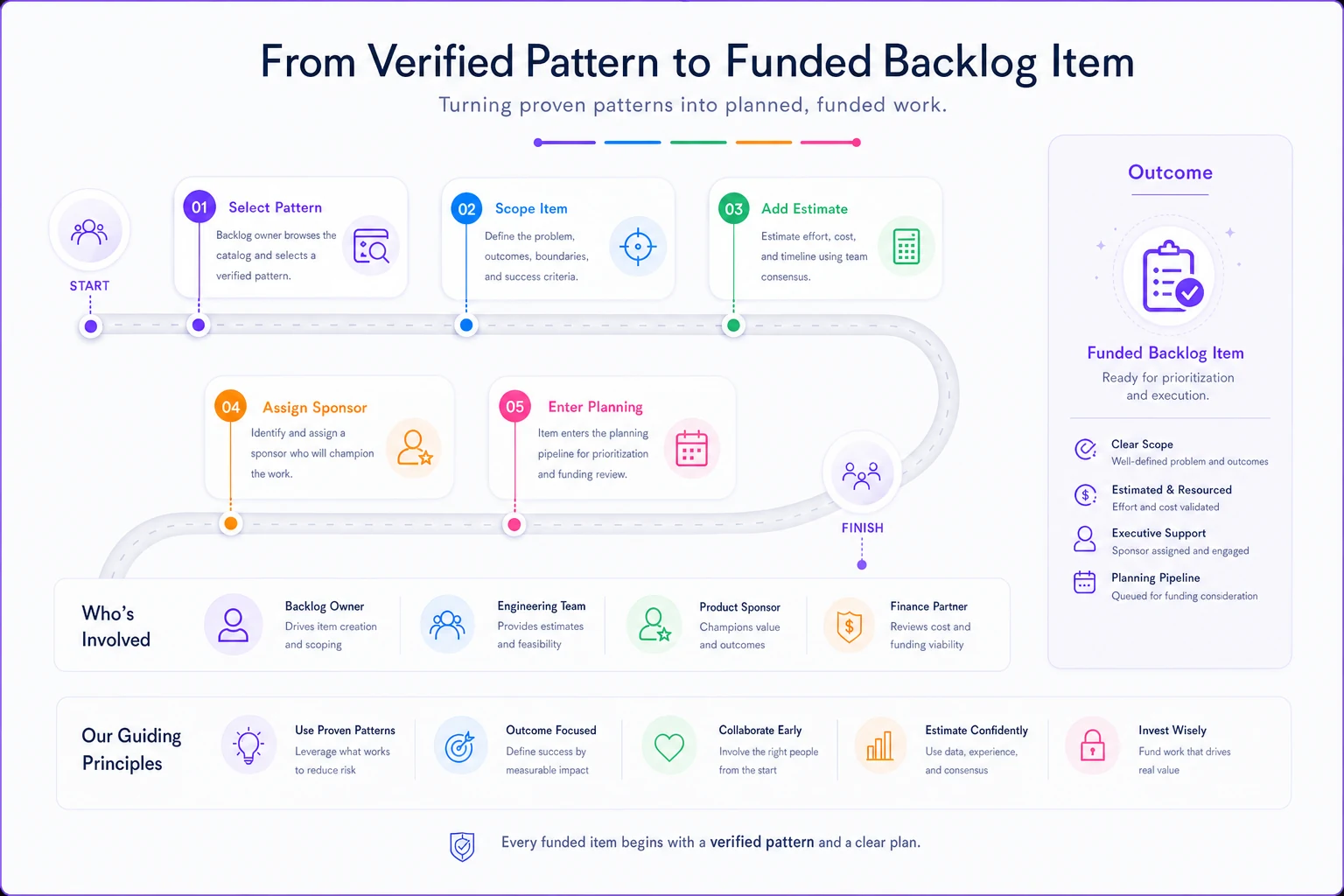
The diagram shows the promotion path from verified pattern to funded backlog item.
Then it competes for funding like everything else. It doesn't get a special lane. What the lifecycle guarantees is that it arrives at the funding conversation pre-verified and pre-estimated, so the decision is "is this worth it relative to other work," not "do we even believe this." That's a much faster conversation.
A typical example: a support experiment shows that a rewritten first-response macro cuts back-and-forth on billing tickets. Verified, cataloged. The backlog owner scopes it as "roll new macro to all billing agents + train," estimates three days, attaches the support ops lead as sponsor. It enters the next planning round as a scoped item with evidence attached. It gets funded because the case is already made.
A real scenario
A roughly 40-person B2B software company had, on paper, a strong experimentation culture — lots of tests, active retros, plenty of "learnings" in Notion. But almost none of it changed the roadmap. When they audited a year of experiments, they found somewhere around 60 completed tests. Fewer than 10 had produced any lasting change. Two had been re-run nearly identically by different people months apart.
They put in a lightweight version of this lifecycle: a hypothesis card at capture, a required reviewer at verify, a single catalog with a status field, and a hard rule that no learning entered the backlog without a sponsor and an estimate.
Over the following couple of quarters, the numbers weren't dramatic but they were real. Roughly a third of verified patterns got promoted into funded work — versus almost nothing before. The duplicate-experiment problem basically stopped, because people checked the catalog first. Planning conversations got shorter because promoted items showed up with evidence already attached. The team didn't run more experiments. They just stopped losing the ones they ran.
When this makes sense — and when it doesn't
When it's worth building:
-
You run enough experiments that losing them costs real effort (roughly one or more per week across the team).
-
Multiple teams could benefit from each other's learnings but currently don't.
-
Leadership funds work through some kind of prioritization, so "fundable backlog item" is a meaningful output.
When it's a bad idea:
-
You're a small team where the same three people run and remember everything. The overhead outweighs the loss you're preventing. Just keep a shared doc.
-
You don't have basic measurement discipline yet. A learning system on top of unreliable data manufactures false confidence at scale, which is worse than no system.
-
Your culture punishes negative results. If "inconclusive" gets treated as failure, nobody will capture honestly, and the pipeline fills with inflated wins.
Who should hold off: teams still fighting to get experiments run at all. Fix the input before you build the pipeline. A beautifully governed catalog with nothing feeding it is just process theater.
The part everyone underestimates
The hardest thing about an organizational learning system isn't the templates or the thresholds. It's the ownership assignments at the seams — the verify handoff and the reuse handoff. Those are the two spots where a result sits waiting for a human to pick it up, and if nobody's explicitly on the hook, it waits forever.
Build two things before anything else. Make verification require a named reviewer who isn't the runner. Make promotion require a named sponsor who owns the funding. Everything else — the cards, the catalog, the statuses — is supporting structure. The whole system stands on the idea that learning becomes real only when someone is accountable for moving it to the next stage. Get the ownership right and the lifecycle mostly runs itself. Get it wrong and you'll have the best-documented pile of ignored insights in the industry.
Build two things before anything else. Make verification require a named reviewer who isn't the runner. Make promotion require a named sponsor who owns the funding. Everything else — the cards, the catalog, the statuses — is supporting structure. The whole system stands on the idea that learning becomes real only when someone is accountable for moving it to the next stage. Get the ownership right and the lifecycle mostly runs itself. Get it wrong and you'll have the best-documented pile of ignored insights in the industry.
Ready to boost your team's productivity?
Join 5,000+ teams using Workyly to streamline workflows, improve communication, and deliver projects faster.