


Documentation debt kills more products than bad code ever will.
I learned this watching a fintech startup lose three major enterprise clients in a single quarter. Not because their payment processing platform failed. Not because competitors offered better features. They lost those accounts because their integration docs were six months out of date, their API changelog was missing critical deprecation notices, and nobody could answer basic implementation questions without scheduling engineering calls.
The kicker? They had twelve people on their documentation team. Twelve. But without clear ownership structures, SLAs, or any connection between doc updates and release cycles, those twelve people produced less reliable documentation than a two-person startup I'd worked with the year before.
Most teams treat documentation like voluntary community service—something nice to have when someone feels motivated. Meanwhile, your project knowledge management becomes a graveyard of half-updated wikis, orphaned Confluence pages, and that one Google Doc everyone swears has the latest architecture decisions but nobody can actually find.
The operational cost of documentation chaos
The typical documentation lifecycle at a growing company goes something like this.
Sprint 1: Developer writes initial docs for a new feature. Pretty comprehensive—maybe 80% complete. Gets a once-over during PR review. Ships.
Sprint 3: Feature gets enhanced. Developer updates the code, forgets the docs exist. Now you're at 60% accurate.
Sprint 5: A customer complains. Support escalates to product. Product assigns it to engineering. Engineering says "next sprint."
Sprint 8: Major refactor. The original developer left. The new developer doesn't even know the docs exist. Now the documentation is actively misleading.
Sprint 12: Sales loses a deal because the prospect couldn't understand implementation requirements. Emergency all-hands to "fix the documentation problem." Everyone writes docs for two days. Then back to normal.
This pattern destroys operational efficiency in ways most teams never bother to measure. Support tickets spike because customers can't self-serve. Engineers waste hours in meetings explaining things that should already be written down. New hires take months to ramp instead of weeks. Sales cycles stretch because technical validation requires calls instead of a documentation review.
A marketing automation company I consulted for figured out their poor documentation was costing them around $1.8M annually—between extended onboarding, increased support load, and deals lost during technical evaluation. They had documentation. Tons of it. But without ownership, verification cycles, or clear standards, it was worse than having nothing at all.
Why traditional documentation approaches fall apart at scale
The core problem isn't laziness. It's treating documentation as a secondary artifact instead of a primary work product.
Stop losing track of your priorities.
Workyly helps you organize, assign, and track every task efficiently.
- Centralized task management
- Real-time collaboration
- Intelligent workflow automation
No credit card required
Think about how we handle code. Every line has an owner. Changes require review. Tests verify functionality. Deployments follow schedules. We have SLAs for uptime, response times, bug fixes. Documentation? "Update it when you can."
-
At 5 people Everyone knows everything. Documentation feels redundant. "Just ask Sarah" actually works.
-
At 20 people Knowledge silos form. Some docs exist but nobody knows if they're current. Slack becomes the primary documentation layer.
-
At 50 people Multiple conflicting versions of the same information exist. Nobody owns anything. New hires are overwhelmed. "Tribal knowledge" becomes an excuse.
-
At 100+ people Complete chaos. Teams build their own documentation systems. Critical knowledge lives in specific people's heads. Every project starts with "figuring out how things actually work."
The standard response—"we need better documentation culture"—misses the point. Culture without systems means relying on individual motivation. That works until your best documenters burn out or leave.
Building documentation-as-work systems
Real project knowledge management means treating documentation like any other deliverable: with owners, deadlines, quality standards, and verification processes.
Here's the framework that actually holds up:
1. Required metadata fields (not optional)
-
Owner Single person accountable for accuracy
-
Reviewer A different person who validates changes
-
Last verified date When someone actually checked this against reality
-
Expiration date When it must be reviewed or archived
-
Dependencies What other docs or systems this connects to
-
Criticality tier P0 (blocks work), P1 (impacts efficiency), P2 (nice to have)
Without these fields, documentation becomes archaeology. "Who wrote this? When? Is it still accurate? Should we trust it?"
2. SLA tiers based on criticality
Not all documentation deserves the same attention. A typo in your company values page matters a lot less than errors in API documentation.
| Criticality | Update SLA | Review Cycle | Verification Required |
|---|---|---|---|
| P0 - Critical | 24 hours | Every release | Technical + User testing |
| P1 - Important | 72 hours | Monthly | Technical review |
| P2 - Standard | 1 week | Quarterly | Owner review |
| P3 - Reference | 2 weeks | Semi-annual | Basic check |
These aren't suggestions. They're commitments. Miss a P0 documentation SLA and it should escalate the same way a production incident does.
3. Release-linked verification
-
Before any release
-
List all documentation impacts
-
Assign owners for updates
-
Set completion deadline (before the release, not after)
-
Include in release checklist
-
Block release if P0/P1 docs aren't updated
One e-commerce platform implemented this after their Black Friday disaster—outdated caching documentation led to six hours of downtime. Now their release process includes mandatory documentation verification. No exceptions. Their last eighteen releases shipped with 100% documentation accuracy.
4. Review cycles that actually happen
Scheduled reviews beat "update when needed" every time.
Monthly P0 review: Owner validates every P0 document is still accurate. Takes 2-4 hours monthly versus 20+ hours when something breaks and nobody knows why.
Quarterly deep dive: Each team audits their documentation. Archive outdated content. Update stale sections. Find the gaps.
Semi-annual ownership review: Reassign documents when people change roles. Nothing worse than critical documentation owned by someone who left eight months ago.
This connects naturally to the retrospective-to-action system that guarantees follow-through—documentation reviews surface the same patterns that retrospectives catch, but prevent them from turning into incidents.
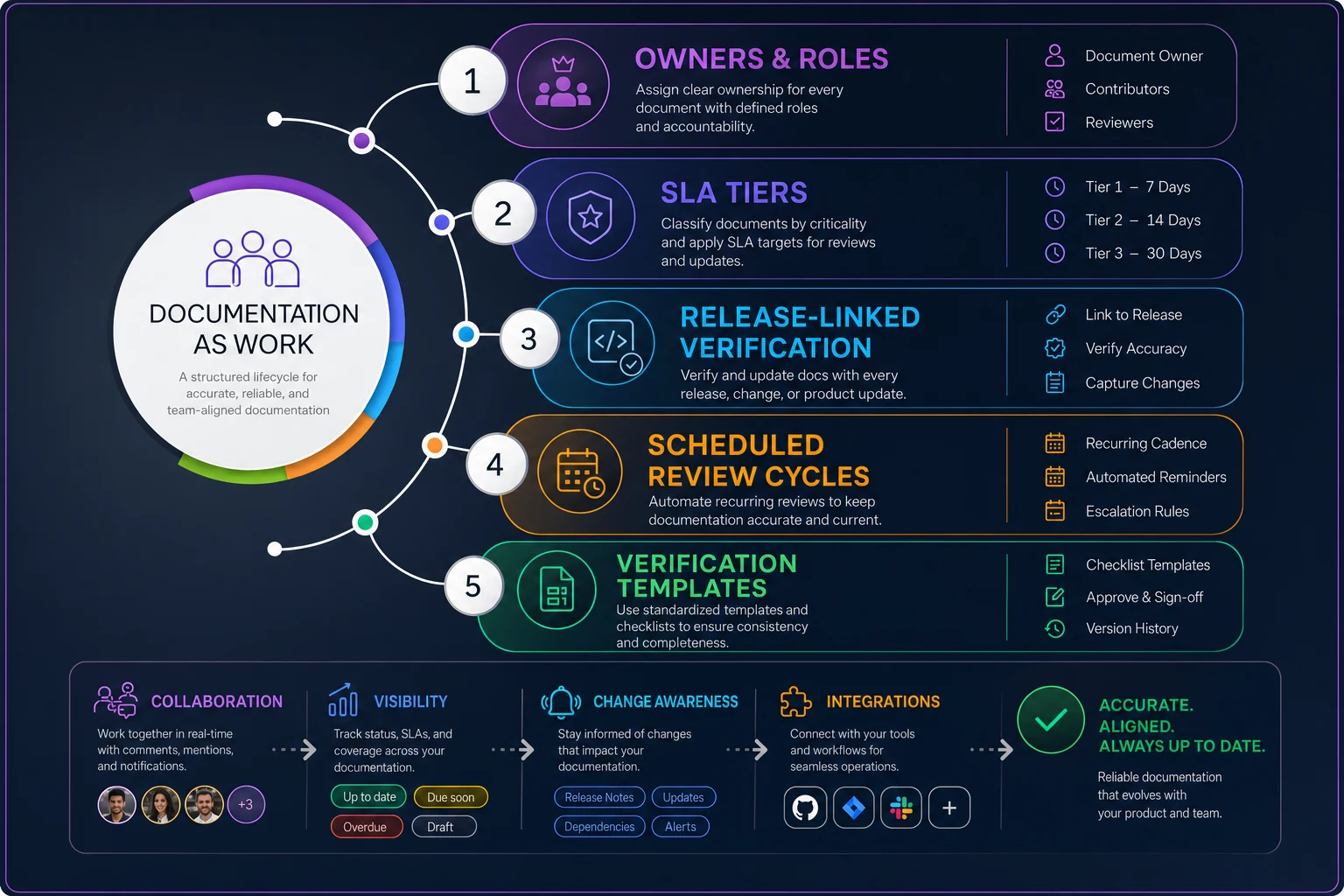
A simple visual of this flow—owners, SLAs, release checks, and review cycles—helps teams see where documentation work fits into releases and sprints.
The verification template that changes everything
Most documentation fails because we write it once and assume it'll stay accurate. Verification templates flip that—making documentation testable and auditable.
Setup Documentation Verification:
-
Environment setup steps executed successfully? [Y/N]
-
All commands/scripts run without errors? [Y/N]
-
Screenshots match current UI? [Y/N]
-
Prerequisites still accurate? [Y/N]
-
Estimated time still realistic? [Y/N]
API Documentation Verification:
-
All endpoints return expected responses? [Y/N]
-
Authentication flow works as documented? [Y/N]
-
Error codes match documentation? [Y/N]
-
Rate limits accurately described? [Y/N]
-
Example requests/responses valid? [Y/N]
Process Documentation Verification:
-
All stakeholders still correct? [Y/N]
-
Steps match current workflow? [Y/N]
-
Tools/systems mentioned still in use? [Y/N]
-
Approval chains accurate? [Y/N]
-
Timelines realistic? [Y/N]
The value isn't the checklist itself—it's requiring someone to actually run through it. A logistics software company made verification mandatory for all P0 docs. Documentation-related support tickets dropped 64% over three months.
Creating accountability without bureaucracy
The typical reaction to documentation-as-work: "This sounds like massive overhead."
It isn't. It replaces hidden costs with visible process.
-
Without structured documentation ownership, a typical 50-person product team loses roughly:
-
15% of engineering time to knowledge searching and sharing
-
25% of support time to preventable questions
-
10-20% longer onboarding for new hires
-
Harder-to-measure damage to customer satisfaction
That works out to somewhere in the range of $400K–$600K annually in lost productivity for a team that size. The documentation-as-work system costs maybe 5% of that to implement and maintain.
Start small and prove the value:
Week 1-2: Pick your five most critical documents. Assign owners. Set review dates.
Week 3-4: Create verification templates for those five documents. Run through them. Fix what's broken.
Week 5-8: Expand to your top 20 documents. Add SLA tiers. Connect to the release process for one team.
Week 9-12: Roll out more broadly. Measure impact on support tickets, onboarding time, and incident frequency.
This gradual approach avoids the "massive documentation initiative" that burns everyone out and produces mediocre results. Similar to the phased blueprint for a team productivity operating system, you build credibility through small wins before you try to scale.
When documentation ownership actually fails
This system isn't magic. It fails—sometimes badly—when:
The owners don't actually know the content. Assigning random people to documentation they don't understand creates worse problems than no documentation. Ownership has to align with expertise.
Review cycles ignore business reality. Quarterly reviews during peak season? Monthly updates during critical launches? The schedule needs to fit operational tempo, not just the calendar.
Verification becomes checkbox theater. If people just mark "verified" without actually testing anything, you've added bureaucracy without value. Spot audits and rotation help.
Tools fight the process. Wikis that don't support metadata, version control without clear workflows—bad tool choices doom good intentions. Tool selection matters more than people admit.
Building verification into your existing workflow
The smartest teams don't build separate documentation workflows. They embed verification into what already exists.
Your team probably has:
-
Sprint planning "What documentation does this work touch?"
-
Release reviews "Are all P0/P1 documents updated and verified?"
-
Post-incident "Did documentation gaps contribute? Who owns the fixes?"
-
Quarterly planning "Which documentation needs major work next quarter?"
This mirrors the approach from converting meetings into clear asynchronous action items—you're not adding meetings, you're adding accountability to touchpoints that already exist.
The compound effect of verified documentation
Nobody talks much about what actually happens when documentation becomes reliable over time.
Month 1: Fewer repeat questions in Slack. Support tickets start dropping.
Month 3: New hires ramp faster. Engineers spend less time in explanation meetings.
Month 6: Customer success handles technical questions independently. Sales cycles shorten because prospects can self-evaluate.
Month 12: You have a living knowledge base that reflects reality. Team velocity increases because people aren't constantly context-switching to answer questions they've answered a dozen times.
A data analytics startup implemented this system about eighteen months ago. They now track "documentation-prevented incidents"—problems caught because someone referenced accurate documentation instead of guessing. They're preventing 12–15 incidents monthly, each of which would have cost 4–8 engineering hours to resolve.
That's not counting the less visible improvements: faster decision-making, reduced cognitive load, better team confidence. When people actually trust documentation, they move faster.
The tools question (and why it matters less than you think)
Everyone wants to know the "best documentation tool."
It matters a lot less than having the right system. Teams succeed with Google Docs and fail with $100K documentation platforms. The tool just needs to support:
-
Metadata fields for ownership and dates
-
Version control
-
Search functionality
-
Access controls
-
Basic workflow automation
That said, AI-powered operational software can reduce a lot of the manual burden here—automated verification runs, intelligent update suggestions, and natural language search make the system sustainable at scale. But you need to get the process right first, then enhance it with technology.
The biggest mistake teams make is buying sophisticated documentation platforms before they've established ownership and verification practices. That's like buying a Ferrari before you know how to drive.
Making the transition without disrupting everything
You can't flip a switch and have perfect documentation tomorrow. But you can start improving immediately.
Phase 1 (Weeks 1-4): Foundation
-
Identify your 10 most problematic documents
-
Assign clear owners (people who actually know the content)
-
Create basic verification checklists
-
Set monthly review reminders
Phase 2 (Weeks 5-12): Expansion
-
Add SLA tiers to all critical documentation
-
Connect documentation updates to release process
-
Implement quarterly review cycles
-
Start measuring impact (support tickets, onboarding time)
Phase 3 (Months 4-6): Systematization
-
Roll out to all teams
-
Automate verification where possible
-
Create documentation dashboards
-
Establish a governance model
Phase 4 (Months 7-12): Optimization
-
Refine SLAs based on actual data
-
Implement advanced verification (automated testing of code samples)
-
Build documentation into performance reviews
-
Create knowledge management metrics
The transformation happens gradually, then suddenly. One day you notice people actually trust and use documentation instead of constantly asking questions or making assumptions.
The bottom line on project knowledge management
Documentation isn't really about writing—it's about operational sustainability.
Every undocumented decision, every outdated guide, every orphaned wiki page creates friction that compounds over time. Teams slow down. Mistakes increase. Knowledge walks out the door when people leave.
The documentation-as-work model—clear ownership, SLAs, verification templates, release linkage—turns documentation from overhead into operational advantage. It's not about creating more documentation. It's about making what exists reliable enough that people actually use it.
Start with five critical documents. Assign owners. Build verification templates. Set review cycles. Check the impact after 30 days.
The results tend to convince even the biggest skeptics that project knowledge management isn't optional—it's the difference between teams that scale and teams that collapse under their own complexity.
Your documentation is either an asset or a liability. The only question is whether you'll build systems to keep it accurate, or keep hoping that "documentation culture" will somehow sort itself out.
The teams winning right now aren't the ones with the most documentation. They're the ones whose documentation actually matches reality.
Ready to boost your team's productivity?
Join 5,000+ teams using Workyly to streamline workflows, improve communication, and deliver projects faster.