



Your retrospective wraps up. Everyone agrees on three solid action items. The energy feels different this time—real commitment. Two weeks later, you're running the next retro and someone asks, "wait, did we actually do that thing we talked about?" Blank stares. Nobody remembers who was supposed to handle it. The same issues resurface like clockwork.
This breakdown happens in the majority of teams. Not because people don't care, but because retrospectives generate intentions, not operational systems. The gap between "we should fix this" and actual completion is where most continuous improvement efforts die.
The accountability vacuum between retrospectives
Most teams treat retrospectives as discussion forums rather than operational planning sessions. You identify problems, brainstorm solutions, maybe write them on a virtual sticky note, then... what? The meeting ends, everyone switches context back to their regular work, and those action items float in organizational limbo.
The core issue isn't motivation or team dysfunction. It's the absence of a retrospective action system that bridges identification and execution. Without clear capture mechanisms, ownership assignments, and verification checkpoints, even the best insights evaporate within days of the meeting ending.
Managing a distributed engineering team taught me this firsthand. We ran bi-weekly retrospectives religiously. Great discussions, smart insights, zero follow-through. Our retrospective board became a graveyard of good intentions. The same blockers kept appearing sprint after sprint because we never operationalized the transition from discussion to action.
Building the capture-to-verification pipeline
After watching many teams struggle with this same pattern, one approach consistently works: treating retrospective outputs as operational work items, not suggestions. This means applying the same rigor you'd use for production incidents or customer deliverables.
Stop losing track of your priorities.
Workyly helps you organize, assign, and track every task efficiently.
- Centralized task management
- Real-time collaboration
- Intelligent workflow automation
No credit card required
The five-component system
1. Immediate capture with context
-
Specific problem statement (not vague improvements)
-
Why it matters now (the pain it's causing)
-
Success criteria (how we'll know it's fixed)
-
Effort estimate (T-shirt size is fine)
Most teams skip the context capture, which becomes a problem when someone picks up the task three days later and can't remember why it mattered. The person who suggested it might be on vacation. The urgency evaporates.
2. Priority scoring within 24 hours
Post-retrospective, someone—usually the facilitator or team lead—scores each item using a simple matrix:
| Factor | Weight | Score (1-5) |
|---|---|---|
| Team pain level | 40% | How much daily friction this causes |
| Implementation effort | 30% | Inverse - lower effort scores higher |
| Dependency count | 30% | Fewer dependencies score higher |
This prevents the common pattern where teams tackle easy items while high-impact improvements sit untouched. One product team I worked with discovered they'd been avoiding their biggest productivity blocker—a flaky test suite—for six months while fixing minor annoyances.
3. Owner assignment with explicit acceptance
This is where most retrospective action systems fall apart: voluntary ownership. "Who wants to take this?" usually means nobody takes it. Instead, assign based on:
-
Relevant expertise
-
Current workload
-
Growth opportunities
The assigned owner must explicitly accept or negotiate. No passive assignments. It sounds heavy-handed, but unclear ownership kills more improvement initiatives than any other single factor.
4. Timeboxed experiments, not indefinite projects
Every action item becomes a 1-2 week experiment with:
-
Clear start date
-
Specific end date
-
Defined "good enough" threshold
-
Fallback plan if it doesn't work
This prevents perfectionism and scope creep. A team fixing their deployment process doesn't need the perfect CI/CD pipeline—they need something better than what they have now.
5. Verification checklist and review ritual
The assigned owner creates a simple verification checklist within 48 hours:
-
[ ] Core problem addressed
-
[ ] Success criteria met
-
[ ] Team trained/informed
-
[ ] Documentation updated
-
[ ] Follow-up scheduled if needed
During the next retrospective, you review completed items first. This creates visible momentum and accountability.
Use T-shirt sizing for quick effort estimates to keep prioritization fast and avoid analysis paralysis.
Here's a simple visual of the pipeline.
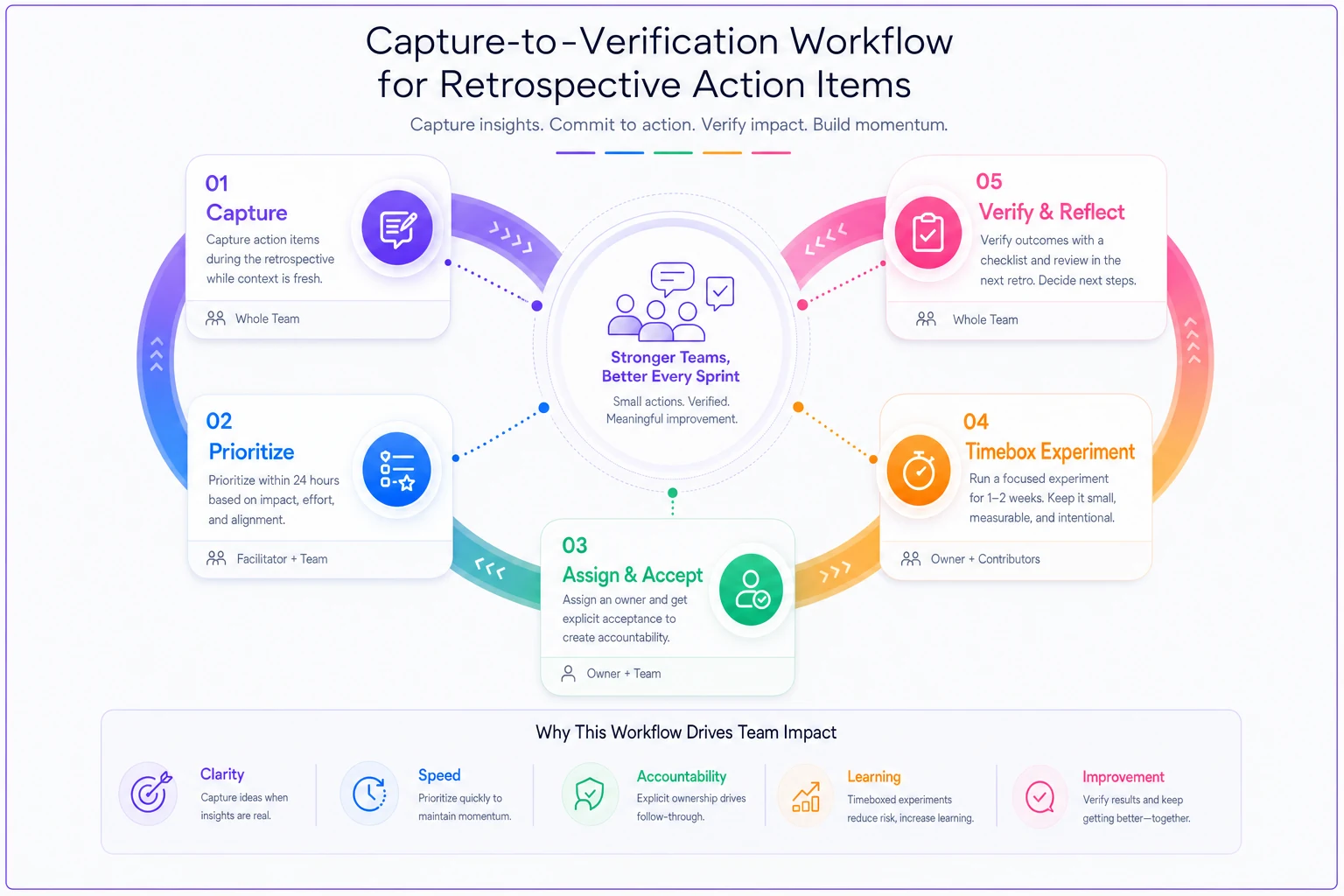
A quick visual like this helps teams align on the process.
The stakeholder script that locks in commitment
One pattern that dramatically improves follow-through: having owners present their action plan to a stakeholder within 72 hours. This could be their manager, a peer, or even just another team member. The script is simple:
"From our last retrospective, I'm owning [specific action]. The problem is [context]. I'm planning to [approach] by [date]. Success looks like [criteria]. If I hit blockers, I'll [escalation plan]."
This verbal commitment creates social accountability. People rarely abandon initiatives they've explicitly committed to in front of others. It also surfaces blockers early—the stakeholder might know about conflicting priorities or have resources to help.
When this system reveals deeper problems
Sometimes implementing this retrospective action system exposes uncomfortable truths.
A mobile app development team discovered their retrospective actions never completed because their sprint commitments left zero slack for improvement work. Every sprint was packed to 100% capacity with feature work. Another team realized their actions kept failing because developers, designers, and product managers had fundamentally different definitions of "improvement." The retrospective action system forced them to confront those misaligned priorities directly.
These revelations are valuable. They shift the conversation from "why don't we follow through?" to "what structural issues prevent us from improving?"
Common failure modes and fixes
The perpetual backlog syndrome Action items accumulate faster than they complete. Fix: hard limit of 3 active items. New items can't start until current ones finish or get explicitly cancelled.
The volunteer burnout pattern The same eager person takes every action item, gets overwhelmed, delivers nothing. Fix: maximum one item per person per retrospective. Spread the load.
The perfection paralysis Teams spend weeks planning the perfect solution instead of making incremental progress. Fix: every action must deliver value within 10 business days. Scope accordingly.
The context switching tax People treat retrospective actions as side projects, squeezing them into margins. Fix: explicitly allocate time during sprint planning. If improvement isn't scheduled, it won't happen.
Measuring whether your system actually works
Track three metrics:
-
Completion rate
Actions completed / actions assigned (target: >70%)
-
Cycle time
Days from assignment to verification (target: <10)
-
Repeat rate
How often the same issue appears in retrospectives (target: <2)
A design agency that implemented this system saw their completion rate climb from around 20% to 75% within two months. More importantly, their retrospectives stopped feeling like Groundhog Day—different issues surfaced because old ones were actually getting resolved.
The tools question (and why it matters less than you think)
Teams often ask about retrospective action tracking tools. Specialized platforms exist, but the system matters more than the software. A Google Doc with the five-component structure beats a sophisticated tool used inconsistently.
If your team already uses project management software, integrate there. Create a dedicated retrospective action board or tag. The less context switching required, the better. For teams that want to reduce administrative overhead, AI-powered operational software can help—automatically creating action items from retrospective notes, assigning owners based on expertise, sending verification reminders. That kind of automation removes the friction that often causes these systems to break down over time. But a manual system executed consistently still beats an automated one people ignore.
Who shouldn't use this system
This system assumes your team actually wants to improve. If retrospectives are purely ceremonial—held because "agile teams do retros"—this won't help. It'll just create more visible evidence of apathy.
It also assumes some level of autonomy. If every improvement requires three levels of approval and a business case, you need organizational change before operational systems.
And if your team is in genuine crisis mode—fighting fires daily, struggling to ship basic commitments—address that first. Converting meetings into clear action items is probably a better starting point than retrospective optimization. Trying to implement this in a team that's already overwhelmed tends to make meetings derail progress further rather than help.
The compound effect of consistent follow-through
A fintech startup implemented this retrospective action system after months of stagnant retros. Early on, they completed small improvements—fixing a flaky test, updating outdated documentation, clarifying a confusing process. Nothing dramatic.
Six months later, their velocity had increased noticeably. Not from any single change, but from dozens of small improvements that actually got implemented. Deployment frequency doubled. Customer-reported bugs dropped significantly.
The real shift was cultural. The team stopped seeing retrospectives as venting sessions and started treating them as operational planning meetings. "We should fix that" became "I'll fix that by Thursday."
That's the whole point. Most teams have plenty of good ideas. What they lack is a reliable way to turn those ideas into completed improvements. The five-component system—capture, prioritize, assign, timebox, verify—provides that bridge.
Start with your next retrospective. Pick one action item. Apply the structure. Have the owner do the stakeholder presentation. Watch what happens when follow-through becomes systematic rather than optional.
Your future retrospectives will have new problems to solve instead of the same recycled frustrations. That's how you know it's working.
Ready to boost your team's productivity?
Join 5,000+ teams using Workyly to streamline workflows, improve communication, and deliver projects faster.