


There's a strange thing that happens to companies somewhere between 40 and 200 people. Strategy stops being the problem. Almost everyone can tell you the top three priorities for the year. What breaks is the connective tissue between what leadership says on Monday and what teams actually spend their week doing.
The gap doesn't show up as a dramatic failure. It shows up as drift. A quarter ends and someone realizes the team spent six weeks polishing a feature nobody in the leadership room considers important anymore. Or a funding decision gets made in a hallway, three teams reshuffle, and two months later nobody can reconstruct why. Individually these are small things. Added up across a year, they're the difference between a company that compounds and one that spins its wheels.
Most people try to fix this with more communication — more all-hands, more Slack updates, more decks. That almost never works, because the problem isn't a shortage of communication. It's the absence of a leadership operating routine that reliably converts strategy into cadence, decisions into records, and priorities into signals people can actually feel in their day-to-day work.
This is a systems piece. Not "run better meetings," but how the whole loop connects — weekly through quarterly — and where it tends to snap under growth.
Why cadence is really a coordination problem, not a calendar problem
The default reading of "operating cadence" is scheduling. Weekly leadership sync, monthly business review, quarterly planning. Set the meetings, invite the right people, done.
But cadence isn't the meetings. Cadence is the rate at which the organization can sense reality, decide, and re-point effort without everything grinding to a halt. Meetings are just the visible surface. Underneath, three separate clocks are running and they rarely tick together:
-
The information clock — how fast real data about delivery, customers, and risk reaches leadership.
-
The decision clock — how fast leadership can commit, reverse, or reallocate once they have that information.
-
The execution clock — how fast teams can actually change direction after a decision lands.
In a small company all three clocks are basically the same speed because the founder is in every conversation. What tends to happen as headcount climbs is that these clocks desync. Information starts arriving late and pre-chewed. Decisions get made but never travel cleanly to the people who execute. Teams keep running last quarter's plan because nobody told them, credibly, to stop.
A leadership routine that works is one that keeps those three clocks roughly synchronized. Everything below is really about that.
The tiered rhythm: what each layer is actually for
The mistake most teams make is treating every leadership meeting as a smaller or larger version of the same thing. A weekly sync becomes a mini quarterly review. A quarterly planning session becomes a giant status update. When every meeting does a little of everything, none of them does anything well.
Stop losing track of your priorities.
Workyly helps you organize, assign, and track every task efficiently.
- Centralized task management
- Real-time collaboration
- Intelligent workflow automation
No credit card required
Each layer of cadence has one job. Here's how it breaks down:
| Ritual | Frequency | Primary job | What it should NOT do |
|---|---|---|---|
| Ops standup (leadership) | Weekly | Surface blockers, confirm nothing is silently on fire | Re-plan the quarter, debate strategy |
| Delivery review | Bi-weekly | Check execution against committed outcomes, catch drift early | Approve new funding |
| Business review | Monthly | Connect delivery to real business signals (revenue, churn, cost) | Micromanage tasks |
| Funding gate / portfolio review | Quarterly | Fund, defund, or rebalance bets; reset priorities | Solve operational blockers |
The reason this separation matters: the weekly rhythm protects execution, the quarterly rhythm protects strategy, and the monthly layer is the translation joint between them. When the monthly review is weak or skipped, strategy and execution slowly stop speaking the same language — leadership keeps talking outcomes while teams keep reporting activity.
A pattern worth watching for: if your quarterly planning constantly gets hijacked by operational firefighting, that's not a planning problem. It's a signal that your weekly and bi-weekly layers aren't catching problems early enough, so everything rolls uphill to the one meeting that's supposed to be about the future.
Decision-review lanes: where good decisions go to die
Cadence gives you the rhythm. Decision-review lanes give you the mechanism for actually deciding inside that rhythm without every choice landing on one person's desk.
The failure mode almost everyone recognizes: a decision gets made in a meeting. Everyone nods. Three weeks later, two teams have interpreted it differently, one team never heard about it, and the person who "owned" it assumed someone else was driving. The decision was made but never routed.
A decision-review lane is just a pre-agreed path a decision travels based on its size and reversibility. The two axes that matter:
-
Blast radius — how many teams, how much money, how much of the roadmap does this touch?
-
Reversibility — can we undo this in a week, or are we stuck with it for a quarter?
Small and reversible? The owning team decides, no meeting, just logs it. Large and hard to reverse? It goes to the funding gate with a written case. The whole point is to stop treating all decisions with the same ceremony. Companies waste an astonishing amount of leadership time debating cheap, reversible things while rushing the expensive, permanent ones.
A few lane rules that hold up well in practice:
-
Every decision above a set threshold gets a written record before it's executed — what we chose, what we rejected, and what would make us reverse.
-
Reversible decisions default to "decide now, review later"; irreversible ones default to "review first."
-
Each lane has a named decider, not a committee. Committees ratify; they don't decide.
-
Anything that reallocates funding or people crosses into the quarterly gate, no exceptions.
This is where linking decisions to funding and monitoring pays off enormously. If you want the deeper mechanics of turning decisions into durable operational artifacts, the piece on decision hygiene at scale walks through lifecycle patterns that tie decision records to funding, monitoring, and rollback triggers. The short version: a decision that isn't written down with a reversal condition isn't a decision, it's a mood.
Here's a quick visual of a decision-review lane workflow.
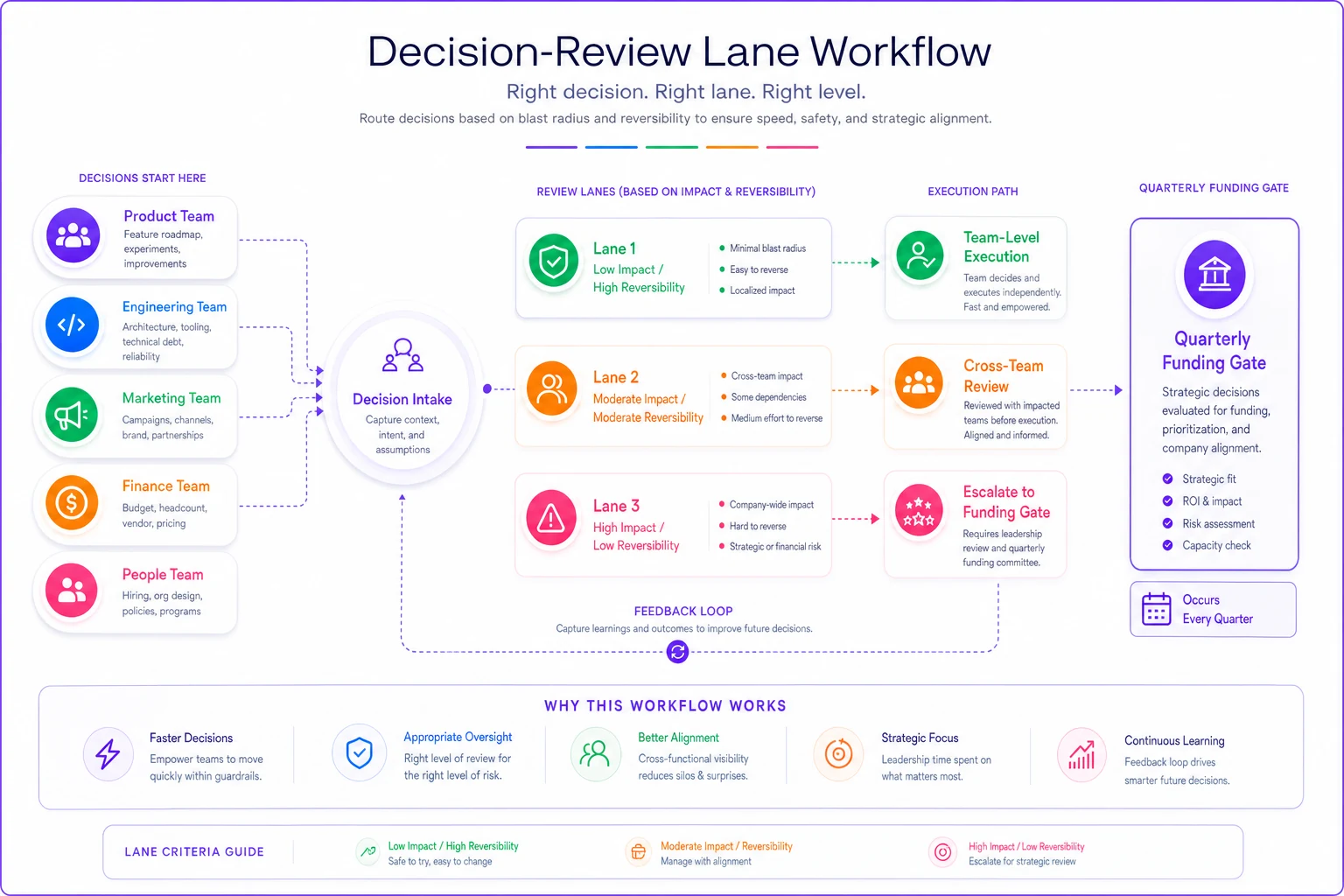
This sketch shows how decisions route differently when they're small and reversible versus large and irreversible.
The short version: a decision that isn't written down with a reversal condition isn't a decision, it's a mood.
Tying comms to funding gates so priorities actually signal
There's a subtle thing that separates companies where priorities feel real from ones where they feel like posters on a wall: priorities that move money get believed. Priorities that only get talked about don't.
Teams are extremely good at reading where the resources actually flow. You can say customer retention is the top priority all quarter, but if every new hire, every reallocated engineer, and every approved budget went to net-new acquisition, the org has correctly concluded that retention is not the priority. Words and dollars disagreed, and dollars always win.
This is why comms templates need to be tied to funding gates rather than floating on their own schedule. The quarterly funding decision and the quarterly priority message should be the same event, told two ways. When you fund a bet, that's the moment you tell the org — clearly, in writing — what got funded, what got cut, and why. The comms is the signal that the priority is real.
A reliable structure for that post-gate message:
-
What we funded and why — the two or three bets that got real resources this cycle.
-
What we deliberately did not fund — this is the part people skip, and it's the most important. Naming what you're not doing is how you kill zombie priorities.
-
What changed from last cycle — so teams can reconcile their current work against the new picture.
-
What we're watching — the specific signals that would cause us to double down or pull back mid-cycle.
-
What this means for you — translated per team, not a generic broadcast.
That last point is where most leadership comms fall flat. A single company-wide message feels efficient but forces every team to translate strategy into their own context, and they'll translate it inconsistently. The extra ten minutes to say "for the platform team, this specifically means X" removes a week of quiet confusion.
For grounding those funding decisions in signals rather than vibes, the approach in portfolio observability that actually drives funding covers the minimal dashboard and decision thresholds that make gate reviews defensible instead of political.
Enforcement behaviors: the part everyone skips
You can design perfect rituals and lanes and templates and still watch the whole thing decay in a quarter. The reason is almost always the same: nobody enforced the routine, so it eroded at the edges until it meant nothing.
Enforcement sounds heavy-handed. In practice it's small, consistent behaviors from leaders that signal "this routine is load-bearing, not optional." A handful that actually move the needle:
-
Decisions made outside the lanes get rolled back or re-run through the lane. The first time a leader lets a hallway decision stand, the lanes are dead. Not because of the one decision, but because everyone now knows the process is theater.
-
Meetings that lose their job get killed, not tolerated. If the delivery review has quietly turned into a status readout, either fix it or cancel it. A ritual that no longer does its job is worse than no ritual — it burns time and creates false confidence.
-
Missing decision records block execution. If a big bet can't point to a written record with a reversal condition, it doesn't get resourced. Harsh, but this is the single behavior that makes decision hygiene stick.
-
Priorities get re-stated with the same words every cycle. When leaders paraphrase priorities differently each quarter, teams assume the priority changed even when it didn't. Consistency of language is an enforcement behavior.
-
Leaders show up prepared or the meeting doesn't happen. A quarterly gate where people read the deck for the first time in the room is a gate in name only.
Make missing decision records block execution until a written record with reversal conditions exists.
The uncomfortable truth: enforcement is mostly about leaders disciplining themselves first. Teams model their behavior on what leaders actually reward and reverse, not on what the process document says.
A real scenario: where the drift showed up
A roughly 90-person B2B software company had all the meetings you'd expect — weekly leadership sync, quarterly planning, the works. On paper the cadence looked healthy. But two consecutive quarters ended with the same complaint from the CEO: "We planned the right things and shipped the wrong ones."
When they mapped it out, the break was obvious. Quarterly planning set three priorities. But there was no monthly translation layer and no funding-tied comms. So after the quarterly kickoff, the priorities were basically never spoken of again until the next quarter. Meanwhile, decisions to shift engineers between projects were being made ad hoc, week to week, with no record and no review lane. By week six of each quarter, actual staffing had drifted well away from the funded plan, and nobody had a single moment where that drift became visible.
They changed three things. Added a monthly business review whose only job was reconciling delivery against the funded priorities. Made every staffing reallocation above a small threshold require a one-paragraph written record. And tied the quarterly comms directly to the funding gate — same meeting, same message, including the "what we did NOT fund" section.
The shift over the next two quarters wasn't dramatic-sounding but it mattered: the share of engineering time spent on non-priority work dropped from somewhere around a third to roughly 10-15%. More telling, the CEO stopped being surprised. Drift still happened — it always does — but now it surfaced in the monthly review instead of at quarter's end. The clocks got back in sync.
When this level of structure makes sense — and when it doesn't
This isn't free. Every ritual, lane, and record costs attention, and attention is the scarcest thing leadership has.
When it makes sense:
-
You're past the point where one person is in every important conversation (usually somewhere north of 30-40 people).
-
Decisions are visibly getting made and then lost, re-litigated, or misinterpreted.
-
Teams can recite the strategy but their actual work doesn't reflect it.
-
Multiple teams share dependencies and reallocations ripple across the org.
When it's a bad idea:
-
You're under 15-20 people and the founder can still hold the whole picture. Adding formal lanes and monthly reviews here just adds ceremony you'll resent.
-
You're in genuine survival mode where the priority changes weekly for real reasons. Heavy cadence assumes a strategy stable enough to be worth protecting.
Who should NOT do this wholesale: early-stage teams tempted to install "how the grown-ups do it." Copying a 200-person operating rhythm at 12 people is one of the more common self-inflicted wounds — you get all the overhead of process with none of the coordination problem it solves. Start with the single ritual that maps to your actual pain and add layers only when a real breakdown demands one.
How the pieces hold together as you scale
The way to think about all of this: cadence sets the rhythm, decision lanes control who decides what and when, funding gates make priorities materially real, comms broadcast the signal, and enforcement keeps the whole thing from decaying. Pull any one out and the others degrade. Cadence without decision lanes gives you meetings that discuss but never commit. Decisions without funding gates give you commitments nobody resources. Funding without comms gives you priorities the org can't read. And all of it without enforcement gives you a beautiful system on a wiki that nobody follows by March.
What changes as you grow isn't the shape of this loop — it's the distance the signal has to travel and the number of places it can leak. At 30 people the loop is tight enough to run informally. At 300, every one of these mechanisms has to be explicit and defended, because there's no longer a single person who can hold it in their head.
If you want to go deeper on the backbone that connects the quarterly funding rhythm to the weekly team beat, the strategy-to-execution operating model lays out how funding gates and team cadence lock together — it's the structural companion to the leadership behaviors described here.
The whole discipline comes down to a simple test you can run any Friday: can a randomly chosen team explain what the top priorities are, point to where those priorities got funded, and show how their current week connects to them? If yes, your operating routine is doing its job. If the answer wobbles, the rhythm has slipped — and it slipped long before anyone noticed the missed quarter.
Ready to boost your team's productivity?
Join 5,000+ teams using Workyly to streamline workflows, improve communication, and deliver projects faster.