

Shared teams have a strange economics problem. The design team, the data team, the internal IT group, the legal review desk — they all produce something people genuinely need, but nobody pays for it in any way that shows up on a balance sheet. So demand is effectively infinite, supply is fixed, and the price is zero. That combination guarantees a mess.
The usual response is to tighten intake forms, add a Jira board, or ask people to "be more realistic with timelines." Those help at the margins. What they don't do is change the underlying incentive. If a stakeholder can ask for anything at any time for free, they will. Not because they're selfish — because there's no signal telling them what their request actually costs anyone.
An internal service strategy built on SLA tiering fixes this by doing something uncomfortable: it attaches a price, a priority, and a promise to every category of work. Not necessarily dollars — but something that trades. This article walks through how the pieces connect: tier definitions, chargeback and credit models, the scripts you use when a VP wants to jump the line, and the scorecards and weekly ritual that keep the whole thing honest.
Why free internal services break at scale
A small internal team can run on goodwill. Five engineers supporting three product squads will just talk to each other, figure out what's urgent, and get it done. The informal system works because everyone can hold the whole picture in their head.
It breaks somewhere around the point where the number of requesters exceeds what one person can mentally track. The breakdown isn't gradual — it's a cliff. One quarter things feel busy but fine. The next quarter the same team is missing deadlines, the lead is spending half their week in triage conversations, and three different stakeholders each believe their request was promised first.
The part people miss: the team didn't get slower. The coordination cost exploded. When ten stakeholders feed one shared team, the number of possible conflicts between their requests grows far faster than headcount. Every new requester adds not one relationship but a web of new prioritization decisions. Without a system that encodes priority somewhere other than the team lead's inbox, that cost lands entirely on a handful of people who then burn out or quit.
The second failure is subtler. Without tiers, everything becomes urgent. Stakeholders figure out quickly that "this is blocking a customer" or "the CEO asked" gets their work done faster, so everyone starts framing everything that way. The urgency signal inflates until it's worthless, and now genuinely critical work is sitting behind a pile of manufactured emergencies.
Tier definitions: the actual backbone
Tiers are where most internal service strategies live or die. Get them vague and you've just renamed your existing chaos. Get them concrete and they do real work — they tell requesters what to expect and tell the team what it's allowed to deprioritize.
Stop losing track of your priorities.
Workyly helps you organize, assign, and track every task efficiently.
- Centralized task management
- Real-time collaboration
- Intelligent workflow automation
No credit card required
A tier needs three things to be useful: a clear definition of what qualifies, a response and resolution commitment, and an explicit tradeoff. That last piece is the one teams skip, and it's the most important.
| Tier | What qualifies | Response / Resolution | The tradeoff |
|---|---|---|---|
| T0 — Incident | Production down, compliance deadline, revenue actively bleeding | Response < 1 hr, work starts same day | Preempts everything; team may drop in-flight work |
| T1 — Committed | Planned, funded work agreed in quarterly planning | Scheduled in roadmap, firm delivery window | Locked once committed; changes cost a renegotiation |
| T2 — Standard | Normal requests with real business value, no hard deadline | Response < 2 days, resolution 1–2 weeks | Scheduled around T0/T1; can slip if capacity tightens |
| T3 — Best effort | Nice-to-haves, exploratory, "when you get a chance" | No commitment, pulled only on slack capacity | First to be cut, no SLA at all |
The trick isn't the table — it's enforcing it. The most common mistake is letting everything drift up to T1 because "it feels important." A tier system only works if T3 actually exists and actually gets deprioritized. If nothing ever lands in best-effort, you don't have tiers, you have a wish list with labels.
One operational pattern worth stealing: cap the percentage of capacity any tier can consume. If T0 incidents are eating 40% of a team's week, that's not a prioritization problem — it's a reliability problem hiding inside your intake. The tier mix is a diagnostic. When the shape of demand is wrong, the tiers tell you before the people burn out.
If you're still building the front door for all this, it's worth pairing tier definitions with solid triage rules — the mechanics of turning ad-hoc requests into a scalable intake with SLA tiers are the foundation this strategy sits on top of.
Chargeback and credit models: making demand feel the cost
Tiers set expectations. They don't, on their own, limit demand. For that you need a model where asking for more costs the requester something. This is where chargeback and credit models come in, and where a lot of teams get nervous because it sounds bureaucratic.
It doesn't have to be. The point of a credit model isn't to run an internal P&L. It's to force a choice. When a stakeholder has a finite budget of service credits for the quarter, they stop asking for everything and start asking for what matters. The scarcity does the prioritization that no amount of intake-form questions can.
-
Soft credits (the starter). Each stakeholder group gets an allocation of credits per quarter based on their size or strategic weight. Each tier costs a different amount — a T1 commitment costs more credits than a T2 request. No money changes hands. When a team is out of credits, they either wait, trade with another team, or escalate to get more. This alone kills most frivolous demand.
-
Showback (visibility without billing). You track the real cost of the work delivered — in engineer-days or a notional dollar rate — and report it back to each stakeholder every month. Nobody gets charged, but everybody sees what they consumed. The behavior change from visibility alone is often enough; people request differently when their consumption shows up on a slide their boss sees.
-
True chargeback (the mature end). Stakeholders have actual budget that gets debited for internal service work. This makes sense in larger orgs where internal teams are cost centers that genuinely need to justify headcount. It's heavier, creates real friction, and should not be anyone's first move.
A realistic way to price tiers in a credit model: give each stakeholder group a quarterly pool, make T1 commitments expensive, T2 moderate, and T3 nearly free (because best-effort work only runs on slack capacity anyway). The pricing itself nudges behavior toward the tiers you want people using.
When chargeback is a bad idea: small orgs, early-stage teams, or any situation where the overhead of tracking credits costs more than the demand it curbs. If your shared team has three stakeholders, don't build an internal economy. Just talk. Credit models earn their keep when the number of requesters is large enough that conversation alone can't resolve contention.
This is also where credit-based thinking connects to capacity planning more broadly. If you want the model to flex across teams rather than just within one, the mechanics of a cross-team capacity marketplace with credit-based allocation extend the same idea to resource leveling across a whole portfolio.
Negotiation scripts: what you say when someone wants to jump the line
A tier system will be tested within its first week. Someone senior will have something they believe is a T0, it won't be, and the team lead will have to hold the line without torching the relationship. That single conversation determines whether your SLA strategy survives or quietly gets abandoned.
The mistake is treating it as a yes/no. The answer is almost never "no." It's "yes, and here's what it displaces." Shifting the conversation from permission to tradeoff changes everything, because now the requester is choosing between two real things instead of fighting you over one.
Here are the scripts that actually hold up:
When someone insists their request is urgent: > "Happy to treat this as T0. To do that I'll pull the team off the billing-integration work we committed to for Thursday, which pushes that into next week. Want me to make that swap, or should we slot this as T1 for next sprint?" Notice what this does. It accepts the request, names the exact cost, and hands the decision back. Most "emergencies" quietly downgrade themselves the moment the person has to personally own what gets displaced.
When a stakeholder is out of credits but keeps asking: > "You're tapped out for the quarter, so this would need to trade against something already committed, or you can request more credits from [sponsor] who owns that pool. Which do you want to do?"
When two stakeholders both claim priority: > "Both of these are legitimate T1s and I can't do both this sprint. I'm going to put the tradeoff in front of [the shared sponsor] with the cost-of-delay on each. Whatever they decide, I'll commit to." That last one matters more than it looks. The worst position for a shared team lead is being forced to adjudicate between two VPs. The script moves the decision to the person who actually owns the tradeoff and keeps the team out of a political fight it can't win. If you want a deeper rubric for handling competing requests, the general framing around urgency×impact scoring for request triage applies cleanly to internal stakeholders too.
The underlying principle: never argue about whether something is important. Everything feels important to the person asking. Argue about what it displaces. The displacement is objective; the importance is not.
SLA scorecards: measuring the promise, not the activity
This is where internal service strategies quietly rot. A team sets up tiers, agrees on SLAs, and then measures nothing. Six months later nobody knows whether the SLAs are being met, stakeholders feel like service got worse, and there's no data to argue with.
An SLA scorecard tracks a small number of things that tell you whether the promises are real. Resist the urge to measure everything. Four or five signals beat twenty, because twenty won't get looked at.
-
SLA attainment — what percentage of requests in each tier hit their response and resolution commitments
-
Tier mix — the shape of incoming demand (if T0 is climbing, something upstream is broken)
-
Aging — requests that have blown past their SLA and are still open, sorted oldest first
-
Credit consumption — how fast each stakeholder is burning their pool, and who's about to run dry
-
Reopened / bounced work — requests that came back, which signals quality or scoping problems that raw throughput numbers hide
The last one is the one people forget. A team can hit 95% SLA attainment while quietly generating rework, because "resolved" and "actually done" aren't the same thing. Tracking bounced work keeps you honest about whether speed is coming at the cost of quality.
In practice: requests come in through a single intake, get tiered at entry, and flow onto the team's board tagged by tier and stakeholder. As work moves, the system timestamps each state change. At the end of the week those timestamps roll up into the scorecard — attainment per tier, aging list, credit balances. The team lead reads it before the weekly review instead of reconstructing the week from memory. The measurement is a byproduct of doing the work, not a separate reporting chore nobody has time for.
The weekly SLA review ritual
Tiers, credits, scripts, and scorecards are all static until something forces them to be used. That something is a short, boring, recurring meeting. The ritual is what keeps the system from drifting back into informal chaos.
The weekly SLA review should be 25–30 minutes, same time every week, with the team lead and ideally a representative from the main stakeholder groups. The agenda is deliberately narrow:
-
Attainment read — Did we hit our tier SLAs last week? Where did we miss, and why? (Two minutes, not a postmortem.)
-
Aging items — Walk the list of anything past SLA and still open. Each one gets a decision: finish it, downgrade it, or kill it. Nothing stays on the list silently.
-
Tier mix check — Is the shape of demand drifting? Is T0 creeping up? Is anyone's credit pool about to run out and cause a scramble?
-
Contested tradeoffs — The one or two decisions that need a sponsor's call. Surface them here instead of in scattered DMs during the week.
-
One adjustment — Change exactly one thing about the system if it's not working. Resist the urge to overhaul. Small, steady adjustments beat quarterly reorganizations.
The discipline that makes this work: the review is for decisions, not status. If a meeting turns into everyone reciting what they did, it's dead within a month. Every item should end in a decision — ship, downgrade, kill, escalate, adjust. If an item has no decision attached, it doesn't belong in the room.
One pattern worth watching for in these reviews: the same stakeholder showing up every week with "emergencies." That's not a prioritization problem, that's a planning problem on their side. The review is where you spot it. The fix isn't to keep absorbing their fire drills — it's to get the sponsor involved so that work arrives as T1 instead of T0.
A real scenario: the internal data team that was always "behind"
A shared analytics team of six supported about nine stakeholder groups across a mid-sized company. On paper they had a request queue. In practice, work got pulled by whoever Slacked the lead most persistently. The team was logging long weeks, the lead was spending roughly half his time in prioritization arguments, and three separate department heads had independently escalated to the VP that "data is a bottleneck."
They put in tiers and a soft-credit model. Each department got a quarterly credit pool. T1 commitments cost real credits; T3 "exploratory dashboard" requests — which had been eating a surprising share of capacity — cost almost nothing but also carried no commitment, so people stopped dumping them in to jump the queue.
The change wasn't instant and it wasn't magic. The first month was mostly the lead using the displacement scripts over and over while people adjusted. But within a quarter the tier mix told the real story: something like 30% of their previous workload had been T3 work nobody would actually spend a credit on. Freeing that capacity meant the genuinely committed work started landing on time. SLA attainment on T1 work went from "we honestly don't know" to the low 90s. The lead got most of his week back. The escalations stopped — not because the team got faster, but because expectations finally matched what the team could actually deliver.
Headcount didn't change. The work the team could do was always enough. What was missing was a system to decide what not to do, and a way to make that decision visible to the people asking.
When this makes sense, and when it doesn't
When an internal service strategy with SLA tiering is worth it: you have a shared team serving multiple stakeholder groups, demand reliably exceeds capacity, and prioritization currently lives in one person's head or inbox. The more requesters you have, the more the system pays for itself.
When it's overkill: tiny teams, a single stakeholder, or situations where the work is genuinely project-based rather than a steady stream of requests. If you can resolve contention in a hallway conversation, you don't need credits and scorecards. Building the machinery too early just adds overhead to something that was working fine.
Who should not do this: teams that aren't allowed to say no. If every stakeholder can override any tier by pulling rank and leadership won't back the team's commitments, no SLA system will survive. The tiers will exist on paper and get ignored in practice. Before building any of this, get an explicit agreement from whoever owns the shared team that the tiers will be defended. Without that backing, you're better off not pretending to have a system at all — a fake SLA is worse than an honest "we'll get to it when we get to it," because it makes a promise you'll be blamed for breaking.
Bringing the pieces together
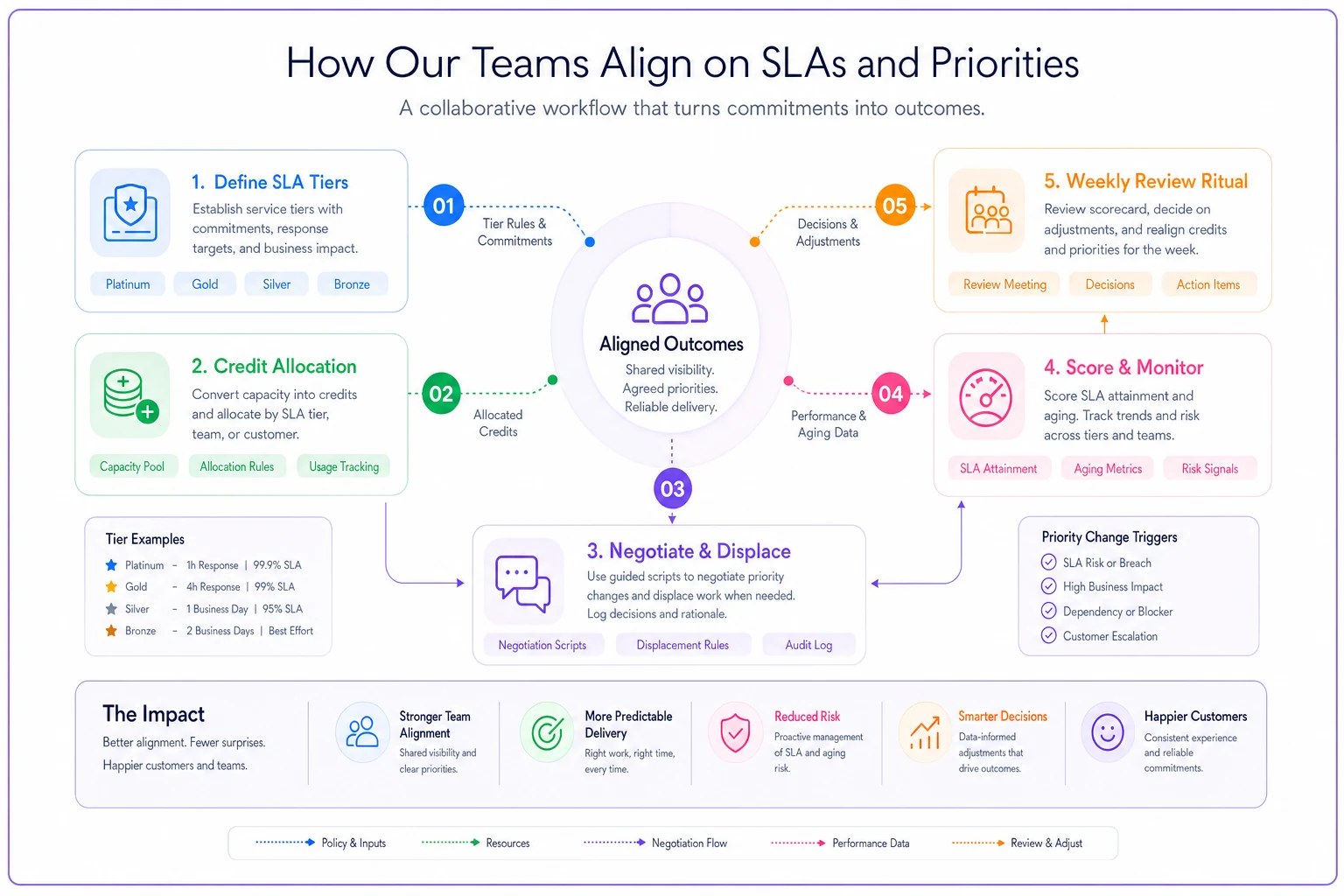
The reason these four components — tiers, credit models, scripts, and the review ritual — belong in one strategy is that none of them works alone. Tiers without credits don't curb demand. Credits without scripts collapse the first time someone senior pushes. Scripts without a scorecard become a he-said-she-said about who promised what. And all of it drifts back to chaos without a weekly ritual forcing decisions into the open.
What you're really building isn't a bureaucracy. It's a way to move prioritization out of one person's head and into a system that stakeholders can see and participate in. Fewer arguments, not more process. When it's working, the team spends its energy on the work instead of defending the work — and stakeholders stop feeling like they're shouting into a queue, because they can see exactly where they stand and what their choices cost.
Here's a simple visual of how the workflow ties the pieces together.
Start small. Define three or four tiers, pick the lightest credit model you can get away with, write down the displacement scripts before you need them, and run the weekly review even when it feels too short to bother. The system earns its keep the first time a VP's "emergency" quietly becomes a next-sprint T1 — because the person asking finally had to choose what it was worth.
Start small. Define three or four tiers, pick the lightest credit model you can get away with, write down the displacement scripts before you need them, and run the weekly review even when it feels too short to bother. The system earns its keep the first time a VP's "emergency" quietly becomes a next-sprint T1 — because the person asking finally had to choose what it was worth.
Ready to boost your team's productivity?
Join 5,000+ teams using Workyly to streamline workflows, improve communication, and deliver projects faster.