
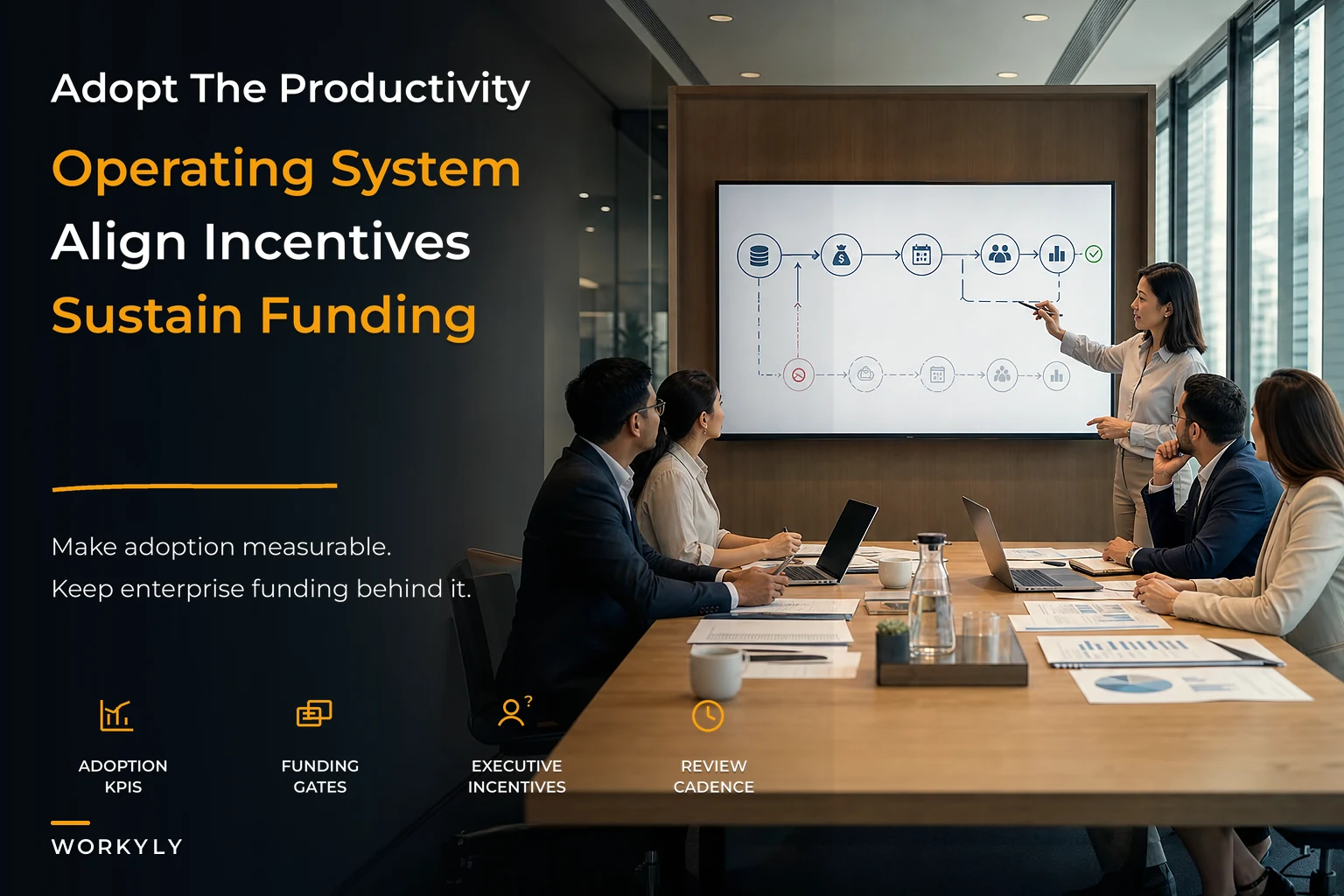

Most enterprise rollouts of a productivity OS don't fail because the software is bad. They fail because adoption gets treated as a comms problem — a few launch emails, a training webinar, maybe a Slack channel — instead of an operational system with owners, incentives, and funding that survives past the launch quarter.
The pattern is almost boringly consistent. The platform goes live, early adopters light it up, the usage dashboard looks great for about six weeks, and then the line flattens somewhere around 35–45% of licensed seats. Leadership asks why, someone blames "change fatigue," and the next tool gets bought eighteen months later to solve the same coordination problem.
This article is about the part nobody wants to own: making adoption an operational discipline with executive skin in the game, measurable KPIs tied to real contracts, and a funding model that doesn't evaporate once the launch budget is spent. If you're rolling out a shared operating system across teams — not just buying licenses — this is the layer that decides whether it sticks.
Adoption is a cross-system problem, not a training event
A productivity OS touches planning, intake, delivery tracking, reporting, and resourcing at the same time. That means adoption isn't one behavior change — it's four or five interlocking ones, each with a different owner who may or may not care about your rollout timeline.
When a VP of Engineering adopts the planning module but the PMO keeps running intake in a separate spreadsheet, you don't get partial adoption. You get negative adoption, because now people are maintaining two systems and quietly resent both. The platform becomes the thing you update after the real work happens somewhere else.
This usually happens when the rollout plan assumes behaviors are independent. They're not. If delivery teams log work in the OS but leadership still asks for status in a separate deck, those teams correctly conclude the deck is what matters. Adoption follows attention, and attention is set by whoever runs the operating cadence — which is exactly why this needs to connect to your strategy-to-execution operating model linking funding gates to team cadence. If the funding and review rhythm doesn't live inside the new system, the new system is a side project.
A clean way to think about it: adoption only compounds when the source of truth and the source of consequences are the same place. Break that link and the whole thing drifts.
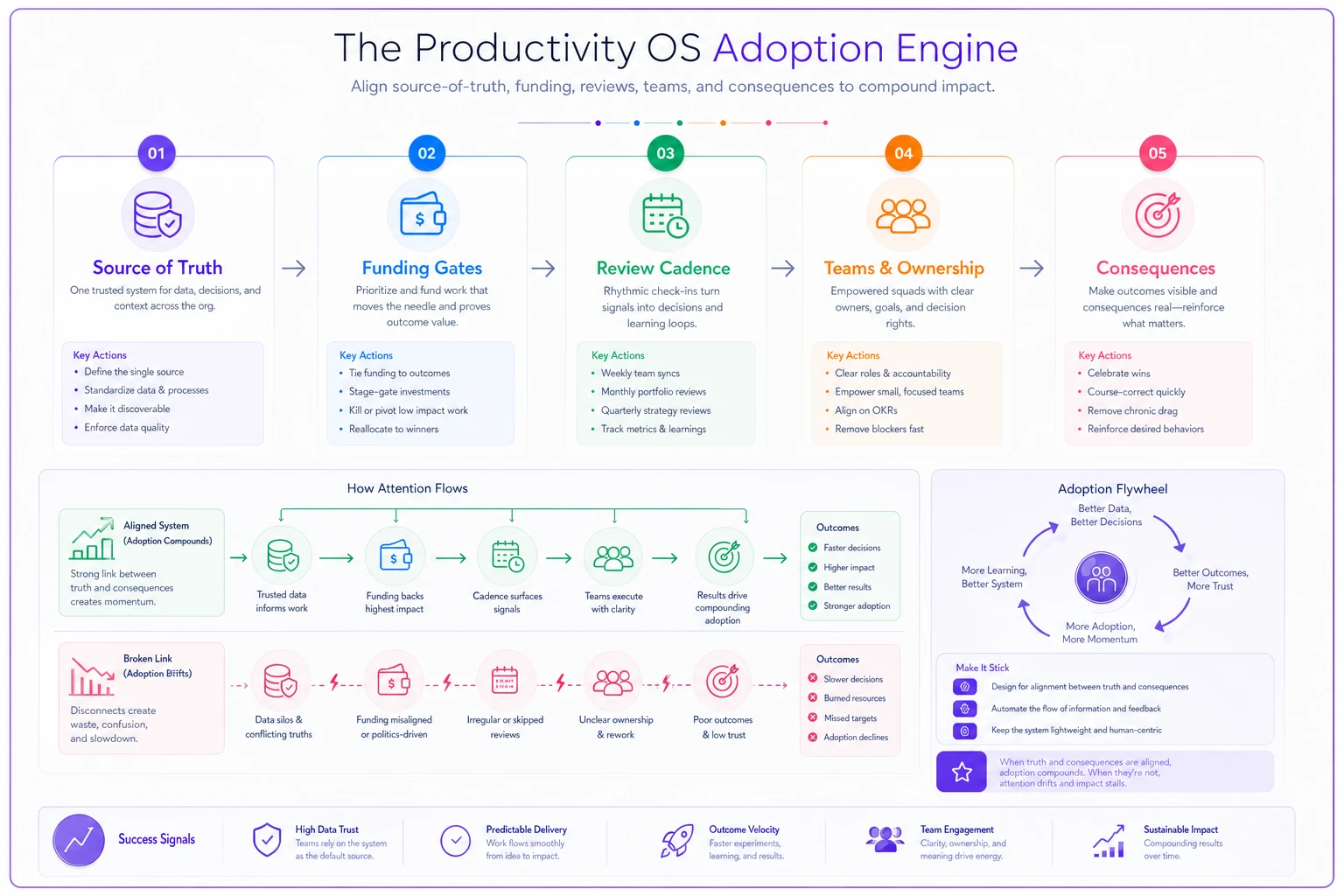
A simple visualization of this flow.
The anti-adoption failure modes you should name out loud
One of the more useful things you can do early is write down the specific ways this will fail — before it does. Naming failure modes gives teams permission to flag them without sounding like they're resisting change.
Stop losing track of your priorities.
Workyly helps you organize, assign, and track every task efficiently.
- Centralized task management
- Real-time collaboration
- Intelligent workflow automation
No credit card required
-
Shadow systems. A team keeps their old tracker "just for now." It never goes away. Six months later it's load-bearing.
-
Executive theater. Leadership endorses the tool publicly but never actually uses it, and their direct reports read that signal instantly.
-
Reporting duplication. Status gets requested in formats the OS can't produce, so people maintain parallel decks and the OS becomes data-entry overhead.
-
The power-user trap. Adoption concentrates in a few enthusiasts whose dashboards look great, masking that 70% of the org never logged in past week two.
-
Reorg amnesia. A team restructures, the champion moves on, and their part of the rollout silently reverts to old habits with nobody tracking it.
-
Incentive vacuum. Nobody's bonus, review, or team scorecard references adoption, so it's always the thing you'll do after the "real" work.
The mistake most programs make is treating these as risks to monitor rather than conditions to design against. Shadow systems don't need monitoring — they need a hard decommission date with an owner and an escalation path. If you leave the old spreadsheet accessible, you've already lost that team.
Assign a named owner and a hard decommission date to each legacy tracker to prevent shadow systems from becoming permanent.
If you leave the old spreadsheet accessible, you've already lost that team.
Put executive skin in the game — or don't bother
Adoption programs without executive incentives are just wishlists. If a leader's quarterly objectives don't reference the operating system, they'll optimize for whatever does appear in their review, and so will everyone who reports to them.
What actually works is attaching adoption to executive performance contracts in a way that's specific and measurable — not "support the rollout" but "80% of your org's active projects tracked in the OS by end of Q2, with status reviews run from the platform, not from external decks."
Across enterprise rollouts, the number matters less than who owns it and whether it's visible in the same room where their other commitments get reviewed. A soft target a leader owns publicly beats a hard target nobody's name is attached to.
A practical structure for tiering executive commitments:
| Role | Adoption commitment | How it's measured | Review cadence |
|---|---|---|---|
| Function head (VP) | Team operates planning + delivery in the OS | % active work tracked; reviews run from platform | Monthly ops review |
| PMO / Program lead | Intake and portfolio reporting fully migrated | Zero external status decks; dashboard is source | Bi-weekly |
| Team lead / Manager | Daily/weekly team cadence runs in-platform | Active-user %, cadence events logged | Weekly team review |
| Executive sponsor | Removes shadow systems, funds sustainment | Decommission milestones hit; budget secured | Quarterly steering |
The point isn't the exact rows — your org will differ. It's that every tier has a named owner, a number, and a place where that number is looked at. Adoption dies in the gap between "everyone's responsible" and "no one specifically."
Measurable adoption KPIs that don't lie to you
Login counts and license utilization are the vanity metrics of adoption. A seat can be "active" because someone opened the app once to close a notification. If you steer by raw active-user percentages, you'll declare victory while the real work still lives in email.
Better adoption KPIs measure whether the operational behavior actually moved into the platform:
-
Source-of-truth coverage — what percentage of active projects have their real status in the OS, verified by spot-checking against what leadership actually reviews.
-
Cadence-in-platform rate — how many recurring reviews, standups, and planning sessions are run from the system versus from external artifacts.
-
Intake capture rate — share of new work that enters through the platform's intake rather than side channels like DMs or hallway asks.
-
Decision traceability — whether decisions and their consequences (funding, reprioritization) are recorded where the work lives.
-
Reporting consolidation — the number of parallel status decks still in circulation, which should be trending to zero.
-
Sustained return rate — of people active in month one, how many are still active in month three. This catches the launch-spike illusion.
Lagging adoption metrics (coverage, consolidation) tell you if the rollout worked. Leading metrics (intake capture, return rate) tell you early if it's about to fail. Track both, and set a decision threshold for each. If sustained return rate drops below roughly 60% by month three for a given team, that's not a nudge-email situation — that's a trigger to investigate shadow systems or missing incentives before the quarter closes.
One caution: don't instrument twelve KPIs. Pick three or four that map to your biggest failure modes and review them consistently. Programs that drown in adoption dashboards usually stop looking at any of them.
Fund the sustainment, not just the launch
The most common structural mistake is treating adoption as a project with an end date. Launch budgets fund training, a rollout team, maybe a few months of hand-holding. Then the budget zeroes out, the rollout team disbands, and there's no one whose job is keeping the system healthy a year later.
Sustainment needs its own line item. Not huge — but named, owned, and recurring. A realistic sustainment model covers:
-
A fractional owner (often 10–20% of a PMO or ops role) who watches the adoption KPIs and runs quarterly health checks.
-
A small budget for ongoing enablement — not one-time training, but onboarding for new hires and refreshers after reorgs.
-
A decommission and migration reserve, because killing shadow systems always takes more effort than anyone estimates.
-
A feedback loop that turns friction into prioritized fixes. This is where tying adoption into an organizational learning system that turns experiments into fundable work pays off — adoption friction becomes documented, fundable improvement instead of grumbling.
A simple sustainment funding approach: tie a fixed percentage of the original platform budget — somewhere in the 8–12% range annually — to adoption sustainment, approved as a standing cost rather than re-justified every cycle. The moment sustainment has to re-fight for budget each quarter, it loses, because it's never the loudest priority in the room.
A real scenario: the 44% plateau
A mid-sized product org — around 180 people across engineering, product, and ops — rolled out a shared productivity OS to replace a tangle of spreadsheets and a legacy ticketing tool. Launch went well. By week six, active usage sat at a comfortable-looking 44% and leadership was ready to call it done.
The problem surfaced in the quarterly review. Three of five function heads were still presenting status from their own decks, built from spreadsheets maintained alongside the new system. Teams were double-entering. The 44% was mostly power users and the PMO.
What fixed it wasn't more training. It was two operational moves. First, each function head got an explicit adoption line in their quarterly objectives: run your ops review from the platform, no external decks, by end of next quarter. Second, the old shared drive folders holding the parallel trackers got a hard decommission date with the exec sponsor's name on it.
Within about ten weeks, source-of-truth coverage climbed from roughly 40% to the low 80s. Not because people suddenly loved the tool, but because the external decks stopped being an option and the review — the place consequences happened — now lived in the system. Sustained return rate at month three landed near 75%, well above the launch-spike pattern they'd have seen otherwise.
Adoption moved when attention and consequences moved. Everything before that was decoration.
When this level of rigor makes sense — and when it doesn't
This is heavy machinery. Executive performance contracts, sustainment budgets, named failure modes — it's overkill for a ten-person team rolling out a shared board. For a small, co-located group, adoption is mostly solved by one person insisting on it and everyone sitting close enough to notice.
When it makes sense: multi-team or multi-function rollouts, anywhere you've got competing existing systems, and any org large enough that leadership can't personally see whether teams are using the thing. The bigger the organization and the more parallel systems in play, the more adoption needs to be engineered rather than encouraged.
When it's a bad idea: if you haven't actually standardized on the operating model yet. Forcing adoption KPIs onto a system people don't agree on generates compliance theater. Get the operating model and phased rollout right first — the phased blueprint for a team productivity operating system covers that groundwork — and layer adoption incentives on top of a system that already works, not one you're hoping will.
Who should not do this: organizations mid-reorg or with unstable leadership. Adoption contracts assume the executives signing them will be around to be held to them. If your leadership bench is shuffling every quarter, build the sustainment layer first and hold the performance-contract piece until the org stops moving under you.
Pulling it together
The uncomfortable truth about enterprise adoption is that it's an organizational design problem wearing a software costume. The tool is almost never the bottleneck. The bottleneck is whether attention, consequences, incentives, and funding all point at the same system — and whether someone owns keeping them pointed there after the launch excitement fades.
Name your failure modes before they happen. Give executives real, measurable commitments that show up where their other commitments get reviewed. Instrument the behaviors that actually matter, not the ones that are easy to count. Fund the boring sustainment work as a standing cost, because the rollout that gets re-justified every quarter is the rollout that eventually loses.
Do that, and your productivity OS stops being the thing people update after the real work — and becomes the place the real work happens.
Ready to boost your team's productivity?
Join 5,000+ teams using Workyly to streamline workflows, improve communication, and deliver projects faster.