


There's a specific kind of dysfunction that shows up once a company crosses maybe 40 or 50 people, and it almost never gets named correctly. People blame it on "slow decision-making" or "too many meetings," and then try to fix it with a values poster about "bias toward action." That never works, because the problem isn't cultural. It's structural. Nobody wrote down who is allowed to decide what, at what dollar amount, by when — and what happens automatically when that clock runs out.
That's the whole thing. Decision-rights architecture funding is just the practice of mapping types of decisions to funding thresholds, named ownership, and time-bound escalation paths. When it's missing, you don't get chaos exactly. You get something quieter and more expensive: a fog where every decision feels like it needs three more people's approval, and nobody's quite sure whose call it is, so the safe move is to wait.
Here's how this system actually works, where it breaks, and what a real wiring layer looks like when it's done right.
The default state: decisions route by anxiety, not by rules
You'll see this pattern almost everywhere before anyone builds explicit decision rights.
A decision comes up — say, a team wants to switch a vendor mid-project, which carries a $22k switching cost. There's no rule that says "switching costs under $25k are the delivery lead's call." So the delivery lead does the natural human thing: routes it upward to avoid getting blamed later. The manager doesn't want to own it either, so it goes to the director. The director wants finance to weigh in. Finance wants it in the next monthly review. Now a two-day decision is a five-week decision, and the vendor deadline passed somewhere in week three.
Nobody did anything wrong. That's what makes it insidious. Every person made a locally rational choice to protect themselves. The system had no rule that let a decision stop climbing.
This usually happens because thresholds and ownership live in people's heads, not in a shared artifact. Someone "knows" that Priya usually approves marketing spend, but there's no written line, no dollar cap, no fallback if Priya's out. So the org runs on tribal memory, and tribal memory doesn't scale past the number of people who share the same lunch table.
The deeper issue: when there's no explicit right to decide, the default is escalation. And escalation feels responsible while quietly being the most expensive routing choice available.
What actually breaks as you scale
Small teams get away with fuzzy decision rights because everyone's in the room. The founder decides, or the two leads hash it out over coffee. The wiring is invisible because the graph is tiny.
Stop losing track of your priorities.
Workyly helps you organize, assign, and track every task efficiently.
- Centralized task management
- Real-time collaboration
- Intelligent workflow automation
No credit card required
Then you add layers, and three things break at once.
1. Threshold ambiguity compounds. At 15 people, maybe five decision types matter. At 80 people, you've got procurement, hiring backfills, scope changes, discount approvals, security exceptions, tooling purchases — each with its own natural dollar or risk boundary. If none of them are written, every one of them defaults to "ask up." Your senior people become full-time approval routers.
2. Ownership goes ambiguous under load. When work is calm, "who owns this" resolves itself. Under pressure — a launch slipping, a customer escalation, a budget freeze — everyone assumes someone else has it. This is where a RACI-lite model matters, and I mean lite: one Accountable, a couple Consulted, everyone else Informed. Heavy RACI matrices die in a drawer. What survives is a single line per decision type that says "this person decides, these people get a say, everyone else finds out after."
3. Escalation has no clock. Without a service-level agreement on the decision itself, "escalated" is just a fancy word for "parked." The decision sits in someone's inbox with no deadline and no defined fallback. What breaks isn't the decision — it's the silence around it. Nobody knows it's stuck until a delivery date is on fire.
The pattern across growing companies is remarkably consistent: the org adds people faster than it adds rules about who those people are allowed to be. Headcount grows linearly; decision ambiguity grows closer to exponentially, because every new node adds new possible routing paths.
The wiring layer: four things every decision type needs
A working decision-rights architecture isn't a policy document. It's a small, boring lookup table that answers four questions for each type of decision. Get these four columns filled in and most of the fog burns off.
| Decision type | Funding threshold (who owns which range) | Accountable owner (RACI-lite) | Escalation SLA + revert path |
|---|---|---|---|
| Vendor switch mid-project | < $25k: delivery lead / $25k–$75k: dept head / > $75k: VP + finance | Delivery lead accountable; finance consulted | 48h to decide, else auto-escalates one level; revert = stay on current vendor |
| Scope change | < 3 dev-days: team lead / 3–10 days: PM / > 10 days: steering group | PM accountable; eng lead consulted | 72h; revert = original scope holds |
| Discount / pricing exception | < 10%: AE / 10–20%: sales manager / > 20%: RevOps + finance | Sales manager accountable | 24h (deal risk); revert = list price |
| Security exception | Any: security lead decides, no dollar bypass | Security lead accountable; no revert without re-review | 24h; revert = exception denied by default |
| Tooling / SaaS purchase | < $2k: manager / $2k–$15k: dept head / > $15k: finance gate | Requesting manager accountable | 5 business days; revert = no purchase |
Make the revert path boring and specific so the default is unambiguous.
Two things worth noticing here.
First, the funding thresholds do the heaviest lifting. A dollar amount is unambiguous. "$25k" doesn't require judgment about seniority or office politics — it just routes. This is why linking funding to decision rights works so well: money is the cleanest possible sorting key, and it removes the "should I bother them?" hesitation entirely.
Second, the revert path is non-negotiable and specific. Every escalation SLA has a defined default that fires if the clock runs out. Not "revisit later" — an actual fallback state the system snaps back to. For scope changes, the revert is "original scope holds." For pricing, it's "list price." The revert path is what makes the SLA real. Otherwise "48 hours" is just a suggestion.
The failure modes, named
Once you start wiring this, you'll hit predictable ways it goes wrong.
-
The heavy-matrix trap. Someone builds a 12-column RACI with "Responsible," "Consulted," "Informed," "Supporting," and a legend. It's beautiful and nobody uses it. Keep it to one accountable owner and a short consulted list.
-
Thresholds set by ego, not risk. VPs sometimes lowball everyone's authority to keep control ("nothing over $5k without me"). This just recreates the bottleneck at the top and signals distrust. Set thresholds to the level of reversibility and blast radius, not to how nervous the exec is.
-
SLAs with no teeth. A 48-hour SLA that nobody tracks is decoration. The clock has to be visible, and the auto-escalation has to actually fire.
-
No revert = permanent limbo. Decisions that stall without a defined fallback don't resolve — they rot. The revert path is the safety valve.
-
One-size thresholds across teams. A $10k call means something different for a 4-person team than a 40-person division. Thresholds should scale with the unit's normal operating budget.
The connective tissue here overlaps a lot with how you handle cross-team dependencies. If you're standing up escalation lanes and ownership at the same time, the modular blueprint for cross-team dependency governance covers the RACI-lite and escalation-lane mechanics in more depth, and the two systems share the same spine.
How to actually build it (a process, not a policy)
Don't roll this out in a big-bang policy memo. Build it incrementally, starting with the decisions that hurt most.
-
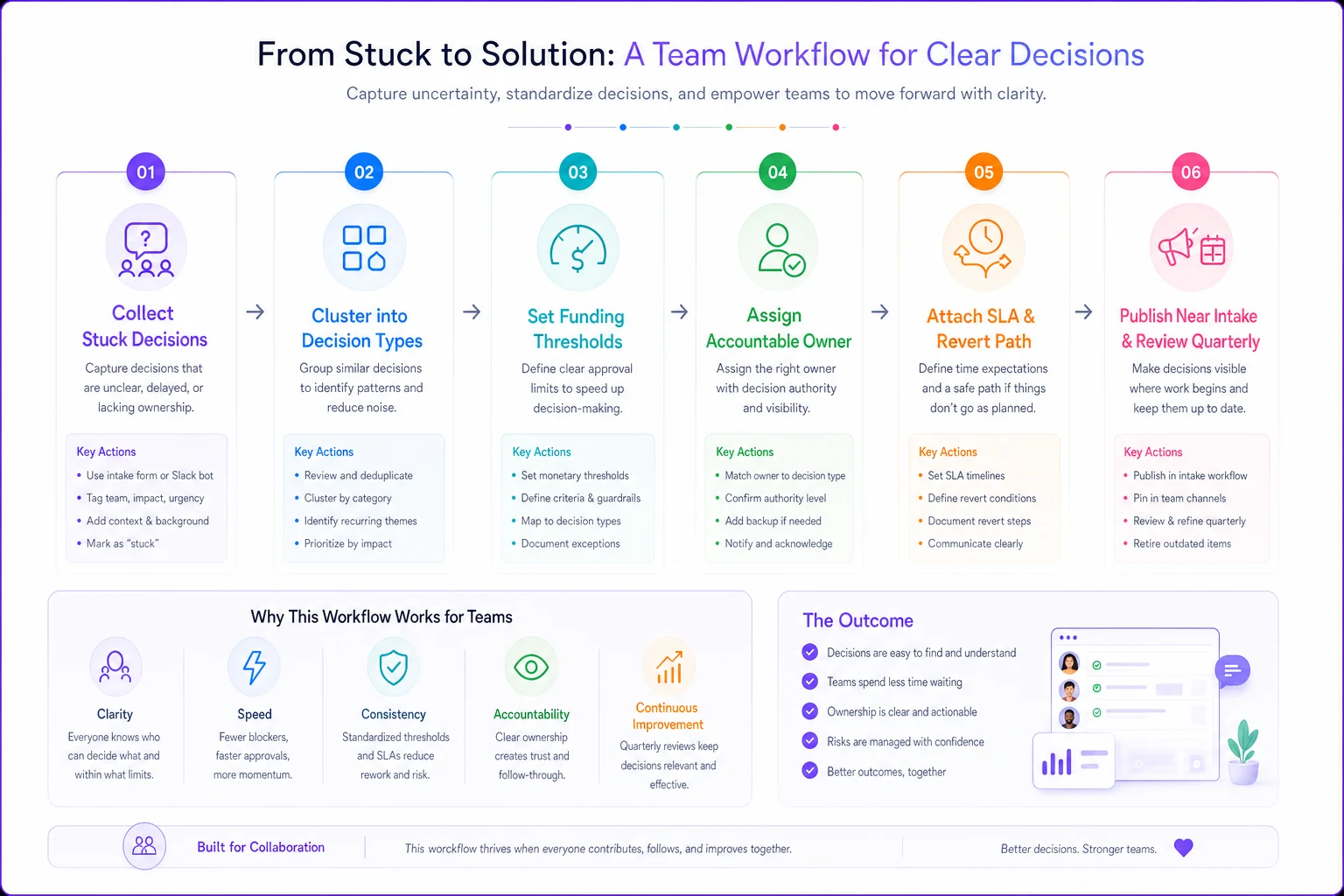
Pull the last 20 stuck decisions. Not hypotheticals — real ones from the last quarter that waited too long or bounced around. These reveal your actual pain, not your imagined pain.
-
Cluster them into types. You'll usually find 6–10 recurring decision types cover the vast majority of what stalls. Vendor changes, scope changes, spend approvals, exceptions. Don't try to enumerate every possible decision — go for the repeat offenders.
-
Set funding thresholds by reversibility, not seniority. For each type, ask: how expensive is it to undo? Cheap-to-reverse decisions get low thresholds and junior owners. Hard-to-reverse ones climb.
-
Assign one accountable owner per type. Add a short consulted list if genuinely needed. Resist the urge to consult everyone — every name you add is a delay you're building in.
-
Attach an SLA and a revert path to each. Time to decide, what happens at expiry, and the exact default state. Make the revert boring and specific.
-
Publish it where the work happens. Not in a wiki nobody opens. Next to the intake form, in the project template, wherever the decision actually gets raised.
-
Review the wiring quarterly against fresh stuck-decision data. The thresholds that made sense at 40 people will strangle you at 100.
A simple workflow diagram can make the steps clearer.
For the broader operating context — how these decision gates connect to funding cadence and team rhythm — the strategy-to-execution operating model linking funding gates to team cadence lays out how the funding side and the execution side stay in sync.
Where automation earns its place (and where it doesn't)
Where automation earns its place (and where it doesn't
The part people get wrong: they think automation makes the decisions. It shouldn't. The judgment stays human. What automation is genuinely good at is the bookkeeping around decisions — the surfacing, the clock-watching, the routing, the revert-triggering.
The mechanical work worth automating:
-
Surfacing outstanding decisions. A running list of what's been raised, who owns it, and how long it's been sitting. The single most common reason decisions stall is that nobody realizes they're stalled.
-
Routing by threshold. When a request comes in tagged with a dollar amount, the system already knows whether it's the team lead's call or needs to climb. No human router required.
-
Firing the escalation SLA. The clock runs on its own. At 48 hours with no decision logged, it auto-escalates one level and pings the next owner. No one has to remember to check.
-
Enforcing the revert path. If the SLA fully expires, the system logs the default state that took effect and notifies everyone. The fallback becomes a recorded event, not silent limbo.
That's the boundary. AI-assisted workflow platforms handle the drip of "this decision is 30 hours old and unowned" so your people aren't doing that tracking manually — but the decision itself stays with the accountable human. When automation starts trying to make the call, you've overshot, and you'll lose trust in the whole system fast.
The decision records that come out of this are worth treating as first-class operational artifacts, not disposable Slack threads. The lifecycle patterns in decision hygiene at scale go deep on linking those records to funding, monitoring, and rollback triggers — which is exactly what makes a revert path auditable later.
A real scenario: the mid-size agency drowning in approvals
A creative agency, around 60 people, three delivery pods. Their problem wasn't dramatic — it was slow bleed. Every scope change, vendor swap, and freelancer hire routed to one of two directors, because that's just how it had always worked. The directors spent a meaningful chunk of each week approving things they had no real opinion on.
The cost showed up in two places. Delivery slipped — decisions averaged somewhere around 6–9 days to resolve, and a few high-value client changes stalled long enough that the client noticed. And one stalled vendor decision cost roughly $18k in rush fees because the switch got approved too late to use the cheaper option.
They didn't restructure anything. They just wired the top five decision types. Freelancer hires under about $5k became the pod lead's call. Scope changes under three days became the PM's call. Vendor switches under $25k dropped to the delivery lead with finance merely consulted. Each got a 48–72 hour SLA and a written revert.
Within a couple of months, average decision time on those types dropped to under two days — most resolved same-day, because the owner now knew it was their call and stopped kicking it upstairs. The directors got back roughly a day a week each. And the rush fees mostly disappeared, because the SLA forced the clock before deadlines got tight.
Nothing about the people changed. The wiring changed.
When this makes sense — and when it doesn't
When it's worth building: You've crossed the point where one exec can't personally touch every meaningful call, decisions are visibly stalling, and your senior people spend real time being approval routers instead of doing their actual jobs. Usually somewhere past 30–40 people, or earlier if you're in a high-decision-volume business.
When it's premature: You're a 10-person team where everyone's in the same channel and decisions resolve in hours. Formalizing decision rights here adds bureaucracy to a system that's already working. Don't wire what isn't broken.
Who should NOT do this: Leaders who want the appearance of delegation without actually giving up control. If you build the table but then quietly override every threshold and pull decisions back up, you've made things worse — now people have written rules and the knowledge that the rules don't hold. Delegation you don't honor is worse than no delegation, because it teaches everyone the system is theater.
The point most teams miss
The instinct when decisions slow down is to add process — more reviews, more sign-offs, more meetings to "align." That's the opposite of what's needed. Slow decisions are almost never a shortage of oversight. They're a shortage of permission — clear, written, dollar-anchored permission to decide at the level where the information actually lives.
A decision-rights architecture built on funding thresholds does one thing well: it pushes each decision down to the lowest level where someone has both the context and the authority, and puts a clock on everything so nothing rots in silence. The thresholds route it. The RACI-lite line owns it. The SLA times it. The revert path catches it if the clock runs out.
Build the boring table. Wire the five decisions that hurt most. Put a clock and a fallback on each. You'll be surprised how much of your "we're just slow" problem was never about speed at all — it was about nobody being sure they were allowed to move.
The instinct when decisions slow down is to add process — more reviews, more sign-offs, more meetings to "align." That's the opposite of what's needed. Slow decisions are almost never a shortage of oversight. They're a shortage of permission — clear, written, dollar-anchored permission to decide at the level where the information actually lives.
Ready to boost your team's productivity?
Join 5,000+ teams using Workyly to streamline workflows, improve communication, and deliver projects faster.