


Most teams can tell you exactly what tickets are open. Almost none can tell you why they chose the approach they're currently building. The reasoning lives in a Slack thread that scrolled away three months ago, or in the head of someone who left in Q2, or in a meeting half the team wasn't even in. And then somebody asks "wait, why did we do it this way?" and the whole room goes quiet.
That gap — between the work and the reasoning behind it — is one of the quietest, most expensive failures in operations. It doesn't crash anything. It just slowly makes your team dumber over time, because every decision has to be re-litigated, re-discovered, or remade from scratch.
Decision records for teams fix this, but not the way most people expect. This isn't about writing more documentation nobody reads. It's about treating decisions as operational artifacts — things with owners, linked tickets, retention rules, and review cadences — the same way you already treat code, tickets, and releases.
The real problem isn't "we don't document decisions"
Plenty of teams do write decisions down. The problem is where and how.
A typical example: a team debates two vendor integrations, picks one in a 40-minute call, and someone drops a two-line summary in a project channel. Six weeks later the integration is causing problems. Nobody remembers the constraints that made it the "right" call. Was it price? A deadline? A compliance requirement that no longer applies? The decision is technically "recorded," but it's not usable.
-
What was actually decided (not the discussion — the outcome)
-
What options were rejected and why
-
What assumptions or constraints drove it
-
Who owns it and who signed off
-
What would make you reverse it
That last one is the piece almost everyone skips, and it's arguably the most valuable part. A decision with no reversal condition is a decision you're stuck defending forever, even after the world changes underneath it.
Why this breaks everywhere, across basically every team
The reason decision records fail isn't laziness. It's that the effort of writing them lands on one person at the worst possible time — right when they're trying to move on to actual work.
Stop losing track of your priorities.
Workyly helps you organize, assign, and track every task efficiently.
- Centralized task management
- Real-time collaboration
- Intelligent workflow automation
No credit card required
In real operations, it usually goes like this: the decision gets made at the end of a long meeting, everyone's mentally checked out, and writing a proper record feels like homework. So it doesn't get written, or it gets written badly. Multiply that by every decision a team makes in a quarter and you've got an enormous amount of institutional knowledge quietly evaporating.
There's also a scaling dynamic most people don't notice until it's already hurting them. When a team is five people, decisions live fine in shared memory. Everyone was in the room. Everyone remembers. Building a decision-record habit at that size genuinely feels like bureaucracy — and honestly, it kind of is.
But somewhere between 15 and 40 people, the shared-memory model collapses hard. New hires have zero context. Teams split. Two groups make contradictory decisions because neither knew the other had already solved it. The cost of not having decision records goes from near-zero to genuinely painful almost overnight, and by then you're sitting on two years of undocumented choices you can never fully recover.
What a decision record should actually contain
Skip the heavyweight architecture-decision-record templates floating around unless you're an engineering org that specifically needs them. For most teams, a decision record needs to be short enough that someone will actually fill it out in under ten minutes.
Here's a template that holds up in practice:
| Field | What goes here | Why it matters |
|---|---|---|
| Decision ID + date | Short unique ref, e.g. DR-142 | Lets you link it from tickets |
| Title | One line, plain English | Findable in six months |
| Status | Proposed / Accepted / Superseded | Tells you if it's still live |
| Context | The situation forcing a choice | The part future-you forgets |
| Decision | What you're doing | The actual outcome |
| Options rejected | Alternatives + why not | Stops re-litigation |
| Owner + approvers | Named people | Accountability |
| Reversal signal | What would make this wrong | The rollback trigger |
| Linked tickets | Ticket IDs / PRs | Connects reasoning to work |
| Review date | When to revisit | Forces a cadence |
The two fields that separate a real operational artifact from a note are reversal signal and linked tickets.
Keep decision records short enough to fill out in under ten minutes so people will actually use them.
Together they turn a static record into something that participates in your workflow instead of rotting in a wiki.
Linking decisions to tickets: where it becomes operational
A decision record floating alone is trivia. A decision record wired into your ticketing system is infrastructure.
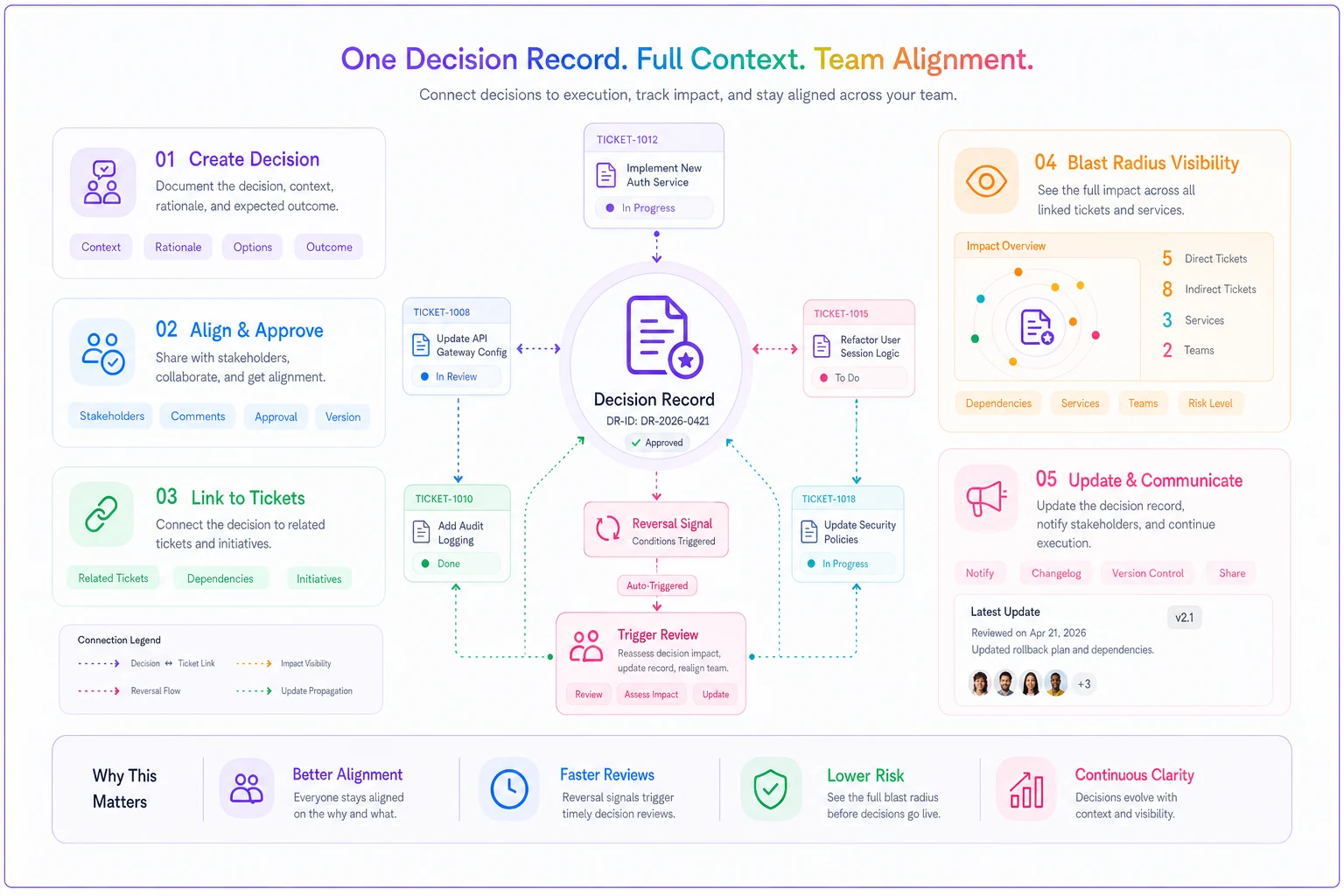
The workflow looks like this. When a decision gets made, it gets an ID. Every ticket that exists because of that decision references the ID in its description. Now anyone working the ticket can click straight through to the reasoning — the constraints, the rejected options, the reversal condition. And it runs the other direction too: from the decision record, you can see every piece of work that depends on it.
[Decision Record DR-142] | ├── Ticket #301 (references DR-142) ├── Ticket #302 (references DR-142) └── Ticket #307 (references DR-142) When reversal signal trips: DR-142 → linked tickets → blast radius visible in under a minute
That bidirectional link is what pays off later. When a reversal signal trips — a vendor jacks up pricing, a compliance rule changes, a metric goes sideways — you don't have to guess what's affected. You open the decision record, look at the linked tickets, and you have your blast radius in thirty seconds instead of a half-day archaeology dig.
Here's a quick visual of that workflow.
This is the same principle behind good cross-team dependency governance — making the invisible connections between decisions and downstream work explicit, so nobody gets blindsided when something upstream shifts.
Retention and review cadences (or: how to stop drowning in dead decisions)
Not every decision deserves to live forever, and pretending otherwise is how decision logs become unusable graveyards. You need retention rules and review cadences, or the whole system collapses under its own weight within a year.
A simple retention model that works:
-
Reversible, low-stakes decisions keep 6–12 months, then archive. Most day-to-day choices fall here.
-
Structural decisions (architecture, vendors, org processes)
keep indefinitely, review annually or on a triggered reversal signal.
-
Superseded decisions never delete — mark them
Supersededand link forward to the decision that replaced them. The trail of why we changed our minds is often more valuable than the current answer.
For review cadence, tie it to the decision's stakes, not the calendar. A quarterly sweep of active structural decisions catches the ones where the world has quietly moved. In practice, most reviews take five minutes and end with "still valid" — but the occasional one where you realize "oh, this hasn't been true since March" saves you from building on a rotten foundation.
One pattern worth stealing: bolt the review onto something you already do. Teams that fold decision reviews into their retros actually follow through, because the meeting already exists. If you've built a retrospective-to-action system, you already have the machinery — decision reviews slot in as another capture-prioritize-verify loop rather than a whole new ceremony nobody wants to attend.
A short numbered process for rolling this out
Don't launch a company-wide decision-record mandate. It'll die. Start narrow:
-
Pick one team and one decision category. Something like "tooling and vendor choices." Small enough to not overwhelm.
-
Create the template with the ten fields above. Put it wherever the team already lives — same tool as tickets if possible.
-
Set the linking rule every ticket spawned by a decision references its ID. Enforce this for exactly one month before judging it.
-
Add reversal signals to every new record. This is the muscle most teams have never built. It'll feel awkward at first.
-
Run a 30-minute review at your next retro. Check the records you made. Kill the fields nobody filled out. Keep what earned its place.
-
Then, and only then, expand to a second team or category.
The whole point is to prove value on a small surface before asking the org to change habits. This maps to the broader idea of building a team productivity operating system in phases rather than one big-bang rollout — decision records are one module in that larger system, not a standalone silver bullet.
A real scenario
A roughly 25-person software services company kept running into the same wall: clients would ask why a project was architected a certain way, and the engineers who'd made the call had rotated onto other accounts. Every answer required pulling two or three people off current work to reconstruct reasoning from old Slack threads. They estimated this "decision archaeology" was eating somewhere around 6–8 hours a week across the team, once you added up all the little interruptions.
They started small — decision records for architecture and vendor choices only, linked to existing tickets, with a reversal signal on each. No fancy tooling. Just the template and a linking rule.
Three months in, the archaeology time dropped to roughly an hour a week. The bigger surprise was onboarding: a new engineer mentioned the decision log got them productive on a legacy account about a week faster than the previous norm, because they could read why things were built the way they were rather than just what they were. Not a dramatic revenue story — but a quiet, compounding recovery of time and context that had been leaking out for years.
Where automation earns its place (and where it doesn't)
Once decision records are linked to tickets, a few things become worth automating — lightly. Reversal signals that map to metrics can trigger a review automatically: if the number a decision depended on crosses a threshold, the linked record gets flagged. Review-date reminders can fire on their own so nobody has to babysit the cadence. When a decision is marked Superseded, the system can nudge you to check its linked tickets for orphaned work.
That's a sensible ceiling. The temptation is to over-engineer this into some elaborate system that generates decision records automatically from meeting transcripts. Resist it. A decision record's value comes from a human deciding what actually mattered — the constraint, the rejected option, the reversal condition. Automation is good at reminding, linking, and flagging. It's bad at judgment, and decisions are pure judgment.
When this makes sense — and when it's overkill
Do this when:
-
Your team is past ~15 people or splitting into sub-teams
-
You've been burned by re-litigating settled decisions
-
Onboarding new people takes forever because context is tribal
-
Decisions have real downstream cost when they turn out wrong
Skip or delay this when:
-
You're a tight team of 4–6 who genuinely share context daily
-
Your decisions are mostly trivial and reversible in an afternoon
-
You'd be creating the process for optics, not because anyone feels the pain
Who should NOT do this: any team that would treat it as a compliance checkbox. A decision-record habit enforced without belief becomes theater — empty templates filled out to satisfy a rule, which is worse than nothing because it looks like you have institutional memory when you don't.
The shift worth making
The change here is smaller than it sounds. You're not adding a huge new process. You're taking something your team already produces constantly — decisions — and giving it the same treatment you already give tickets and code: an owner, a status, links to related work, a retention rule, and a review cadence.
Do that consistently, and your team stops paying the same reasoning tax over and over. The context that used to leak out the moment a meeting ended starts accumulating instead — into something people can actually search, link to, and trust six months later. That's the whole point: turning your team's judgment from a disappearing conversation into an asset that compounds over time.
Do that consistently, and your team stops paying the same reasoning tax over and over. The context that used to leak out the moment a meeting ended starts accumulating instead — into something people can actually search, link to, and trust six months later. That's the whole point: turning your team's judgment from a disappearing conversation into an asset that compounds over time.
Ready to boost your team's productivity?
Join 5,000+ teams using Workyly to streamline workflows, improve communication, and deliver projects faster.