

Most organizations don't have a prioritization problem. They have a fragmentation problem that looks like a prioritization problem.
Strategy lives in a slide deck somewhere. Intake requests pile up in three or four different queues depending on which team got asked first. The market signals that should steer funding — internal capacity costs, cost of delay on competing bets, actual demand pressure from customers — live in people's heads and get surfaced only when someone shouts loud enough in a meeting. And decision records, if they exist at all, sit in a doc nobody reopens.
Then everyone wonders why it takes four meetings and two weeks to decide whether a project gets funded.
The fix isn't another prioritization framework. You probably have three already. The fix is wiring the pieces you already have into a single fabric, so that a request entering at the top produces a ranked, funded queue at the bottom — with the reasoning attached and most of the meetings gone. That's what this is about: the architecture, not the ceremony.
Why fragmentation feels like chaos even when everyone's doing their job
Each team's local system is usually fine. Support has an intake process. Engineering has a backlog. Finance has a funding cadence. Leadership has a strategy. The problem is that none of these systems talk to each other in a format the next one can consume.
A typical example looks like this. A sales lead files a feature request. It enters Support's queue as a ticket, gets a severity tag, and sits. Three weeks later a VP mentions the same customer in a QBR and now it's "strategic." Engineering hears about it from the VP, not the ticket, and spins up a quick estimate. Finance finds out when someone asks for budget mid-quarter. By the time it's funded, four different teams have touched it, nobody shares the same priority number, and the original ticket is still sitting in Support marked "open."
That's not a discipline failure. It's a translation failure. The request changed units at every boundary — from ticket to strategic ask to estimate to budget line — and lost its ranking each time.
What breaks is the connective tissue. Intake tiers don't map to funding thresholds. Decision records don't link back to the request that triggered them. The signals that should shift priority — capacity cost going up, a competing bet getting cheaper to delay — never reach the people ranking the queue. Everyone's optimizing their slice, and the whole thing still feels like a scramble.
The three layers that have to connect
Think of cross-team prioritization architecture as three layers that need a shared vocabulary, not three separate processes.
Stop losing track of your priorities.
Workyly helps you organize, assign, and track every task efficiently.
- Centralized task management
- Real-time collaboration
- Intelligent workflow automation
No credit card required
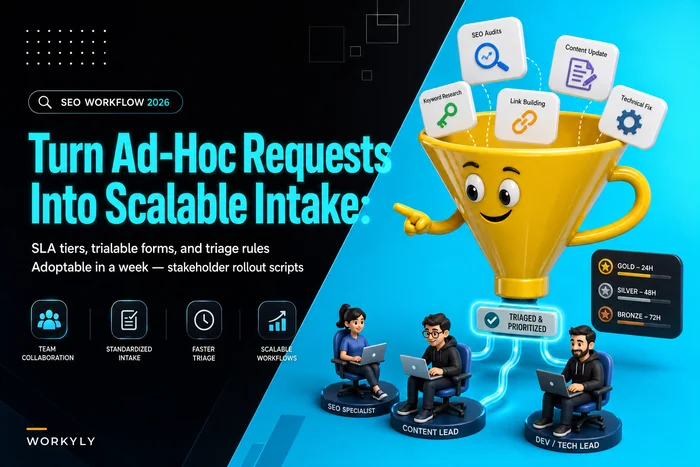
Layer 1 — Intake tiers. Every request enters somewhere. The tier it enters at should carry meaning the rest of the system can read. If you've already set up a structured scalable intake with SLA tiers and triage rules, you're ahead — the tier is the first signal. A Tier-1 request isn't just "urgent," it's a request that qualifies for a specific funding lane and a specific decision speed.
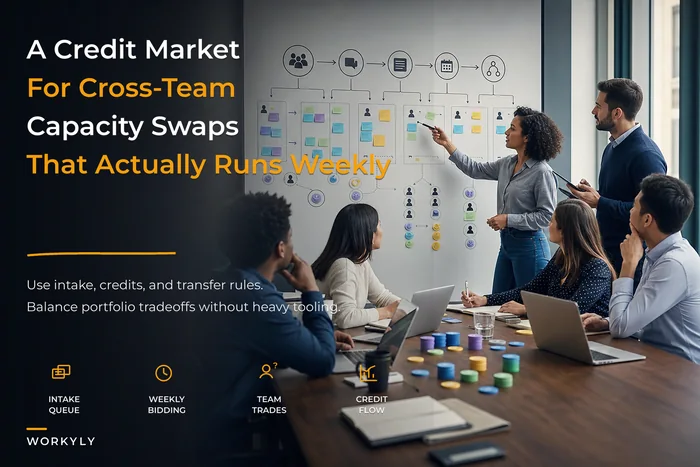
Layer 2 — Credit-market signals. This is the layer most teams skip, and it's the one that makes the whole thing work. Priority shouldn't be a static score set at intake — it should move as the cost of resources and the cost of delay move. When a team's capacity gets expensive because they're overcommitted and borrowing from three other projects, that cost should show up in the ranking. A cross-team capacity marketplace with credit-based allocation is the cleanest version of this: teams spend credits to pull work, and the price of pulling tells you something real about contention.
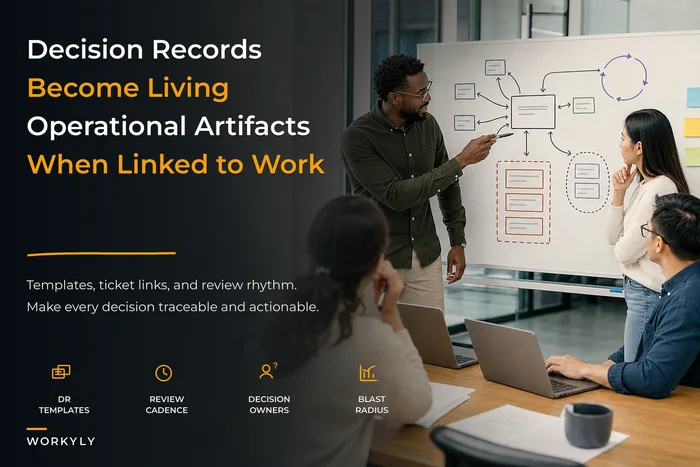
Layer 3 — Decision records. When something gets funded, declined, or deferred, that outcome has to be captured in a way that links back to the request and forward to the work. Treating decision records as operational artifacts — with linked tickets and a review cadence — is what keeps the queue from being re-litigated every month. The decision isn't a Slack message. It's a node the next request can reference.
The "fabric" is just these three layers sharing one scoring language so a request can travel from intake to funded queue without being manually re-interpreted at each handoff.
What the connection actually looks like in practice
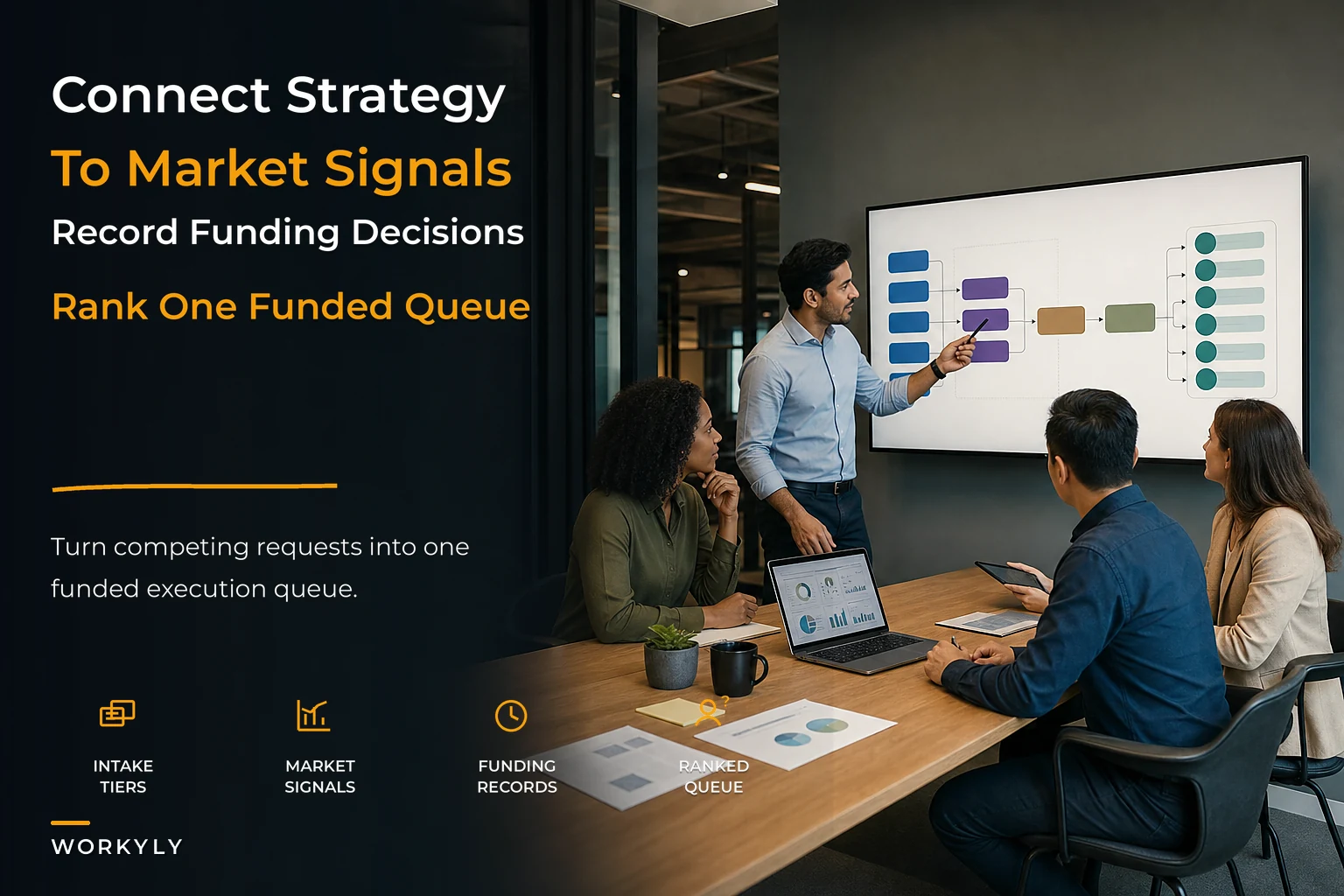
The architecture only makes sense when you see a request move through it. Here's the general flow — a request enters tiered intake, picks up market signals as conditions change, gets recorded at the funding decision, and lands in a single ranked queue.
[Request arrives] ↓ [Intake tier assigned] → sets decision deadline → sets funding lane ↓ [Market signals applied] → capacity credit cost (contested vs. available) → cost of delay vs. competing items in lane ↓ [Funding decision recorded] → score at decision time → signals that drove it → linked ticket ↓ [Single ranked, funded queue]
Here's a visual of that flow.
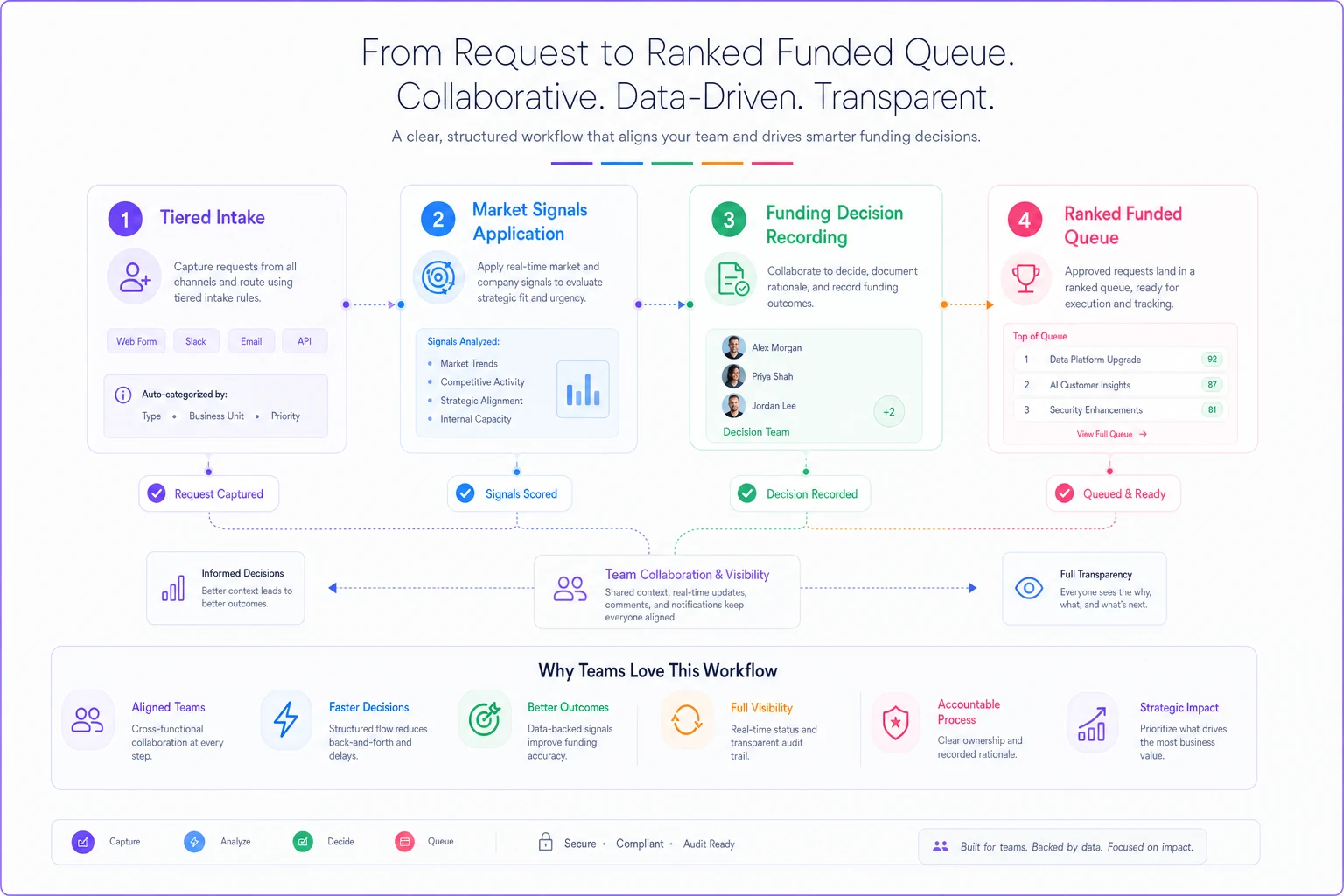
A request arrives and gets a tier at intake based on who it affects and how reversible the outcome is. That tier sets two things: the decision deadline (Tier 1 decides in 48 hours, Tier 3 can wait for the monthly batch) and the funding lane it's eligible for.
Next, the request picks up market signals. This is where most static systems fall apart — they rank once and freeze. In a connected system, the request's position moves with two inputs: the credit cost of the capacity it needs (are the required teams cheap or contested right now?), and the cost of delay relative to everything else in the lane. A request that needs a team everyone's fighting over is expensive to fund this cycle, and the fabric reflects that automatically instead of hiding it until a planning meeting blows up.
Then the funding decision gets recorded — not as a yes/no, but as a record that captures the score at the moment of decision, the signals that drove it, and the ticket it funds. That record becomes the default answer the next time someone asks "why isn't my thing getting done?" You point at the queue and the record, not at a calendar invite.
The output of all three layers is a single funded queue. One list, ranked, with reasoning attached. That's the whole point — replacing the meeting where six people argue about priority with a queue that already encodes the argument.
A comparison: scattered prioritization vs. integrated fabric
The right column is only better if your organization is big enough to feel the left column's pain.
| Dimension | Scattered (typical) | Integrated priority fabric |
|---|---|---|
| Where requests live | 3–5 separate queues | One intake, tiered at entry |
| How priority is set | Static score, set once | Moves with capacity cost + cost of delay |
| Role of meetings | Where ranking happens | Where exceptions get resolved |
| Decision visibility | Lives in someone's memory | Linked record, re-usable |
| Funding signal | Surfaces mid-quarter, by surprise | Visible in the queue continuously |
| Re-litigation | Monthly, from scratch | Rare, points to the record |
| Time to fund a mid-size bet | 1–3 weeks, several meetings | Days, often async |
Which brings up the part most frameworks skip.
When this makes sense — and when it absolutely doesn't
When it makes sense. You've got three or more teams whose work depends on each other, a steady stream of incoming requests from multiple directions, and funding decisions that regularly stall in meetings. If you're spending more time deciding what to do than doing it, the fabric pays for itself fast. The signal is usually meeting load: when prioritization needs a recurring weekly meeting plus a monthly planning offsite plus constant ad-hoc escalations, your ranking isn't encoded anywhere, so people have to re-derive it every time.
When it's a bad idea. If you're a single team of eight people who all sit in the same channel, this is massive overhead for no gain. Just talk to each other. The architecture exists to replace coordination that doesn't scale — if your coordination still fits in one conversation, don't build machinery around it.
Who should NOT do this. Organizations that haven't fixed their intake yet. If requests still arrive through random DMs and hallway conversations, building a market-signal layer on top is building a second story on sand. Get intake tiered and consistent first. Same goes for teams with no appetite for recording decisions — if leadership won't commit to writing down why something got funded, the fabric degrades back into tribal memory within a quarter.
A real scenario
A mid-sized B2B software company — around 70 people, five delivery teams — was running prioritization through a weekly "triage sync" plus a monthly funding review. Requests came in from sales, support, and two internal ops teams. Nobody could agree on priority because each source had its own urgency.
The visible symptom: the weekly sync had grown to about 90 minutes with twelve attendees, and roughly a third of funded work was getting reshuffled within the next cycle anyway. Cost-of-delay never entered the conversation — whoever presented most convincingly won.
They rebuilt the flow over about six weeks. Intake got collapsed into one tiered queue. They added a lightweight credit model so teams had to "spend" from a capacity budget to pull cross-team work, which surfaced contention nobody had been pricing. Funding decisions started getting recorded with the score and the signals attached.
The outcome wasn't dramatic in the way marketing decks promise. The weekly sync dropped to roughly 30 minutes and became an exceptions meeting — the queue handled the routine ranking. Reshuffling fell off noticeably because funded work now had a recorded rationale people could point to. The thing the lead actually cared about: the gap between "a decision is needed" and "a decision is made" went from one to two weeks down to a few days for most items, because the queue already carried the reasoning.
Not every number moved. Customer-facing cycle time barely changed at first — the architecture fixed deciding, not doing. That came later.
Building it without boiling the ocean
You don't roll this out all at once. The sequence below tends to hold up better than trying to wire all three layers simultaneously — each step creates a foundation the next one actually needs.
-
Consolidate intake to one tiered queue. Every request gets a tier at entry, and the tier sets the decision deadline. Don't move to anything else until this is stable for a few weeks.
-
Attach a cost-of-delay estimate to each tier. Rough is fine — high/medium/low works. The goal is to stop ranking by presentation volume.
-
Introduce capacity contention as a signal. Even a crude credit budget per team exposes which work is genuinely expensive to pull this cycle. This is the piece that changes behavior.
-
Record every funding decision against its request. Score, signals, funded ticket. Make it a two-minute artifact, not a document.
-
Shrink the meeting. Once the queue encodes the ranking, the recurring sync becomes an exceptions-only meeting. Protect that — it's the payoff.
A quick readiness checklist before you start:
-
Requests from all major sources can enter one place
-
You can name your intake tiers and what each one means for funding
-
You have some notion of cost-of-delay, even qualitative
-
Teams have a rough sense of their capacity ceiling
-
Leadership agrees funding decisions get written down
-
There's an owner for the queue, not a committee
If you can't check the first and last boxes, fix those before anything else. An unowned queue and scattered intake are the two failure points that kill this fastest.
The failure points to watch as you scale
A few patterns reliably break the fabric as the organization grows.
The first is tier inflation — when everything becomes Tier 1 because teams learn that's how you jump the queue. If tiers are drifting upward, they're not tied to real constraints. Tie them to funding lanes with actual limits and the inflation stops, because a tier now costs something.
Tie tiers to funding lanes with actual limits to stop tier inflation.
The second is stale signals. Capacity cost and cost-of-delay only help if they're current. A credit model that nobody updates is worse than no model, because it looks authoritative while lying. Build the refresh into an existing cadence rather than making it a separate chore.
The third, and the most common, is the shadow queue. Someone important doesn't like the ranking, so a parallel priority list grows in a VP's inbox. The moment two queues exist, the fabric is dead — because the real decisions migrate to the one with power behind it. The defense is making the official queue the only path to funding. No record, no money.
These three failure modes aren't hypothetical. They show up in roughly that order as the organization grows, and the third one is the hardest to fix because it's political, not technical.
Bringing it together
Cross-team prioritization architecture isn't about being more disciplined or running better meetings. It's about connecting three things you already have — tiered intake, real signals about capacity and delay, and recorded decisions — so that a request can travel from "someone asked for this" to "this is funded and ranked" without a human manually re-interpreting it at every boundary.
The meetings shrink because the queue carries the reasoning. Funding signals get clearer because they're visible continuously instead of surfacing by surprise. And the arguments mostly stop, because the answer to "why isn't my thing getting done" becomes a queue position and a decision record instead of a debate.
Start where your fragmentation hurts most — usually intake or decisions — and wire outward from there. The architecture earns its keep one connection at a time, not in a big launch.
Ready to boost your team's productivity?
Join 5,000+ teams using Workyly to streamline workflows, improve communication, and deliver projects faster.