

The dangerous thing about automation isn't the flow you built last week. It's the one you built fourteen months ago, that three teams now depend on, that nobody remembers configuring, running on a service account tied to someone who left in the spring.
Most orgs don't get burned by a single bad automation. They get burned by accumulation. One team wires up a Zapier flow, another builds a Google Apps Script, someone in finance schedules a nightly export, and product ships an internal bot that reassigns tickets. Individually, each one is defensible. Collectively, they form an invisible dependency graph where a change in one place silently breaks something two departments over — and nobody connects the dots for days.
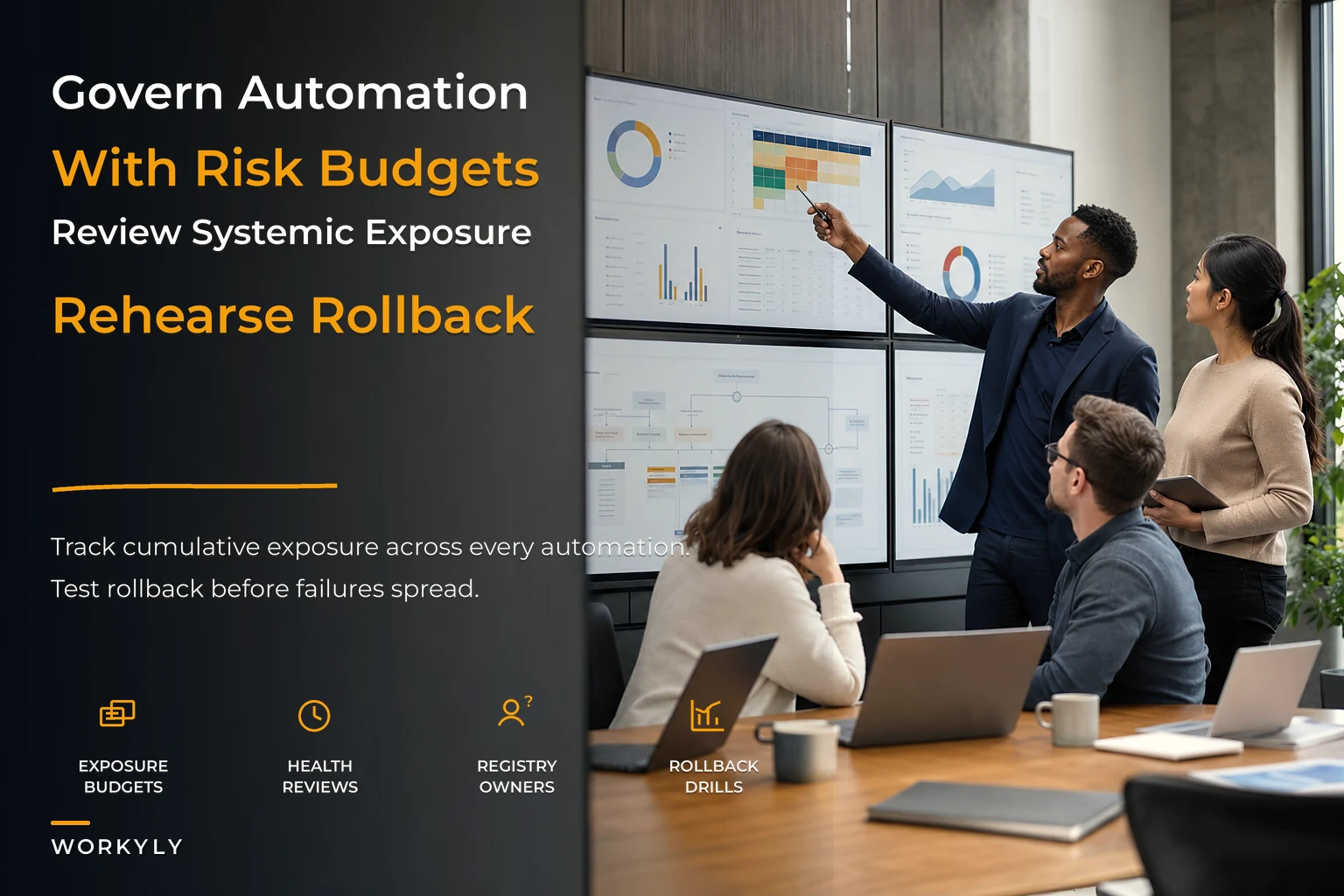
That's the actual problem with automation governance at scale. Not whether any single automation is safe, but whether you can see, measure, and unwind the combined exposure across everything running at once. Cumulative-exposure thinking, a real registry, risk budgets, and rehearsed rollback matter far more here than any individual preflight check.
Why the risk compounds instead of adding up
If you had ten automations and each had a 1% chance of causing a mess in a given month, you might assume you're looking at roughly 10% aggregate risk. In real operations it's worse, because automations aren't independent. They share credentials, read and write the same records, trigger each other, and fail in correlated ways.
A typical example: a data-sync job starts writing malformed timestamps. Minor on its own. But three downstream automations consume that field — a reporting refresh, a billing reminder, and an SLA escalation bot. Now one silent bug fans out into wrong invoices, missed escalations, and a dashboard that lies to leadership. The failure didn't add up. It multiplied.
What shows up across a lot of growing teams is that the risk curve bends upward somewhere around the 20–30 automation mark. Below that, tribal memory works — someone just knows how things connect. Past that point, the person who knows leaves, gets promoted, or simply can't hold the whole map in their head anymore. That inflection point is where governance stops being optional and becomes the thing standing between you and a bad quarter.
The mistake most orgs make is treating each automation as a project that ends at launch. It doesn't. Every live automation is a standing liability that keeps accruing risk as the systems around it quietly change.
The three failure modes that show up at scale
Before getting into the system, it helps to name what actually breaks. Systemic automation trouble at scale almost always falls into one of three buckets.
Stop losing track of your priorities.
Workyly helps you organize, assign, and track every task efficiently.
- Centralized task management
- Real-time collaboration
- Intelligent workflow automation
No credit card required
Orphaned ownership. The automation runs fine, but nobody owns it. When it breaks, there's a scramble to figure out who even built it. This is by far the most common one and the hardest to fix retroactively.
Silent drift. The automation still runs, but the assumptions it was built on quietly changed — a form field got renamed, an API version deprecated, a status value added. It doesn't error out. It just does the wrong thing, confidently, for weeks.
Blast-radius blindness. Someone changes one automation without knowing what depends on it. The change is correct in isolation and catastrophic in context.
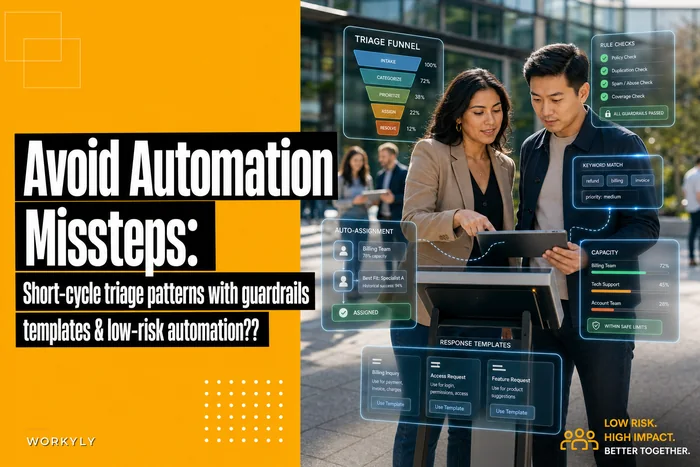
If you've read the earlier piece on avoiding automation missteps with short-cycle triage patterns, this is the org-level version of that same problem. Guardrails on a single flow protect one flow. Governance protects the interactions between all of them.
The automation registry: your single source of truth
You cannot govern what you cannot see, and almost nobody can actually see their full automation footprint. Ask a mid-sized team to list every live automation and you'll get maybe 60% of them on the first pass. The rest surface only when they break.
The registry is the foundation. It doesn't have to be fancy — a shared table works fine to start — but it has to be complete and maintained, not a one-time audit that goes stale in a month. Every automation gets a row. The columns that actually matter:
-
Name and plain-English purpose (what breaks in the business if this stops)
-
Owner — a named person, not a team
-
Systems touched — what it reads from and writes to
-
Credentials used — which account or key, so you can audit access
-
Trigger type — scheduled, event-driven, or manual
-
Risk tier — low / medium / high, based on blast radius
-
Last health review date
-
Rollback method — how you turn it off and undo its effects
That last column is the one people skip, and it's the one that saves you at 2 a.m. An automation without a documented rollback isn't an asset; it's a bet.
Keep rollback steps concise and executable from a known account so reversals are reliable under pressure.
The purpose column deserves a note. "Syncs CRM to spreadsheet" tells you nothing about consequences. "Feeds the weekly revenue report finance uses to forecast" tells you exactly how much pain a failure causes. Write the consequence, not the mechanism.
Risk budgets: deciding how much exposure you'll carry
Instead of asking "is this automation safe?" the better question is "how much total risk are we willing to run at once, and does this new one fit inside that ceiling?"
That's a risk budget. You set a cap on cumulative high-tier exposure, and new automations have to fit under it. If a team wants to launch a new high-risk automation and you're already at the ceiling, something has to be retired, downgraded, or hardened first. It forces a trade-off conversation that otherwise never happens.
| Factor | Low (1) | Medium (2) | High (3) |
|---|---|---|---|
| Blast radius | One team, internal only | Multiple teams | Customer-facing or financial |
| Reversibility | Easy undo, clear rollback | Manual cleanup needed | Hard/impossible to fully undo |
| Change frequency of dependencies | Stable systems | Occasional changes | Systems change often |
Multiply the three. An automation scoring 3×3×3 = 27 is a systemic risk that deserves scrutiny before it ships. One scoring 1×1×2 barely registers. Sum the scores across everything live and you get a single number — your total exposure — that leadership can actually reason about.
A risk budget isn't about saying no to automation. It makes the cost of new exposure visible so it competes for space against the value it creates. Teams stop treating automation as free.
When risk budgets actually make sense
This works well once you're past roughly 15–20 live automations, or the moment any automation touches money or customers. Below that, a budget is bureaucratic overhead you don't need yet — a solid registry and clear ownership will carry you fine.
When it's a bad idea
Don't impose a formal risk budget on a five-person team running six simple internal automations. You'll spend more time scoring than building, and you'll teach people that governance means friction. Governance should scale with the footprint, not ahead of it.
Periodic health reviews: catching drift before it costs you
A registry tells you what exists. Health reviews tell you whether it still works the way you think it does. Silent drift is invisible precisely because nothing alarms — so you have to go looking on a schedule.
Tie review frequency to risk tier. High-tier automations get reviewed monthly, medium quarterly, low twice a year. A health review isn't a deep audit; it's a quick verification:
-
Does it still run? Check recent execution logs for silent failures or skipped runs.
-
Does it still do the right thing? Spot-check a handful of recent outputs against expected results.
-
Do the assumptions still hold? Confirm the fields, statuses, and APIs it depends on haven't changed.
-
Is the owner still here and still the owner? Reassign anything orphaned immediately.
-
Is the rollback still valid? Re-read the documented rollback and confirm it would actually work today.
Most catastrophic automation failures were preceded by weeks of small warning signs that nobody was scheduled to notice. The health review is you scheduling someone to notice. A twenty-minute check on a high-tier automation is cheap insurance against a multi-day cleanup.
One realistic scenario: an operations team ran a nightly automation that closed out completed jobs and triggered customer follow-up emails. A downstream tool added a new "pending review" status that the automation didn't recognize, so those jobs never closed and follow-ups never sent. Nothing errored. It surfaced only when a customer complaint made someone dig in — about three weeks and an estimated few hundred missed follow-ups later. A monthly health review would've caught the mismatch on the first pass.
Rollback and playback drills: rehearse the thing you hope never happens
Everyone documents rollback. Almost nobody tests it. An untested rollback is a hypothesis, not a plan.
Rollback drills are exactly what they sound like: you deliberately practice turning off an automation and reversing its effects, on a schedule, before you need to do it under pressure. The first time a team runs one, they almost always find the documented rollback is incomplete — the toggle disables the trigger but leaves half-written records, or the "undo" script was never actually run against real data.
Playback drills go one step further. You take a known-bad input and run it through the automation in a safe environment to confirm your guardrails catch it and your rollback cleans it up. This is where you learn whether your safety net has holes before live data falls through it.
-
Quarterly for high-tier automations
full rollback rehearsal in a staging environment.
-
On every major change
a playback drill against the new version before it goes live.
-
After any incident
a rollback drill on the fixed version to confirm the repair is real.
The most valuable outcome of these drills isn't the fixed rollback script. It's the confidence to move fast. Teams that have rehearsed rollback ship automations more aggressively, because they know they can pull the cord cleanly. Teams that haven't move timidly or, worse, recklessly.
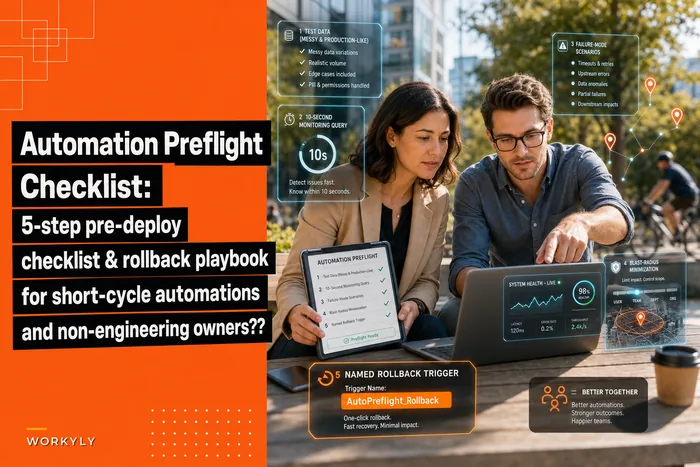
For the tactical version of this at the individual-automation level, the automation preflight checklist and rollback playbook covers the short-cycle mechanics that feed into this org-wide drill practice.
How the pieces work together as one system
None of these four components does much alone. A registry with no risk budget is just a list. A risk budget with no health reviews decays as reality drifts from your scores. Rollback drills on automations you can't find in a registry are theater.
In practice, the workflow runs like this. A new automation gets proposed. Before it ships, it's scored for exposure and checked against the current risk budget — if there's room, it proceeds; if not, the team negotiates what to retire or harden. Once live, it's entered in the registry with a named owner and a documented rollback. From there it enters the health-review rotation at a cadence matched to its risk tier. High-tier ones get periodic rollback drills. Every scored change re-checks the budget and triggers a playback drill.
Here's a simple diagram of the workflow.
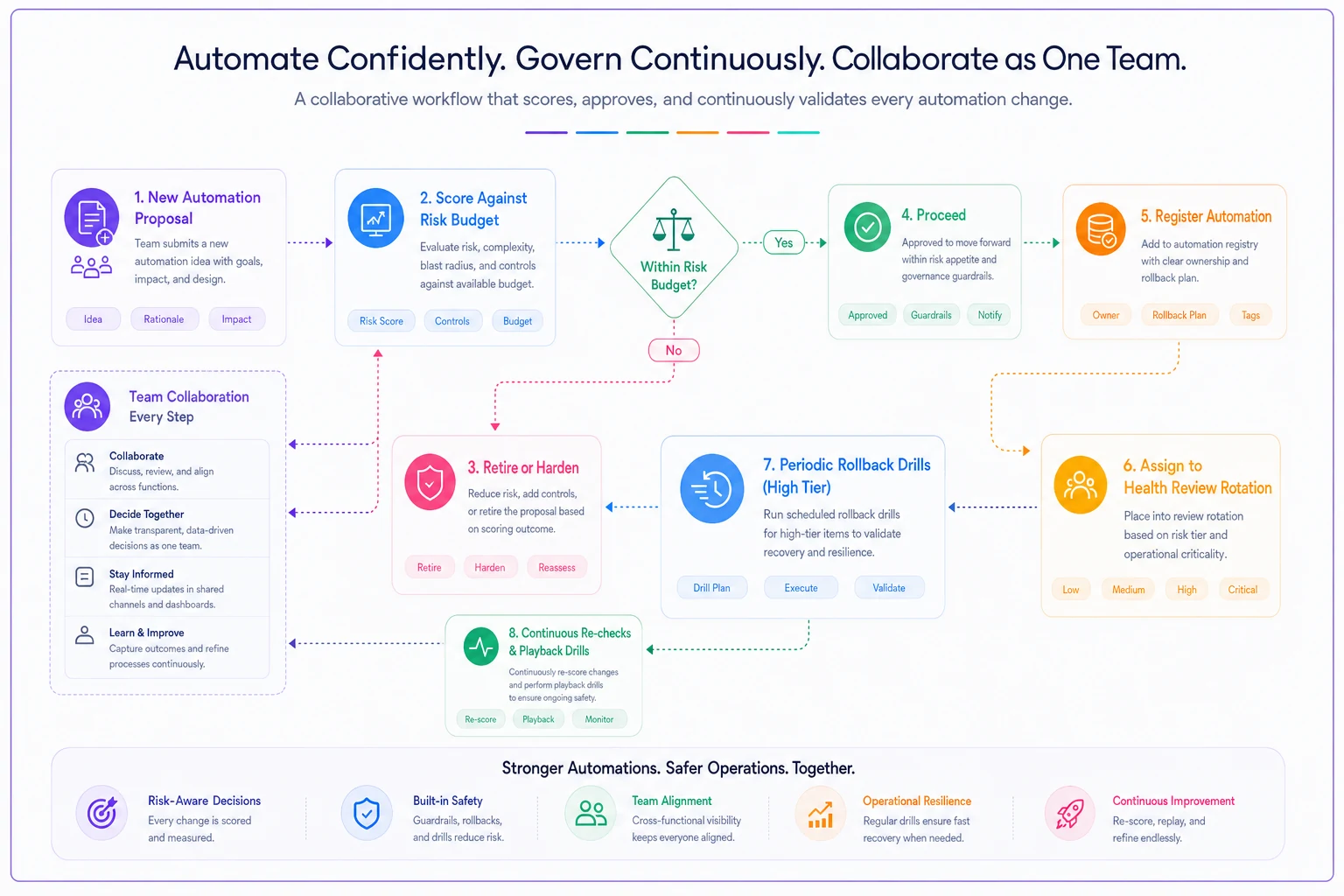
The feedback loop is the point. Exposure is measured continuously, not assumed at launch. Ownership is enforced, not hoped for. Drift is hunted on a schedule. And the ability to undo is proven, not documented and forgotten. That's the difference between an automation footprint that gets safer as it grows and one that quietly becomes a landmine field.
For non-technical owners trying to stand this up without an engineering background, the automation and AI governance framework for non-engineering owners breaks down the ownership and decision-rights side in plainer terms.
Who should not build this yet
If you're running a handful of low-stakes internal automations and everyone still knows who owns what, building a full governance apparatus will slow you down for no real gain. Start with the registry alone — just the list, kept current — and let the rest come when your footprint earns it.
The teams that genuinely need all four layers share a profile: enough automations that no single person holds the map, automations that touch money or customers, and multiple teams making changes that ripple into each other's work. If that describes you, the cost of not having cumulative-exposure controls isn't hypothetical. It's a matter of when, not if, two automations collide in a way nobody predicted.
A realistic before-and-after
Consider a services company running project and billing operations with around 25 live automations spread across ticketing, invoicing, scheduling, and internal notifications. Before governance, they had no complete inventory — the real count only became clear after they started listing things out and found six automations nobody remembered. Two ran on a former employee's credentials. Somewhere in the range of three or four billing-related failures a year, each taking a day or two to untangle, plus the slow erosion of trust in their own dashboards.
After building a registry, scoring exposure, and putting the high-tier billing automations on a monthly review with quarterly rollback drills, the picture changed in a way that felt less dramatic than expected but mattered a lot. The orphaned automations got real owners. The credential risk got closed out in the first week. Silent-drift issues started getting caught during reviews instead of during customer complaints — from discovering problems weeks late to catching most within a review cycle. Billing incidents didn't vanish, but the ones that happened got resolved in hours instead of days because rollback was already rehearsed.
Nothing about that transformation was flashy. That's kind of the point. Governance done right is quiet. The wins show up as things that didn't break, cleanups that took an hour instead of a week, and a team that trusts its own systems again.
The takeaway
Systemic automation risk isn't a technology problem you solve once. It's an accumulation problem you manage continuously — by seeing everything you run, capping how much combined exposure you'll carry, checking on schedule for the drift that never announces itself, and rehearsing the rollback you hope you'll never need.
Get those four working together and automation stops being a growing pile of hidden liabilities and starts being what it's supposed to be: leverage you can actually trust as you scale.
Systemic automation risk isn't a technology problem you solve once. It's an accumulation problem you manage continuously — by seeing everything you run, capping how much combined exposure you'll carry, checking on schedule for the drift that never announces itself, and rehearsing the rollback you hope you'll never need. Get those four working together and automation stops being a growing pile of hidden liabilities and starts being what it's supposed to be: leverage you can actually trust as you scale.
Ready to boost your team's productivity?
Join 5,000+ teams using Workyly to streamline workflows, improve communication, and deliver projects faster.