

The most dangerous phrase in vendor work isn't "we're behind." It's "it's done."
Because "done" from a vendor almost never means done from your side. It means the invoice is coming, the account manager is moving on, and whatever they shipped is now sitting in your environment waiting to blow up a sprint you already committed to internally. The gap between their definition of complete and yours is where roadmaps quietly die.
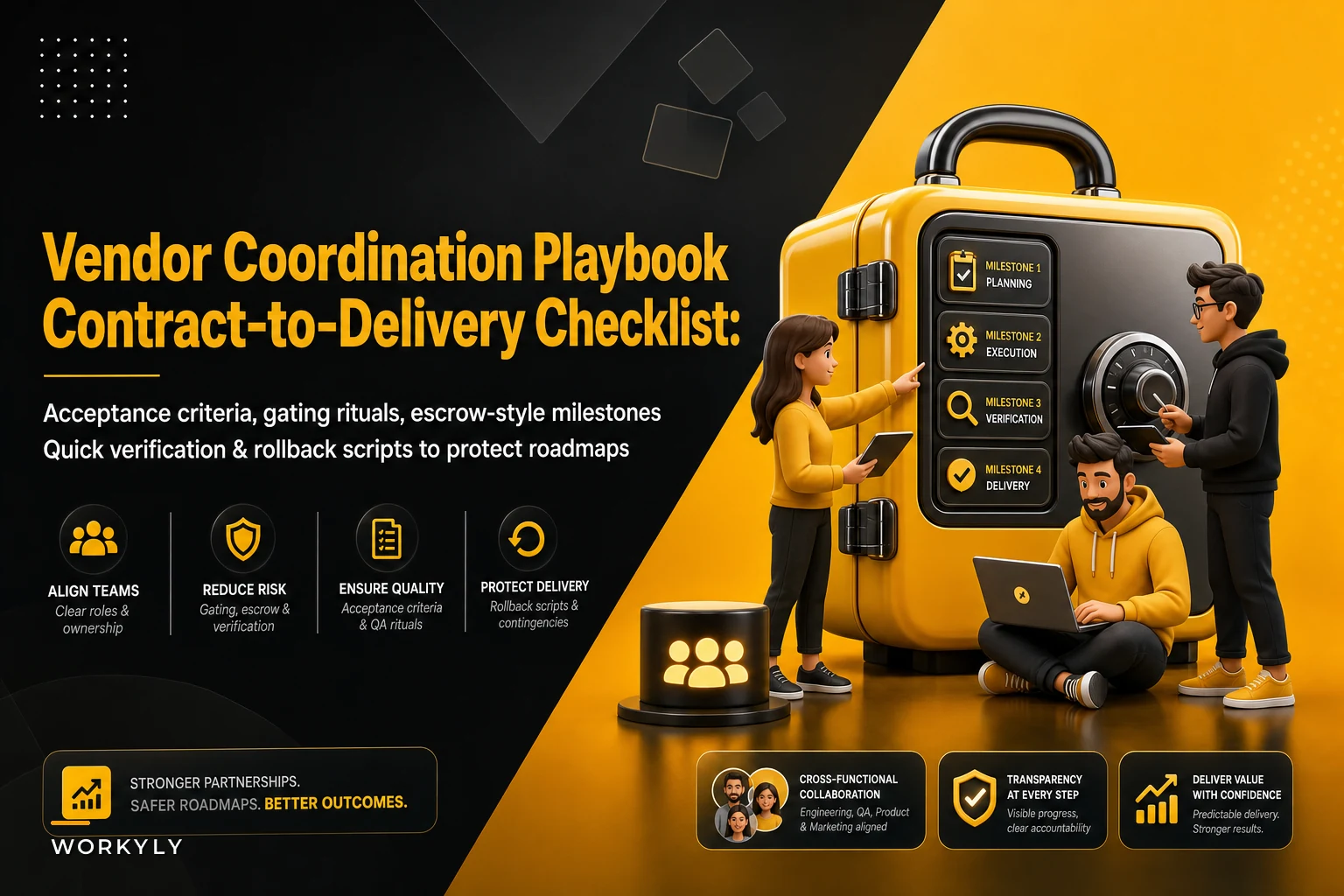
This playbook is about closing that gap — a contract-to-delivery checklist, real acceptance criteria, escrow-style milestones, and rollback rituals that let you unwind a bad delivery without torching two weeks of your own team's work. Not vendor management theory. The specific mechanics that keep a late or broken handoff from becoming your problem.
The specific failure this prevents
Worth naming precisely, because most PMs recognize the shape but never gate against it.
You sign a vendor for a defined piece of work — a data migration, an API integration, a design system, a compliance module. The contract lists deliverables. The kickoff feels good. Then somewhere around 60% through, the vendor hits something they didn't scope, their best engineer rolls onto another client, and the delivery date holds only because they quietly redefine what "delivery" means. You get a handoff that technically checks the contract boxes but fails the moment your team actually touches it.
Now you're in a bad spot. Your roadmap assumed this dependency landing clean. Two engineers are scheduled to build on top of it starting Monday. The vendor considers the work delivered and payment due. And you're holding a half-working thing with no clean way to reject it or roll back to where you were.
This almost always traces to one root cause: acceptance was never defined as a gate, only as a formality. Nobody agreed, in writing, on the specific conditions under which you could say "no, this isn't accepted" — and what happens to money, timeline, and your codebase when you do.
Why "contract deliverables" aren't acceptance criteria
Contracts describe what gets built. Acceptance criteria describe how you verify it works and who decides. These are not the same document, and treating them as one is where PMs get burned.
Stop losing track of your priorities.
Workyly helps you organize, assign, and track every task efficiently.
- Centralized task management
- Real-time collaboration
- Intelligent workflow automation
No credit card required
-
What "synced" means (real-time? batch? which fields?)
-
How you'd prove it works before paying
-
What error rate is acceptable
-
Who runs the verification and when
-
What happens if it fails verification
Acceptance criteria fill exactly those gaps. And here's something worth knowing from experience: vendors will happily accept vague deliverables and resist specific acceptance criteria — because vague deliverables let them declare victory, while specific criteria let you withhold approval. If a vendor pushes back hard on tightening acceptance language, that's not a legal quibble. It's information about how the project is going to end.
Good acceptance criteria are boring and testable. "Sync completes for 10,000 test records with under 0.5% field mismatch, verified against a known dataset, run by our engineer in staging." You can pass or fail that. You cannot pass or fail "delivers a customer data sync."
The escrow-style milestone structure
The single biggest leverage point in vendor coordination is tying money to verified milestones instead of claimed ones. Not because vendors are dishonest — most aren't — but because payment-on-claim removes their incentive to fix things after the invoice clears.
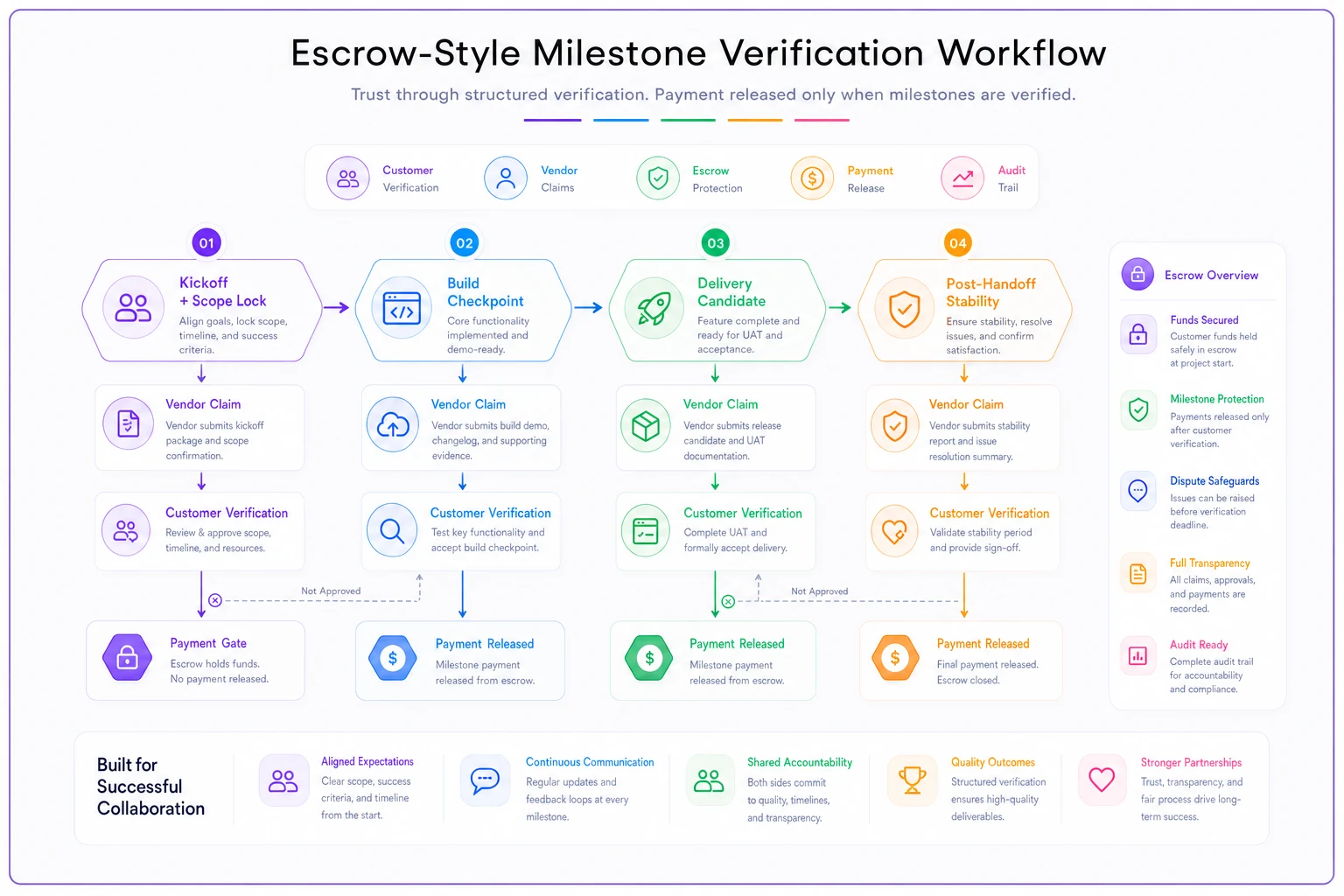
Escrow-style doesn't require a literal escrow account. It means structuring milestones so that a meaningful chunk of payment releases only after your side verifies the work, not when the vendor says it's ready. A typical breakdown:
| Milestone | Vendor claims | You verify | Payment released |
|---|---|---|---|
| Kickoff + scope lock | Scope signed | Acceptance criteria agreed in writing | 15% |
| Build checkpoint | Core built in vendor env | Demo against 3 acceptance tests in shared staging | 25% |
| Delivery candidate | "Done" | Full acceptance suite run by your engineer | 40% |
| Post-handoff stability | Integrated | 10 business days with no P1/P2 defects | 20% |
That last row is the one most teams skip. Holding back 20% for a stability window means the vendor is financially motivated to answer your messages for two weeks after "delivery" instead of vanishing. Across a lot of vendor engagements, final retention changes post-delivery responsiveness more than any relationship-building does.
One caution: don't stack retention so heavy that a small vendor can't float the cash. A boutique three-person shop can't wait 90 days for 50% of the contract. Match the retention size to the vendor's ability to survive it, or you'll lose good small vendors to your own payment terms.
Here's a simple visual of that milestone flow.
One caution: don't stack retention so heavy that a small vendor can't float the cash. A boutique three-person shop can't wait 90 days for 50% of the contract. Match the retention size to the vendor's ability to survive it, or you'll lose good small vendors to your own payment terms.
The gating rituals that actually hold
A gate only works if someone is empowered to stop the work at it. Otherwise it's just a milestone, and milestones get waved through under deadline pressure. The difference is a named person with authority to say "not yet" and a ritual that forces the question to actually be asked.
-
Scope-lock gate. Before any real building starts, acceptance criteria are frozen and signed by both sides. No verbal "we'll figure out the details later." The ritual: a 30-minute review where you read the acceptance criteria out loud and both sides confirm each one is testable. Boring. Extremely effective.
-
Delivery-candidate gate. The vendor says it's done; you don't call it done yet. Your engineer runs the full acceptance suite in a shared staging environment before the word "delivered" enters any email. Verification happens before the delivery meeting, so the meeting is about results, not promises.
-
Integration-stability gate. The work sits in your environment through a defined window before final payment. A short daily defect check for the stability window, with a clear P1/P2 definition agreed up front so "is this a blocker" isn't a debate you're having while already stressed.
The mistake PMs make here is running gates as status updates instead of decisions. A gate meeting should end with an explicit verdict — pass, conditional pass with named fixes, or fail — written down and dated. "Looks good, let's keep going" is not a verdict. It's how a fail slips through wearing a pass costume.
Quick verification rituals: proving it works before you commit your roadmap
Verification is where most vendor deliveries get accepted on faith because nobody scheduled the time to actually check. The fix is making verification a small, pre-planned ritual instead of an open-ended "test it thoroughly" that never happens because everyone's busy.
-
Pull the acceptance criteria list — the exact one frozen at scope-lock.
-
Run each criterion as a pass/fail check, no interpretation allowed. If a criterion isn't testable as written, that's a scope-lock failure you're catching late — note it.
-
Capture evidence for each
a screenshot, a log, a test output. Not "seems fine." Actual artifacts.
-
Timebox it. Verification should fit in a defined window — often a half-day to two days depending on scope. If it can't, your acceptance criteria were too fuzzy.
-
Produce a one-line verdict per criterion and a single overall verdict.
The point of the artifacts isn't paperwork. It's that when a vendor argues "we delivered what was agreed," you have a dated log showing criterion 7 failed against the frozen spec. That conversation gets very short when you have evidence and they have a memory.
Rollback rituals: the part that protects the roadmap
Almost nobody sets this up in advance, and it's the whole reason your roadmap survives a bad delivery: before you integrate a vendor's work, you decide how you'd un-integrate it.
Acceptance can fail. When it does, the damage isn't the failed delivery — it's that your team has already started building on top of it, so backing out means unwinding their work too. A rollback ritual defined before handoff keeps a vendor's failure from spreading into your own committed work.
-
Snapshot before integration. Whatever state your environment is in before the vendor's work lands, capture a clean, restorable version. Config, data, dependencies. So "roll back" means restore a known-good state, not reconstruct it from memory.
-
Integrate behind a switch, not into the load-bearing path. Feature flag, isolated branch, staging-first — whatever your stack allows. The vendor's work should be reversible without a heroic effort.
-
Define the rollback trigger up front. "If the acceptance suite fails on any P1 criterion, we do not integrate into main and we notify the vendor within one business day." Written before emotions and deadlines are involved.
-
Protect your team's dependent work. Don't schedule internal engineers to build on top of a vendor dependency until it clears the delivery-candidate gate.
That last point is the quiet killer. PMs sequence their own team's work as if the vendor dependency will land clean, because assuming success makes the roadmap look better on paper. Then it doesn't land clean, and now you're rolling back not one deliverable but a week of your own team's dependent work. Sequence dependent internal work after the vendor clears verification, even if it makes the timeline look slower. A slower honest timeline beats a fast one that detonates.
A real scenario
A mid-sized logistics company — around 40 people, small internal product team — contracted a vendor to build a carrier-rate integration feeding their quoting tool. Contract value was in the low five figures, deliverable listed as "integration with live carrier rate API."
The vendor delivered on time. The demo looked clean. The PM accepted it, paid in full, and scheduled two internal engineers to build the quoting UI on top of it the following week.
Then it broke in real use. The integration handled the happy path but choked on carriers that returned rates in a different format — roughly 15–20% of their actual volume. By the time it surfaced, the internal team had already built quoting logic assuming clean rate data. Unwinding it cost close to two weeks of internal time, and the vendor — fully paid — took eleven days to respond seriously because there was no money left on the table.
On the next engagement, they changed four things. Acceptance criteria specified a test set covering all carrier formats, not just the common ones. Final 20% payment held for a 10-day stability window. Verification ran in staging before "delivered" was ever said. And internal build work was scheduled only after the delivery-candidate gate cleared.
The next integration wasn't perfect — one edge case still slipped — but it was caught in staging, fixed by a vendor still owed money, and it never touched the internal roadmap. That's the whole difference. Not zero problems. Problems that stay contained to the vendor's side of the line.
When this level of structure makes sense — and when it doesn't
Not every vendor engagement needs escrow milestones and rollback rituals. Overbuilding process on a $500 one-off will cost you more in friction than the work is worth.
This makes sense when:
-
The vendor's work is a dependency other work is scheduled on top of
-
A failed delivery would force your own team to redo work
-
The contract value or roadmap risk is high enough to justify the coordination overhead
-
You've been burned by this vendor category before
This is overkill when:
-
The deliverable is self-contained and nothing depends on it landing on time
-
The vendor is a long-trusted partner with a clean track record on similar work
-
The work is cheap enough that a full redo would cost less than the gating process
Who should be careful with this: teams that use process as a substitute for judgment. Gates and rituals don't replace a PM paying attention. A team that runs every checklist perfectly but never actually looks at whether the delivered thing is good will pass a broken deliverable through a perfect process. The rituals surface the decision; a human still has to make it.
Making it stick without drowning in overhead
The temptation after reading all this is to build an elaborate vendor governance system. Don't. The version that survives contact with real deadlines is compact: one frozen acceptance-criteria doc per engagement, a milestone payment split with real retention, three named gates, a pre-defined verification ritual, and a rollback plan captured before integration. That fits on a page.
Where teams lose it is treating each of these as separate documents scattered across email threads, contracts, and someone's Notion page. The acceptance criteria live in the contract addendum, the verification results live in a Slack thread, the rollback plan lives in nobody's head. When the delivery goes sideways, you're reconstructing the whole picture under pressure. Keeping the acceptance criteria, gate verdicts, verification artifacts, and rollback triggers linked together in one place — however you run your work — is what turns this from a nice idea into something you can actually execute when a delivery is on fire. The same discipline that helps you restart stalled projects with clear triage questions and a relaunch plan applies here: the structure only helps if it's captured somewhere you'll actually look during a crisis.
Keep the acceptance criteria, gate verdicts, verification artifacts, and rollback triggers linked together in one place.
And if vendor deliveries are becoming a steady stream rather than one-offs, it's worth handling the incoming coordination the way you'd handle any recurring load — with defined intake and clear rules, similar to how you'd turn ad-hoc requests into a scalable intake with SLA tiers rather than reacting to each one from scratch.
The one thing to change first
If you take only one move from this: hold back your final payment for a stability window, and schedule your own team's dependent work only after the vendor clears verification.
Those two changes alone prevent the specific disaster this whole playbook exists to stop — a vendor's "done" quietly becoming your roadmap's emergency. Everything else is refinement. Those two are the load-bearing walls. Get them in place on your next engagement and see how much calmer the handoff feels when "it's done" no longer means the problem just became yours.
If you take only one move from this: hold back your final payment for a stability window, and schedule your own team's dependent work only after the vendor clears verification. Those two changes alone prevent the specific disaster this whole playbook exists to stop — a vendor's "done" quietly becoming your roadmap's emergency. Everything else is refinement. Those two are the load-bearing walls. Get them in place on your next engagement and see how much calmer the handoff feels when "it's done" no longer means the problem just became yours.
Ready to boost your team's productivity?
Join 5,000+ teams using Workyly to streamline workflows, improve communication, and deliver projects faster.