


Projects stall for the dumbest reasons. A key person switches teams mid-sprint. Budget gets frozen for a "review" that drags on for three months. The sponsor who championed everything gets promoted and suddenly nobody remembers why it mattered. Or the technical blocker that was "two weeks away" from resolution has been two weeks away for eight weeks now.
The worst part isn't that the project stops moving. It's that it becomes an organizational zombie—technically alive on someone's roadmap, eating up mental bandwidth in status meetings, but producing nothing. Teams tiptoe around it. New hires ask about it. Executives occasionally remember it exists and demand updates that require scrambling through six-month-old Slack threads.
Most organizations handle stalled projects terribly. They either pretend the project is still active, lying to themselves in weekly standups, or quietly let it rot until someone brave enough finally suggests killing it. Neither approach works because stalled projects rarely need to die—they need surgical intervention followed by strict governance to prevent another stall.
The triage questions that actually matter
When a project stalls, teams waste weeks debating what went wrong instead of figuring out what needs to happen next. The restart process starts with brutal honesty about three things: why it stalled, what's different now, and what minimal version could actually ship.
Start with the stall diagnosis. Not the surface reason—the real operational breakdown. "Waiting on vendor selection" usually means nobody owns the vendor decision and the budget holder is avoiding commitment. "Technical complexity" often translates to the architect who understood the system left and nobody else wants to touch it. Get specific about the actual blocker, not the polite version people share in steering committees.
Ask these triage questions in order:
Why did this stall (really)? Skip the diplomatic answers. Was it resource hoarding between departments? A technical approach that was doomed from the start but nobody wanted to admit it? Political infighting over ownership? Until you name the real issue, you'll restart into the same wall.
What's genuinely different now? This question kills most restart attempts. If nothing has changed since the stall, you're not restarting—you're just failing again with fresh energy. Different means: new decision maker with actual authority, technical blocker removed, budget finally approved with a PO number, competing project finished so resources are available. Without a real change, don't restart.
What would a 30% version look like? Not an MVP that's "minimal" but still takes six months. What could you ship in 30 days that delivers 30% of the original value? Most stalled projects aimed too high initially. A customer portal that stalled might restart as a basic status page. An inventory optimization system might restart as a simple reorder alert.
Who will own the restart? Not "the team" or "product and engineering together." One human with a name who will be accountable for the restart. This person needs both the authority to make calls and the time to actually drive it. If you can't name this person, don't restart.
Pro-tip: Name one human who will be accountable for the restart and give them unilateral authority to act during the MV relaunch.
What specific governance will prevent another stall? Generic "better communication" isn't governance. You need specific mechanisms: daily standups with escalation triggers, hard deadlines with pre-agreed kill switches, resource locks that can't be redirected, budget holds that prevent mid-project freezes.
A marketing analytics platform stalled for four months because three departments couldn't agree on data definitions. Triage revealed the real issue: the CMO wanted credit for sales influence, the sales VP wanted to protect their metrics, and finance wanted cost attribution clarity. The restart focused on a 30% solution—just marketing campaign performance without attribution—owned by a senior marketing analyst with weekly CMO check-ins. They shipped in six weeks.
Building the minimum viable relaunch plan
The minimum viable relaunch needs to be embarrassingly small. Most restart attempts fail because teams try to preserve the original scope, just with tighter timelines. That's not a restart—it's denial with a fresh Gantt chart.
Stop losing track of your priorities.
Workyly helps you organize, assign, and track every task efficiently.
- Centralized task management
- Real-time collaboration
- Intelligent workflow automation
No credit card required
The scoping session should make stakeholders uncomfortable. If nobody's saying "but what about..." during scope cuts, you haven't cut enough.
Time box: 30 days maximum Longer than 30 days and you risk another stall. The momentum psychology of stalled projects is fragile. Teams need a quick win to believe this time is different. Pick what you can actually deliver in 30 days, not what you wish you could deliver.
Resource lock: dedicated, not shared Shared resources killed the project once already. The restart needs dedicated people, even if that means fewer people. Better to have two dedicated developers than six who are "partially allocated." Calculate actual hours available after meetings, other projects, and realistic productivity. If someone is "50% allocated," they're really closer to 20% available.
Scope floor: the one thing that must work Identify the single feature or outcome that would make the restart worthwhile. Everything else is negotiable. For a customer service platform, it might be "agents can see ticket history." For a reporting system, it might be "daily revenue number is accurate." This becomes your immovable scope floor—if you can't deliver this, kill the restart.
A typical MV relaunch plan looks like this:
| Week | Focus | Key Activities |
|---|---|---|
| Week 1 | Setup and alignment | Confirm resource availability with calendar blocks; set up tooling and access; create 30-day delivery plan; hold kick-off with clear scope floor communication |
| Weeks 2–3 | Core development | Daily standups with same-day blocker escalation; no scope additions; twice-weekly demos of working pieces |
| Week 4 | Integration and testing | Basic testing for scope floor feature only; document shortcuts taken; prepare launch communication |
The relaunch plan must also include failure triggers. If any of the following happen, the project stops immediately:
-
Key resource gets pulled for more than 2 days
-
A technical blocker emerges that would push the timeline past 30 days
-
The scope floor feature proves impossible with the current approach
-
A stakeholder attempts to expand scope without extending timeline and resources
Pre-agreeing on these triggers before the restart begins is what separates a disciplined relaunch from one that slowly drifts back into stalled territory.
The 30/60/90 day cadence that prevents re-stalling
After the MV relaunch, most teams relax. The project is moving again, stakeholders are happy, the crisis feels managed. This is exactly when projects re-stall. You need strict governance cadence for the first 90 days to prevent sliding back into zombie status.
A simple visual of the 30/60/90 cadence:
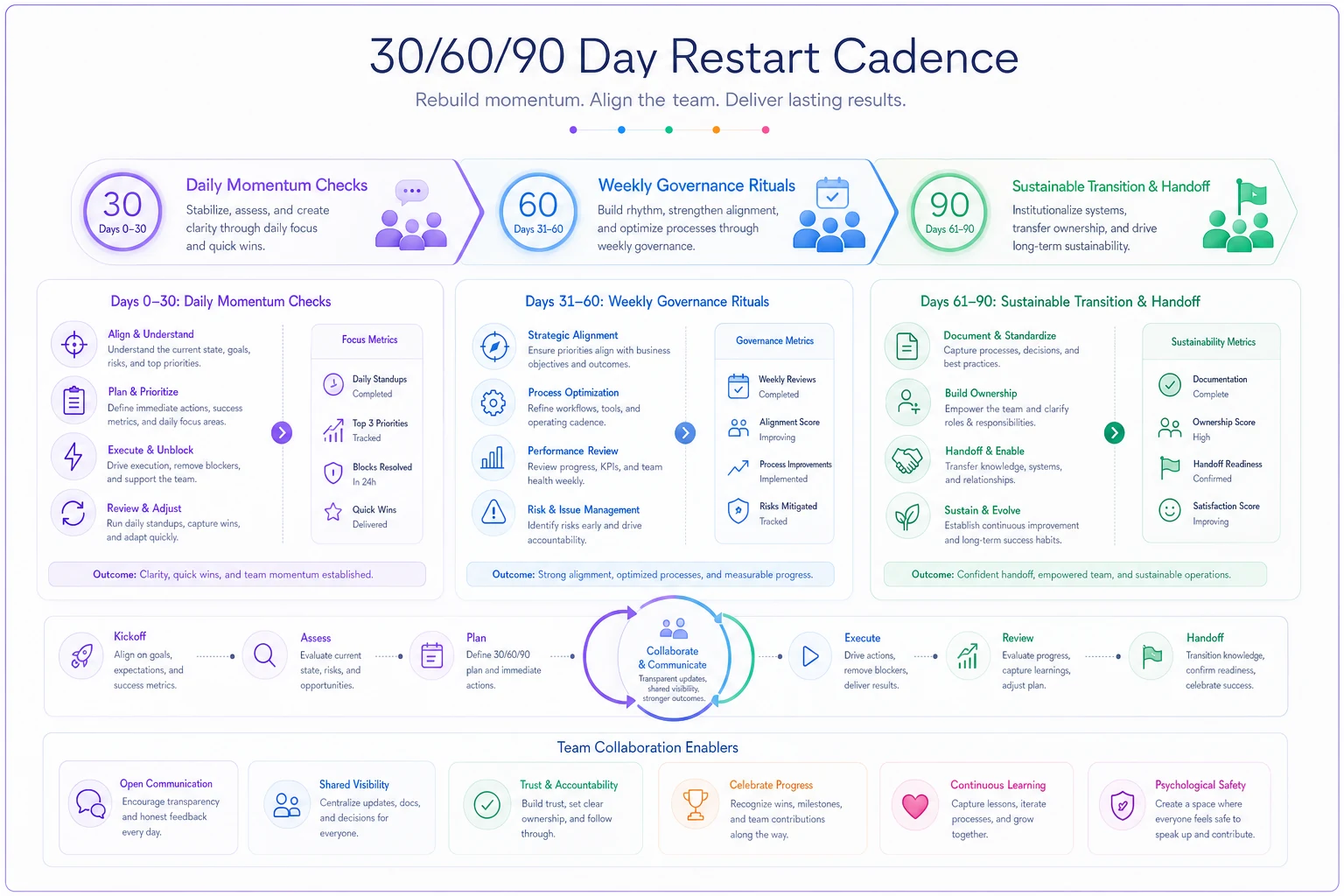
Use this workflow to guide daily and weekly rituals during the first 90 days.
Days 0–30: Daily momentum checks The first 30 days require daily attention. Not daily meetings—daily momentum verification.
Every morning, the restart owner confirms: yesterday's planned work actually completed, today's work is clearly defined and assigned, no blockers exist that could eat more than 4 hours, and resource availability matches plan. If any answer is "no," escalation happens that day. Not tomorrow, not after the standup—that day.
A health tech startup restarting their provider onboarding system used a simple Slack bot that pinged the restart owner every morning at 8 AM with these four questions. If any answer was "no," it automatically scheduled a 30-minute problem-solving session for 10 AM. Simple, but it caught problems before they became week-long delays.
The restart owner also maintains a public dashboard showing days since restart, features shipped (actual working features, not "90% complete" estimates), blockers resolved with resolution time, and the next milestone with a specific date and deliverable.
Days 31–60: Weekly governance rituals After the first month, shift to weekly governance focused on preventing scope creep and resource drift.
Monday planning session (30 minutes max): review what shipped last week, confirm this week's specific deliverables, identify any resource risks, and document scope change requests without approving them. Thursday checkpoint (15 minutes): verify Monday's plan is on track, escalate emerging blockers, confirm next week's resource availability.
The restart owner has unilateral authority to reject scope changes during this period. Stakeholders can request additions, but they go into a Phase 2 backlog that won't be considered until day 91. It sounds harsh. It works.
One pattern that shows up constantly: around day 45, a senior stakeholder suddenly gets interested again and wants to add "just one small feature." This is where most restarts begin sliding back toward stalled. The governance cadence must include pre-agreed responses to these requests. "That's a great idea for Phase 2" becomes the automatic answer.
Days 61–90: Sustainable transition The final month transitions from emergency governance to sustainable operations. Not about relaxing standards—it's about embedding the governance into normal operating rhythm so it doesn't depend on crisis energy to function.
-
What we shipped (demos, not descriptions)
-
What we're shipping next (specific features with dates)
-
Resource confirmation for next two weeks
-
Phase 2 scope prioritization discussion (still no approvals)
The restart owner begins documenting handoff materials: technical decisions and shortcuts taken, process changes that prevented re-stalling, the resource model that actually worked, and governance mechanisms worth maintaining.
By day 90, you make the critical decision: continue to Phase 2 or declare victory and move on. Many successful restarts should end at day 90. If the 30% solution is providing 70% of the value, maybe that's enough.
The governance mechanisms that actually prevent re-stalling
Generic "better project management" doesn't prevent re-stalling. You need specific operational mechanisms with teeth—ones that make re-stalling harder than continuing.
Resource locks with penalties When someone gets pulled from the restart project, there must be immediate consequences. Not angry emails or disappointed looks in meetings—actual operational penalties that make resource theft expensive.
A resource lock agreement should name specific individuals committed for specific hours per week, require departments to cover contractor costs if they pull someone, mandate a minimum two-week notice for resource changes, and trigger automatic timeline extensions for emergency pulls.
A financial services company made this work by creating a "restart resource pool" funded by departments with stalled projects. If a department pulled resources from a restart, they forfeited their pool contribution—usually somewhere in the $25k–$50k range—which went toward hiring contractors. Suddenly, nobody had emergencies urgent enough to justify pulling restart resources.
Scope creep triggers automatic pause Every scope addition, no matter how small, triggers an automatic project pause for replanning. The pause requires a full re-scoping exercise with timeline impact, resource confirmation for the extended timeline, stakeholder sign-off on the new plan, and an explicit option to continue with original scope or stop entirely.
Most stakeholders quickly learn that their "small" additions aren't worth a two-week planning pause. The few that genuinely are get proper planning instead of being squeezed in.
Weekly proof of life demonstrations Not status reports. Not "85% complete" updates. Actual working demonstrations of whatever exists. Every week, something must be demoed that wasn't there the previous week. If nothing can be demoed, the project is stalling.
The demo can be tiny: a working button that does one thing, a report with real data even if it looks rough, an integration that passes one message, a workflow that handles the happy path only. The point isn't impressive progress—it's continuous visible progress. A logistics software restart required five-minute Friday demos. One week the demo was literally "the login page now remembers your username." Fine. It was more than existed the week before.
Pre-committed kill switches Define exactly when the restart dies. Not "if things aren't going well" but specific triggers: core feature not working by day X, budget exceeding Y with scope floor unmet, key resource unavailable for Z consecutive days, technical approach failing by milestone M.
When a trigger hits, the project stops. Not a discussion about stopping—it stops. The restart owner sends the shutdown notice, team members return to previous work, and a retrospective gets scheduled.
A retail analytics platform restart had a kill switch for day 21: if they couldn't pull real-time inventory data by then, the technical approach was wrong and continuing was pointless. Day 19 they realized it wouldn't work. Day 20 they tried one last approach. Day 21 they killed it. No drama, no extended suffering, no slow slide back into stalled purgatory.
The restart checklist that actually works
This checklist should be a living document, not a one-time assessment. Each phase needs specific checkpoints that confirm momentum is holding.
Pre-restart checklist:
-
Real blocker identified and removed
-
Named owner with actual authority assigned
-
30% scope defined with clear scope floor
-
Resources locked with penalties defined
-
Kill switches documented and agreed
-
30-day plan with daily check-ins scheduled
Day 1–30 checklist:
-
Daily momentum checks happening
-
Public dashboard updated
-
Weekly demos showing working features
-
Scope change requests documented but rejected
-
Resource availability verified daily
-
Blockers resolved same-day
Day 31–60 checklist:
-
Weekly governance rhythm established
-
Scope creep successfully resisted
-
Stakeholder interest managed without expansion
-
Phase 2 backlog created but not started
-
Sustainable practices documented
Day 61–90 checklist:
-
Bi-weekly stakeholder reviews happening
-
Handoff documentation started
-
Phase 2 vs. completion decision scheduled
-
Governance mechanisms embedded in normal operations
-
Success metrics defined and measured
The checklist shouldn't sit in a static document. Build it into your operational platform where it can trigger alerts, track completion, and automatically escalate when items are missed. When governance is automated, it's much harder for projects to silently drift back into stalled status.
Making restarts stick with operational discipline
The difference between projects that successfully restart and those that re-stall comes down to operational discipline in the first 90 days. Not project management expertise, not better tools, not more resources—just the discipline to follow the governance mechanisms even when they feel excessive.
One software company looked back at their stalled projects over two years. The ones that restarted successfully all had three things in common: resource locks that actually held, scope discipline that felt unreasonable to stakeholders at the time, and governance mechanisms with real consequences. The ones that re-stalled all started with good intentions but relaxed their governance "just this once" somewhere around day 40 to 50.
The restart checklist isn't about perfection. It's about creating enough structure that momentum can rebuild while keeping the organizational behaviors that caused the original stall from creeping back in. Most projects don't need to be perfect—they need to be done. The 30% solution that ships beats the 100% solution that stalls every time.
Your operational platform should track patterns across all restarts: which governance mechanisms actually prevent re-stalling in your organization, what the optimal restart timeline looks like for your team size, and how many scope change requests you can absorb before momentum dies. That data helps refine your restart process from generic best practice into something that actually fits your operational reality.
The hard truth about stalled projects is that most shouldn't be restarted at all. But for the ones that should, the restart needs to be disciplined and time-boxed. Otherwise you're not restarting—you're just rearranging deck chairs while pretending this time will be different.
Ready to boost your team's productivity?
Join 5,000+ teams using Workyly to streamline workflows, improve communication, and deliver projects faster.