

Most teams don't have a big-escalation problem. Big incidents get a war room, a bridge call, someone senior yelling in Slack. Those get handled.
What leaks through are the small ones. A customer success manager pings an engineer directly. A support lead flags something in standup that "isn't urgent but keeps coming up." A sales rep forwards an angry email with "can we do anything about this?" None of these are severity-1. All of them are real. And almost none of them ever become a tracked backlog item with an owner and a due date.
That gap — between a small escalation being mentioned and it becoming work someone is accountable for — is where most teams quietly bleed trust and accumulate rework. This is the piece your escalation to backlog runbook actually needs to solve, and it's the part almost everyone skips.
The specific failure: escalations that die in DMs
The problem is more specific than "we lose track of things."
A support lead notices three enterprise customers hit the same billing-export bug this week. It's not breaking anything. Invoices still send. But finance teams on the customer side are annoyed, and one of them mentioned renewal in the same breath.
The support lead does the reasonable thing: DMs the engineer who touched billing last quarter. Engineer replies "yeah that's a known edge case, it's on our list somewhere." Everybody feels like something happened. Nothing happened. There is no ticket. There is no owner. "On our list somewhere" is not a list.
Six weeks later, the same bug shows up in a churn post-mortem. Now it's expensive. Now it's a meeting.
This happens because the escalation had just enough attention to feel resolved and not enough structure to survive the week. The conversation became the deliverable — which means the moment it ended, the work evaporated.
Why small escalations specifically slip through
Big escalations survive because they trigger process automatically. Small ones don't clear the bar, so they rely entirely on someone choosing to log them. And logging is friction nobody's incentivized to do in the moment.
Stop losing track of your priorities.
Workyly helps you organize, assign, and track every task efficiently.
- Centralized task management
- Real-time collaboration
- Intelligent workflow automation
No credit card required
-
The reporter isn't the owner. The person who spots the issue — support, CS, sales — usually can't fix it and doesn't own the backlog it belongs in. So it gets tossed over a wall verbally and lands nowhere.
-
No urgency language exists for "small but real." Teams have language for P1/P2 incidents and language for roadmap features. Almost nothing for the messy middle — recurring annoyances that aren't fires but aren't roadmap either.
-
Triage happens in the wrong medium. Escalations arrive in Slack, email, hallway conversations, standups. Backlogs live in Jira, Linear, or a board somewhere. The translation step between those two worlds is manual, boring, and constantly skipped.
-
No conversion moment. There's no recurring point in the week where someone asks "what small escalations came in, and where did they go?" Without that ritual, conversion depends entirely on individual memory.
The thing most teams miss: you don't fix this by asking people to log more. You fix it by creating one conversion point where raw escalations get turned into structured work, on a schedule, by someone whose job it is.
The urgency×impact triage card
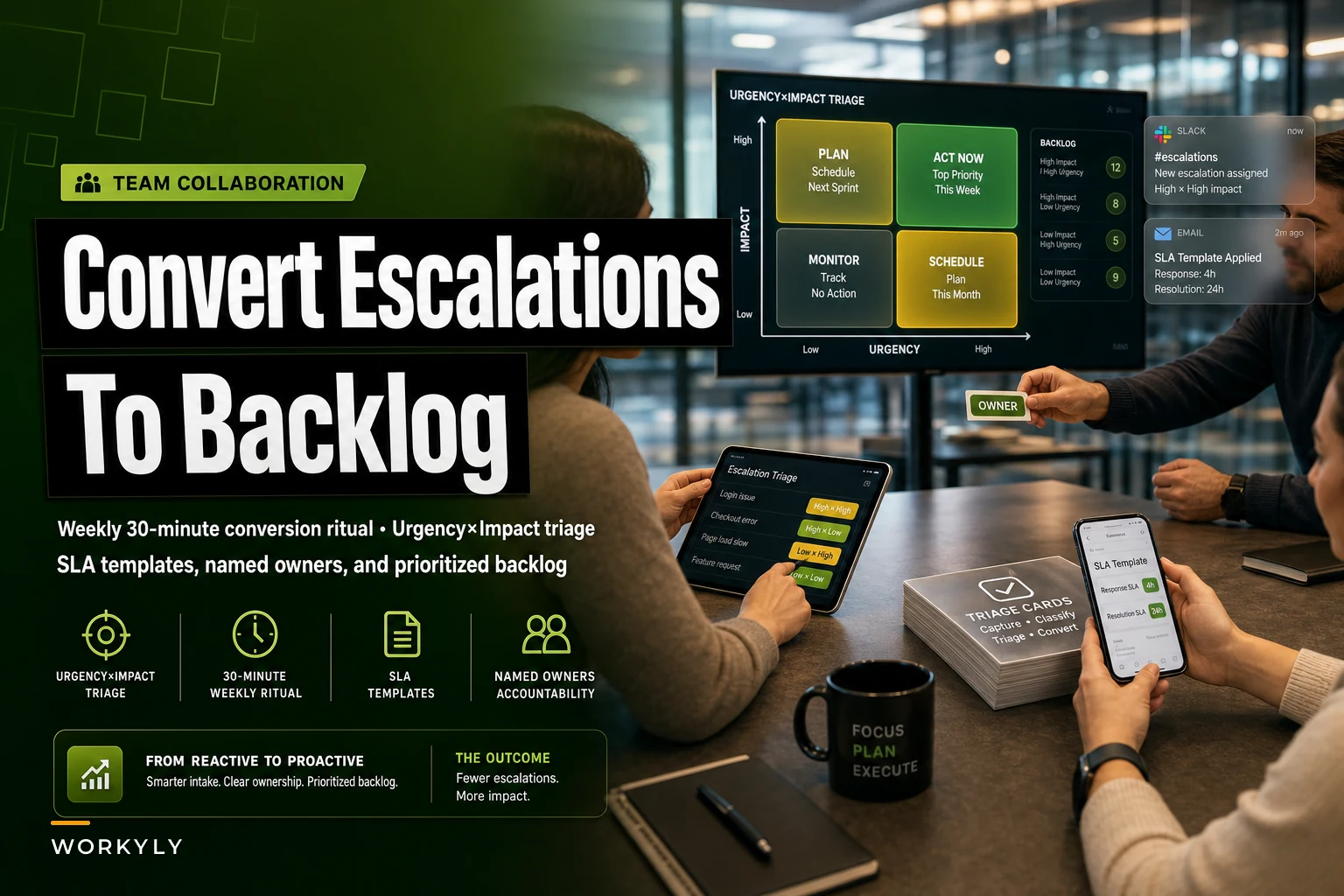
Before anything becomes a backlog item, it needs a fast, defensible read on how much it actually matters. Not a 40-field intake form — a card someone can fill out in the 90 seconds they'd otherwise spend writing a Slack message.
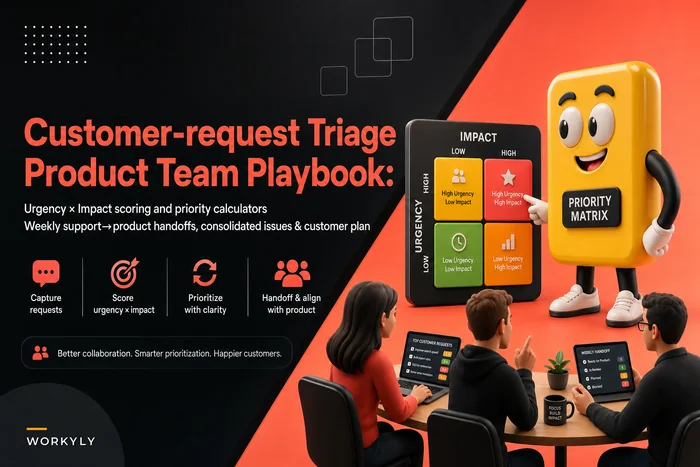
The scoring borrows the same logic used in customer-request triage for product teams, but the goal here is different: not to route a single request, but to decide whether a loose escalation earns a slot in the backlog at all.
-
What happened (one sentence, plain language)
-
Urgency — is this getting worse, or is it stable? (Low / Med / High)
-
Impact — how many customers or how much revenue is touched, roughly? (Low / Med / High)
-
Reporter + evidence — who saw it, and where's the proof (ticket IDs, screenshots, thread link)
-
Suggested owner or area — best guess, not a commitment
Urgency and impact multiply into a rough priority:
| Urgency \ Impact | Low impact | Med impact | High impact |
|---|---|---|---|
| Low urgency | Log & watch | Backlog (normal) | Backlog (high) |
| Med urgency | Backlog (normal) | Backlog (high) | Fast-track |
| High urgency | Backlog (high) | Fast-track | Escalate now |
The "Escalate now" corner rarely fires — if it did, it was never really a small escalation to begin with. The valuable cells are that middle band. That's where the billing-export bug lives: low-to-med urgency, med impact, quietly recurring. In a DM-driven process that item disappears. On a triage card it lands in "Backlog (high)" and gets an owner.
One mistake worth calling out: don't let people self-rate their escalation's impact as High by default. Everyone thinks their fire is the hottest. Anchor impact to something countable — number of affected accounts, tickets opened in the last 14 days, dollar value at risk. Vague impact ratings are how your backlog fills with noise.
SLA templates for customer communications
Converting an escalation into a backlog item solves your tracking problem, but it does nothing for the customer or the internal reporter still waiting. If the CS manager who raised the billing bug never hears back, they stop using the process and go back to DMing engineers directly — right back where you started.
-
Acknowledgement SLA — how fast the reporter gets confirmation the escalation was received and triaged. Should be measured in hours, not days. It's about respect, not resolution.
-
Decision SLA — how fast they learn what happened to it
promoted to backlog, merged with an existing item, or declined with a reason.
-
Progress SLA — for items that get worked, how often they receive an update while in flight.
Templates, tiered by triage outcome:
Acknowledgement (all escalations): > "Got your escalation on [thing]. Logged it, triaged as [priority]. You'll hear back on next steps by [decision date]."
Promoted to backlog: > "Update on [thing]: it's now [TICKET-ID], owned by [name], slotted for [rough timeframe]. I'll ping you when it moves."
Declined (with reason): > "On [thing] — we're not picking this up right now because [specific reason: low impact / duplicate of X / by design]. If the situation changes — more accounts hit, revenue at risk — reopen it and we'll re-triage."
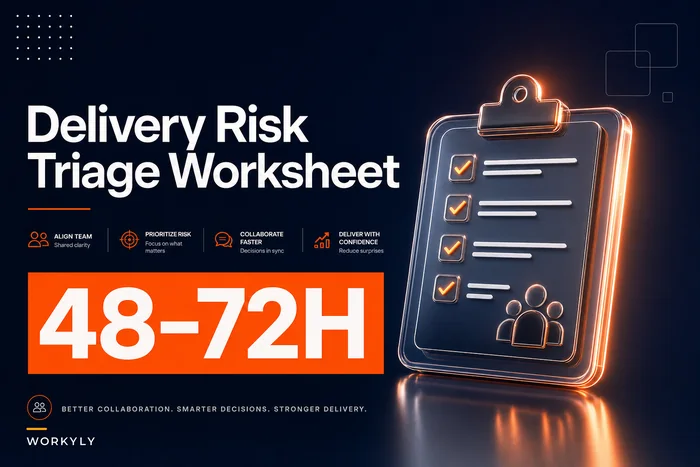
That decline template is the one people skip and shouldn't. A clear no with a reason keeps trust intact. Silence is what teaches people the process is a black hole. The delivery risk triage worksheet makes the same point — the follow-up ritual matters as much as the initial score, because unacknowledged risk quietly becomes actual risk.
Attach the clock to the tier, not to your calendar. A Backlog (high) item might warrant a 24-hour acknowledgement and a 3-day decision. A "Log & watch" item might get acknowledged and explicitly parked with no further update promised. Being honest that something is parked beats implying it's queued when it isn't.
The weekly conversion ritual
The triage card and SLA templates are inert without a moment where they actually get used. This is the mechanism the whole runbook depends on, and it's deliberately small.
Once a week, 30 minutes, one owner — usually a PM or a support-to-product liaison — everyone else optional. The agenda is one thing: turn the week's raw escalations into backlog items or explicit declines.
The flow itself isn't complicated. Raw escalations from Slack, email, and standups get pulled into a single queue. From there, you dedupe, score each item using the urgency×impact card, make a decision — promote, merge, or decline — assign a real owner to anything that moves forward, then fire the appropriate SLA template back to whoever raised it. All in the same session.
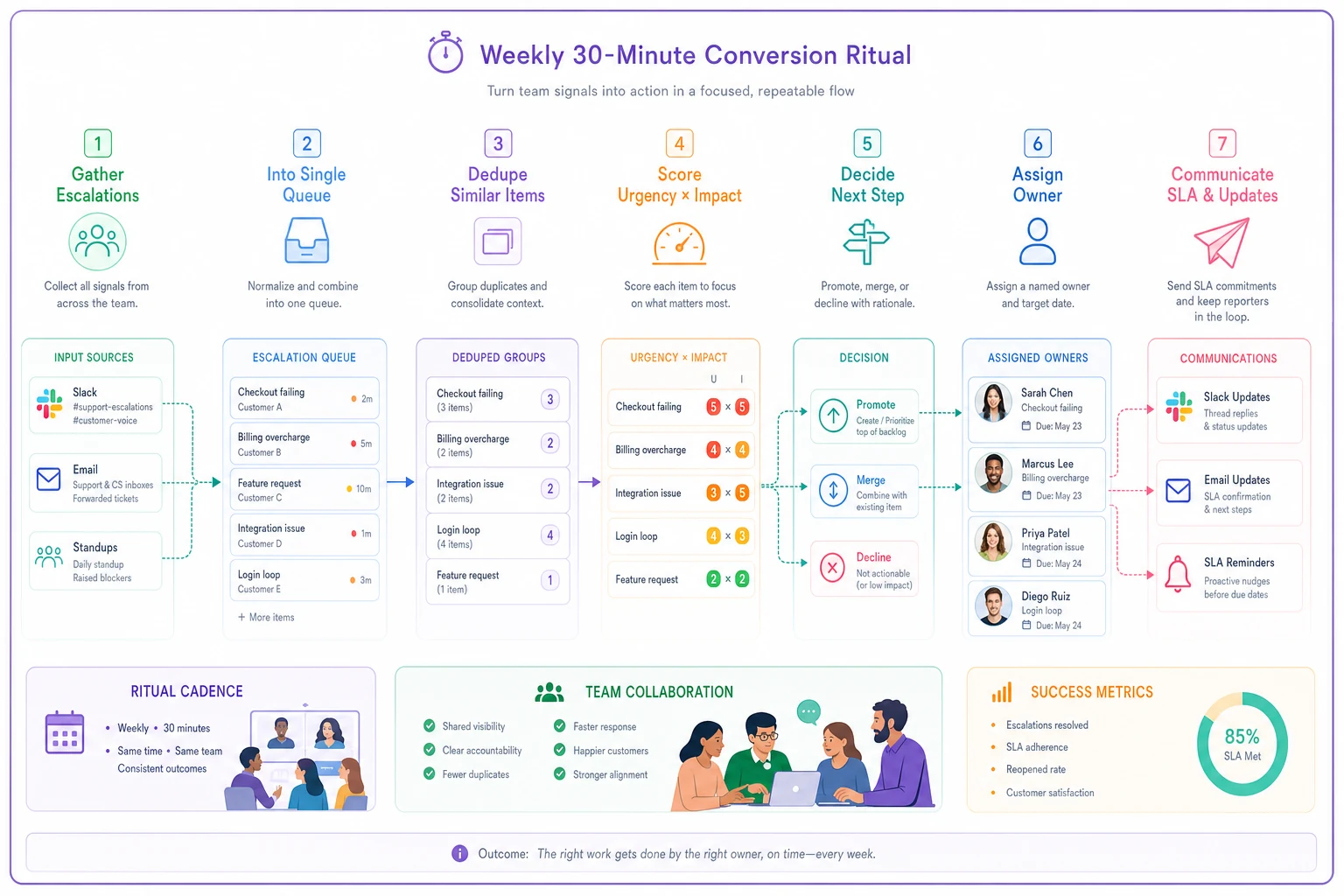
The flow, step by step:
-
Gather — pull every escalation that landed since the last session. Slack flags, forwarded emails, standup mentions, triage cards people filled in. One list.
-
Dedupe — merge anything that's the same underlying problem. Three customers hitting the same bug is one item with three data points, not three tickets.
-
Score — run each through the urgency×impact card if it isn't already scored. Takes seconds once you're in the habit.
-
Decide — promote, merge, or decline. Every item leaves this step with a decision. Nothing stays as "let's discuss next week." Next week is where things go to die.
-
Assign — promoted items get a real owner and a rough slot. Not "the team" — a name.
-
Communicate — fire the SLA template to each reporter. Acknowledged, promoted, or declined. All of them, same session.
Make the session rule "nothing leaves undecided" explicit at the start so the team treats the meeting like the single source of conversion.
The non-negotiable rule: nothing leaves undecided. The entire point is breaking the "on our list somewhere" habit. If an item genuinely needs more information, the decision is "declined pending X, reporter owns getting X" — which is still a decision with an owner.
Teams that run this ritual find the volume drops after a few weeks. Not because fewer things go wrong, but because reporters learn the format. They start pre-filling triage cards because they know a vague DM won't survive Thursday's session. The ritual trains the intake.
Where operational software helps here is narrow and unglamorous: a shared board where the triage card is the intake form, escalations from support channels land in one queue instead of scattered across DMs, and SLA clocks are tracked automatically so acknowledgements don't rely on someone remembering. AI-assisted routing can flag probable duplicates and suggest likely owners before the session starts, which cuts the dedupe step noticeably. But none of that matters if the weekly decision moment doesn't happen. The tooling reduces friction; it doesn't replace the ritual.
A real scenario
A B2B analytics company, around 40 people, engineering team of nine. Their support and CS teams were escalating directly to engineers via DM — reasonable at that size, since everyone knew each other.
The symptom: engineers estimated they were losing roughly 5–7 hours a week to context-switching on "quick questions" that turned out to be untracked bugs. Worse, in a quarterly review they found that of the small escalations raised over three months, they could only account for what happened to about half. The rest had genuinely vanished.
-
Escalations with a documented decision went from roughly half to nearly all of them.
-
Engineer interrupt time dropped noticeably — not to zero, but the "quick DM" habit faded because people knew Thursday's session would catch it.
-
The decline templates turned out to be the surprise win. About a third of escalations got a clear, reasoned no — and reporters actually reported higher satisfaction, because "no, here's why" beat silence every time.
Nothing about this was a big transformation. It was a small, boring, repeated conversion step that stopped things from falling out of the process. That's the whole point.
When this makes sense — and when it doesn't
Do this if you have multiple teams feeding work to each other informally, escalations arrive in mixed channels, and you've ever discovered a "known issue" in a post-mortem that nobody had tracked. That's the exact failure mode this fixes.
Skip the full ritual if you're a small team where all escalations already land in one channel and get triaged same-day. Adding a weekly session to a five-person team that's already fast just creates ceremony. Use the triage card and SLA templates, drop the meeting.
Who should not do this: teams whose real problem is that big incidents aren't handled well. If your severity-1s are chaotic, fix incident response first. This runbook assumes your fires are covered and it's the smoldering stuff that's leaking.
The whole thing lives or dies on one habit: giving small escalations a single scheduled moment to become tracked, owned, communicated work — instead of trusting that a DM and a "yeah, it's on our list" counts as progress. It doesn't. It never did.
Ready to boost your team's productivity?
Join 5,000+ teams using Workyly to streamline workflows, improve communication, and deliver projects faster.