

Roadmap negotiations rarely fail because someone made a bad argument. They fail because everyone in the room is arguing about the wrong thing — usually urgency — while the actual tradeoff sits untouched. Sales says the enterprise deal will close if we ship SSO. Support says the churn from the billing bug is bleeding accounts. Platform says if we don't pay down the queue infrastructure now, everything slows down in Q3. Each is right. None of them are comparable.
The problem with most cross-team negotiation scripts you'll find online is that they optimize for winning the conversation. That's the wrong goal. If you "win" and ship the wrong thing, you inherited the risk. What you actually want is a negotiation that produces a defensible, shared decision — one the other teams will still support in six weeks when their thing still hasn't shipped.
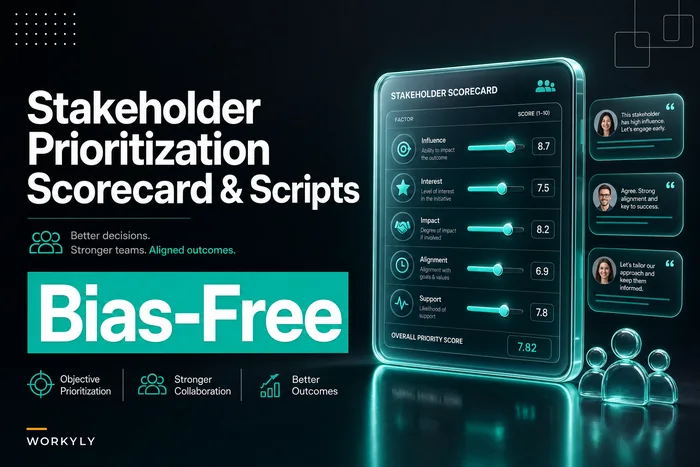
This post is narrow on purpose. It's about the specific moment where two or more legitimate asks collide and you have to sequence them. Not intake, not triage scoring (we've covered removing bias from request triage separately). This is the live conversation, plus the rubric and framing that make it survivable.
Why these conversations go sideways
The core failure is that people negotiate on who feels most confident, not on what it costs to wait.
Watch any roadmap standoff long enough and you'll notice a pattern: the loudest team isn't the one with the most exposure, it's the one with the most political capital or the nearest deadline they set themselves. A self-imposed "we promised the customer Friday" beats a quiet "we're accruing 4 hours of manual reconciliation per week" every single time, even though the second one compounds.
The other reason: nobody has a common unit. Revenue, risk, engineering-days, and customer trust don't share a currency, so the conversation defaults to volume and vibes. Whoever tells the most vivid story wins the slot. That's not prioritization, that's theater.
And there's a quieter failure — the false binary. Someone frames it as "A or B this quarter," when the real options include "a thin slice of A now, B fully in six weeks," or "B now because A's window doesn't actually close until Q3." Negotiations collapse when the menu only has two items on it.
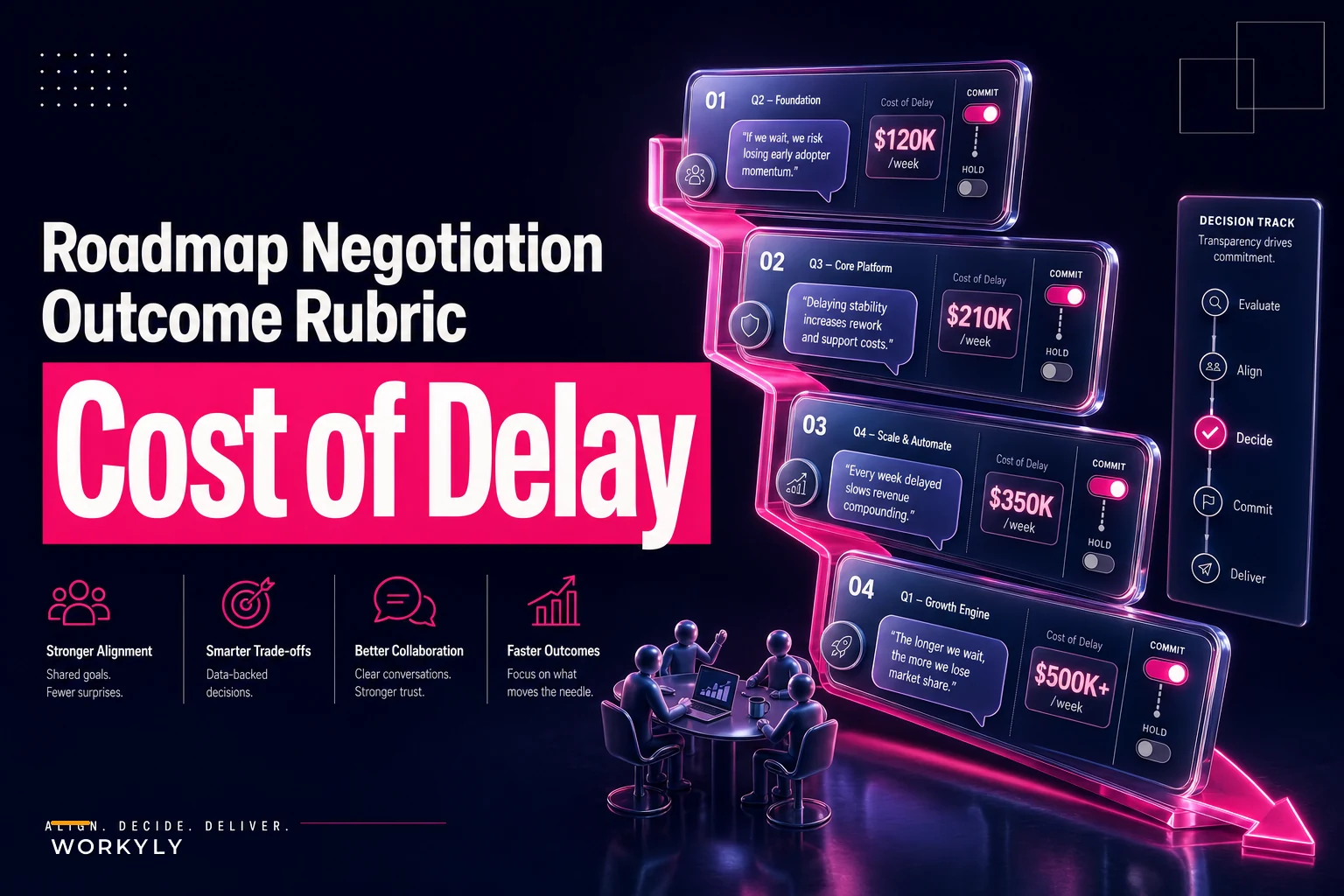
The unit that actually works: cost of delay
You don't need everyone to agree on priority. You need everyone to agree on what each week of delay costs. That reframes the whole conversation from "mine is more important" to "here's what happens if this waits."
Stop losing track of your priorities.
Workyly helps you organize, assign, and track every task efficiently.
- Centralized task management
- Real-time collaboration
- Intelligent workflow automation
No credit card required
Cost of delay isn't a precise financial model here — you're not going to defend it in a board meeting. It's a forcing function to make people quantify the thing they're implicitly claiming. When Sales says the SSO deal is urgent, cost of delay makes them answer: does the deal actually walk if it slips two weeks, or does it just get uncomfortable? Nine times out of ten, "urgent" turns out to mean "I'd rather not have the awkward call."
Here's a simple rubric to score each competing ask. Keep it to four dimensions so it fits on one screen and can be filled out live.
| Dimension | Question you ask the requester | Scoring guide |
|---|---|---|
| Delay slope | What changes for the worse each week this waits? | Flat (nothing compounds) / Linear / Accelerating |
| Window | Is there a hard date after which the value drops sharply? | Open / Soft date / Hard cliff |
| Reversibility | If we're wrong about sequencing, how expensive is the correction? | Cheap / Moderate / Expensive |
| Confidence | How sure are we the stated outcome is real? | Verified / Plausible / Asserted |
The trick is the delay slope row. Most people can't tell you their slope on the spot, and that itself is the signal. A request with an "accelerating" slope — a data-quality issue that gets harder to unwind every day, a churn problem that spreads — genuinely can't wait. A request that's "flat," meaning it'll cost the same to do in March as it does now, can almost always yield the slot, no matter how loud the requester is.
Worth naming a pattern that shows up constantly: teams systematically overstate their window and understate their reversibility. "Hard cliff" claims deflate fast when you ask, "walk me through what specifically happens the day after." And "we can never redo this" usually means "redoing it would be annoying," which is a Moderate, not an Expensive.
The scripts
Scripts aren't for sounding polished. They're for staying on the unit when the room wants to drift back to volume and confidence. Here are the four you'll reuse constantly.
1. The slope question (opens the real negotiation) > "Help me understand the shape of the delay. If this ships six weeks later than you want, what's different — is it the same cost, a bigger cost, or does something break that we can't undo?"
This does two things. It's non-adversarial — you're helping them, not challenging them. And it quietly forces them to distinguish inconvenience from actual accrual. People who've been coasting on "it's urgent" tend to soften here on their own.
2. The window test (breaks false cliffs) > "You mentioned the customer needs this by the 30th. If we hit the 30th with a partial version — say, the read-only piece — does that hold the deal, or does it have to be the full thing?"
Almost every hard date has a thinner slice that satisfies it. This script surfaces the slice without you having to propose scope cuts, which would put you on the defensive.
3. The tradeoff-out-loud frame (removes the false binary) > "Right now I'm hearing three asks that all fit into two slots. I'm not going to pick a winner in my head — I want us to say out loud what each one costs to wait. Whoever's delay is flat this quarter, you're volunteering the slot. Let's find out who that is."
Saying you won't decide privately is disarming. It moves the conflict off you and onto the rubric. The teams argue with the framework, not with you — and crucially, not with each other in a way that leaves scars.
4. The commitment frame (locks the decision so it survives) > "So the sequence is B first, then A the following cycle. Before we close — A team, are you good defending this sequence to your stakeholders next week? Because if we're going to relitigate it Thursday, let's finish the argument now."
This is the one people skip, and it's why decisions unravel. A negotiated sequence that isn't commitment-tested in the room becomes a background grumble that resurfaces the moment something slips. Asking someone to pre-commit to defending the decision converts silent losers into co-owners.
The workflow, start to finish
Here's how this actually runs when three asks land in the same planning window.
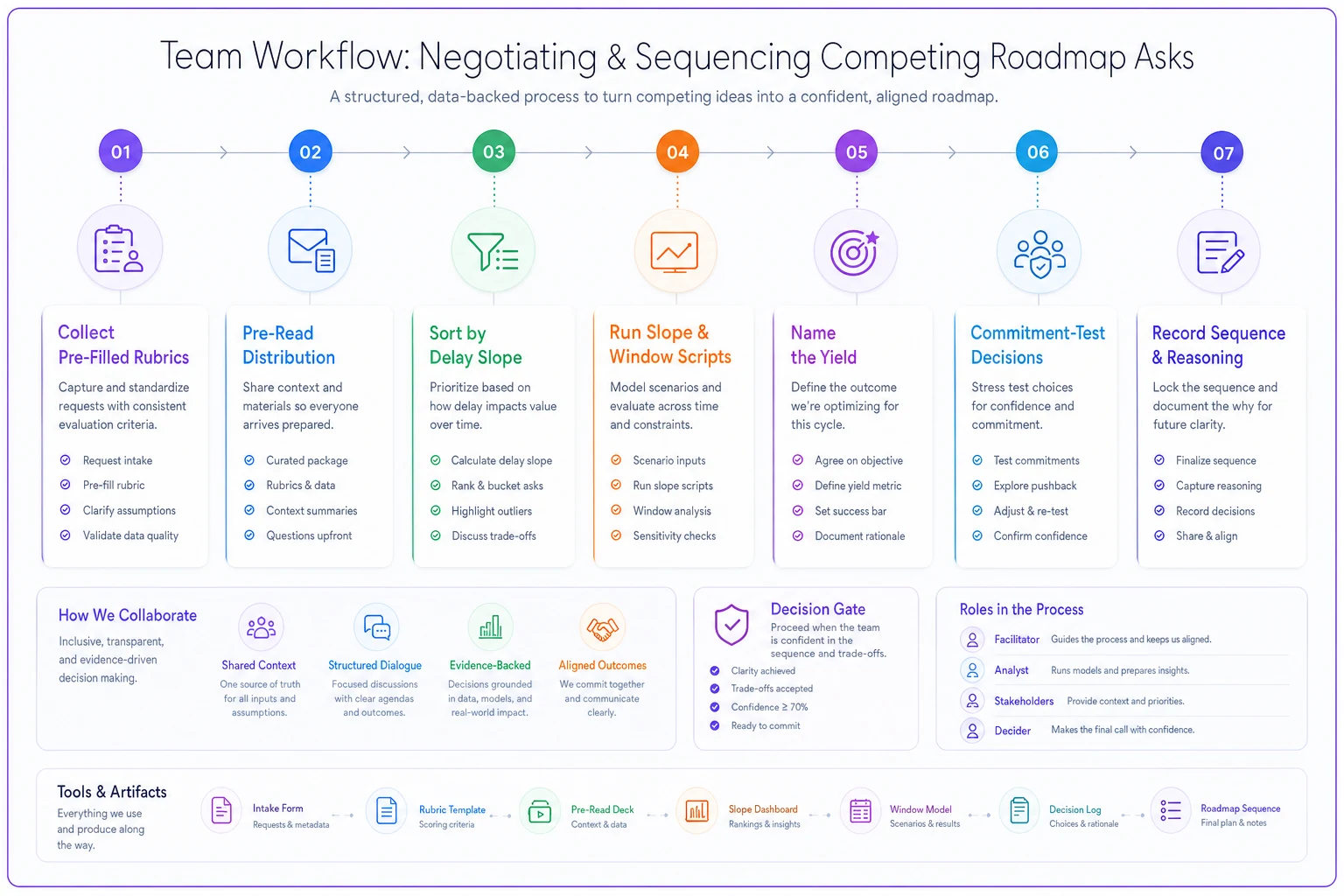
Send the filled rubrics 24 hours ahead — the meeting is for reconciling disagreement, not for hearing pitches.
-
Collect the asks in the same format before the meeting. Each requester fills the four-dimension rubric themselves. This matters — self-scoring exposes the weak claims before anyone's ego is on the line in a room.
-
Pre-read, don't present. Send the filled rubrics 24 hours ahead. The meeting is for reconciling disagreement, not for hearing pitches. Pitches reward performance; pre-reads reward substance.
-
Sort by delay slope, not by requester. Put the accelerating-slope items at the top regardless of who asked. Let the ordering be visible and boring.
-
Run the slope and window scripts on anything that looks like a false cliff. Usually one or two claims collapse here, and the sequence half-decides itself.
-
Name the yield explicitly. Whoever's item is flat-slope, open-window gets named as the one that waits — and you say why, using their own rubric answers.
-
Commitment-test before closing. Every team confirms they'll defend the sequence externally.
-
Write the sequence and the reasoning in one place. Not the decision alone — the reasoning. When someone reopens it in three weeks, you point at the recorded slope, not your memory.
The pre-read step is the one teams resist and the one that changes everything.
Meetings where people present live reward whoever's most fluent under pressure. Meetings built on pre-filled rubrics reward whoever's claim is most real.
Visualize this sequence as a simple workflow.
Those are different people surprisingly often.
A realistic scenario
A mid-size B2B software team, roughly 14 engineers across three squads, kept ending planning with the same fight. Sales wanted a reporting export for a prospect. Support wanted a fix for a permissions bug generating around 20–25 tickets a week. Infra wanted to migrate a job queue before load got worse.
Two cycles in a row, Sales won the slot — the prospect story was vivid and the AE was in the room. The export shipped. The prospect, it turned out, was three months from a decision anyway. Meanwhile the permissions tickets kept climbing, and support was burning somewhere around 6–8 hours a week on manual workarounds.
They ran the rubric the third cycle. On paper: the export was flat-slope, soft-date, cheap-to-reverse. The permissions bug was accelerating-slope (spreading to more account types), reversible-but-getting-worse. Infra was linear-slope with a soft window in Q3.
Sequenced honestly, the export dropped to third. And when the slope question got asked out loud, the AE actually agreed. They shipped the bug fix, ticket volume dropped back toward single digits within two weeks, and the export shipped the following cycle with zero deal impact. Nothing about the work changed. What changed was that the decision got made on cost of delay instead of on who told the better story.
When this makes sense — and when it doesn't
Use this when you have genuinely competing legitimate asks, cross-team stakeholders with real stakes, and a recurring pattern of the loudest voice winning. That's the exact situation it's built for.
Skip it when the priority is genuinely obvious. If something's on fire, don't run a rubric — go put it out. Ceremony over a clear answer just burns trust and makes the framework feel bureaucratic when you actually need it later.
It's a bad idea when you don't have the authority to make the sequence stick. If the decision gets overturned by an executive on a whim two days later, running an elaborate negotiation teaches everyone the process is decorative. Fix the authority problem first, or you're just performing fairness. This ties into having a real operating model underneath the conversation — something we get into with the team productivity operating system blueprint.
Who should not run this: anyone using it to launder a decision they've already made. People can smell a rigged rubric instantly, and the second they do, every future negotiation gets harder. The framework only works if you're genuinely willing to let the slope change your mind.
The part everyone gets wrong
The instinct is to make the rubric more precise — add weights, add dollar figures, add a scoring formula that spits out a ranked list. Resist it. The moment the number looks authoritative, people start gaming the inputs instead of arguing honestly, and you've rebuilt the exact theater you were trying to escape, just with spreadsheets.
The rubric's job isn't to compute the answer. It's to make people say out loud what they're actually claiming, in a form that's comparable across teams. The conversation makes the decision. The scripts keep that conversation on the one thing that matters — what waiting costs — and the commitment frame is what keeps the decision from quietly falling apart the following week.
Keep it rough, keep it visible, and make everyone defend their own slope. That's most of the job.
Ready to boost your team's productivity?
Join 5,000+ teams using Workyly to streamline workflows, improve communication, and deliver projects faster.