

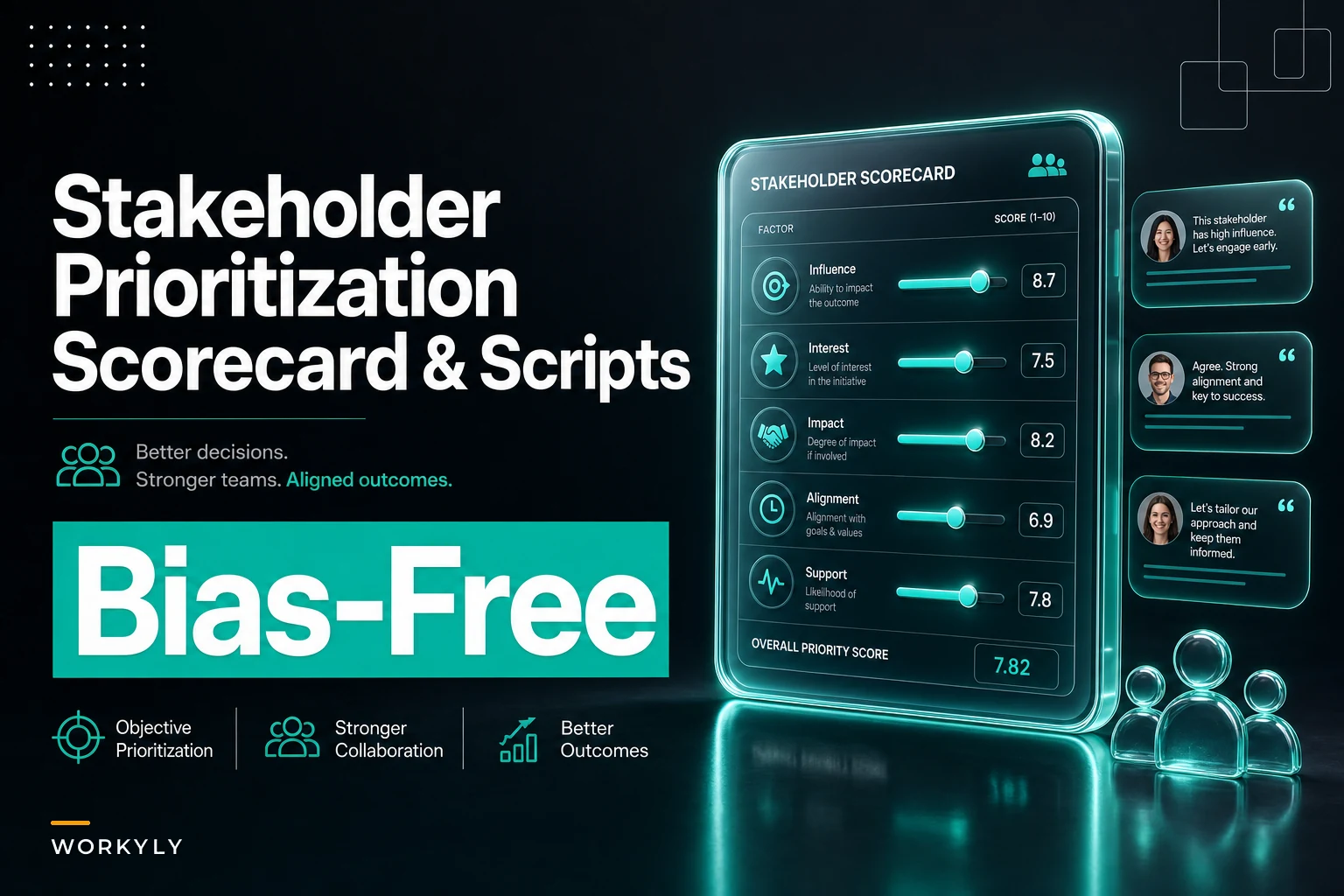

Marketing wants their landing page changes yesterday. Sales insists their CRM integration can't wait another week. Customer Success has three "critical" feature requests from enterprise clients. Meanwhile, your product team is drowning in a backlog that keeps growing because nobody can agree on what actually matters.
Most teams handle this backwards. They focus on who's asking instead of what's needed. They negotiate endlessly instead of scoring objectively. They avoid hard conversations, so the same arguments resurface every sprint planning session.
Without a scoring model, the loudest voice wins. Without conversation scripts, every priority discussion becomes a political minefield. Without clear criteria, bias creeps into every decision — and nobody even notices it happening.
The hidden cost of broken prioritization
Most teams think broken prioritization just means working on the wrong things. The real damage runs deeper.
A design team at a logistics startup tracked their work for three months and found something alarming. They'd started and stopped the same dashboard redesign four times because different executives kept overriding the priority. Total wasted time: roughly 340 hours. Around two months of designer capacity burned on context switching alone.
What really kills productivity is the trust erosion. When teams see priorities flip constantly, they stop believing in any priority. They start sandbagging estimates. They work slower because they assume their current project will get deprioritized anyway. One engineering manager described it well: "My team doesn't sprint anymore. They jog, waiting for the next priority change."
A mid-sized SaaS company calculated that poor stakeholder request prioritization cost them over $1M annually through:
-
Delayed feature launches (lost revenue opportunities)
-
Increased contractor costs to handle "urgent" requests
-
Higher attrition from frustrated employees leaving
-
Technical debt from rushed, half-finished projects
The financial impact compounds fast.
Why traditional prioritization methods fail
RICE scores, value vs. effort matrices, MoSCoW analysis — these frameworks look good in theory. In practice, they fall apart the moment a VP walks in with an "urgent" request.
Stop losing track of your priorities.
Workyly helps you organize, assign, and track every task efficiently.
- Centralized task management
- Real-time collaboration
- Intelligent workflow automation
No credit card required
The problem isn't the frameworks themselves. It's that they assume rational actors working with complete information. Real stakeholders have competing incentives, incomplete visibility, and genuine emotional investment in their requests. Real organizations don't run on clean spreadsheets.
Traditional methods also fail at handling the human element. They don't account for:
-
Power dynamics (the CEO's pet project always wins)
-
Recency bias (the latest crisis gets top priority)
-
Squeaky wheel syndrome (persistent requesters get resources)
-
False urgency (everything gets labeled critical)
Take the typical scenario: Product uses RICE scoring to prioritize features. Marketing ignores it because "customer perception" isn't captured in the formula. Sales dismisses it because deal velocity isn't properly weighted. Engineering questions the effort estimates. By the time everyone's done debating the scoring methodology, three sprints have passed and nothing moved.
Building a lightweight scoring model that actually works
Effective stakeholder request prioritization doesn't require complexity — it requires consistency and transparency. Here's a model teams can realistically implement in under a week.
The 5-Factor Scoring Framework
1. Business Impact (0-5 points)
-
5
Directly affects revenue or reduces costs by >$100k annually
-
4
Impacts 50%+ of customers or a key strategic initiative
-
3
Affects 20-50% of customers or improves a key metric by 10%+
-
2
Affects 5-20% of customers or addresses a known pain point
-
1
Nice to have, affects <5% of customers
-
0
No measurable impact
2. Urgency Window (0-5 points)
-
5
Blocking current operations or customer commitments
-
4
Needed within 2 weeks for an external deadline
-
3
Needed within 1 month for a business milestone
-
2
Needed within the quarter for a planned initiative
-
1
Flexible timing, needed within 6 months
-
0
No specific timeline
3. Resource Efficiency (0-5 points)
-
5
Less than a day of effort, single person
-
4
2-3 days, single person
-
3
1 week, small team (2-3 people)
-
2
2-4 weeks, small team
-
1
1-2 months, full team
-
0
More than 2 months or requires new hires
4. Risk Reduction (0-5 points)
-
5
Eliminates a critical business risk or compliance issue
-
4
Significantly reduces operational risk
-
3
Addresses a moderate security or stability concern
-
2
Improves reliability or reduces minor risks
-
1
Marginal risk improvement
-
0
No risk impact
5. Strategic Alignment (0-5 points)
-
5
Core to primary business strategy
-
4
Directly supports OKRs for the current quarter
-
3
Enables future strategic initiatives
-
2
Aligns with team goals
-
1
Tangentially related to strategy
-
0
No strategic connection
Sample Scorecards in Action
| Request | Business Impact | Urgency | Resources | Risk | Strategy | Total |
|---|---|---|---|---|---|---|
| Sales: CRM integration | 4 (affects all deals) | 3 (Q4 planning) | 2 (4 weeks) | 2 (data accuracy) | 4 (revenue OKR) | 15 |
| Marketing: Landing page | 2 (conversion lift) | 4 (campaign launch) | 4 (2 days) | 0 (no risk) | 2 (brand initiative) | 12 |
| Support: Ticket routing | 3 (response times) | 2 (ongoing pain) | 3 (1 week) | 3 (SLA compliance) | 3 (CX goals) | 14 |
The scores reveal what gut feelings obscure. The CRM integration wins not because Sales shouted loudest, but because it holds up across multiple dimensions. Marketing's request, despite the campaign deadline pressure, doesn't carry enough business impact to jump the queue. That's a much easier conversation to have when the numbers are sitting right there in front of everyone.
Here's a simple diagram of the triage workflow.
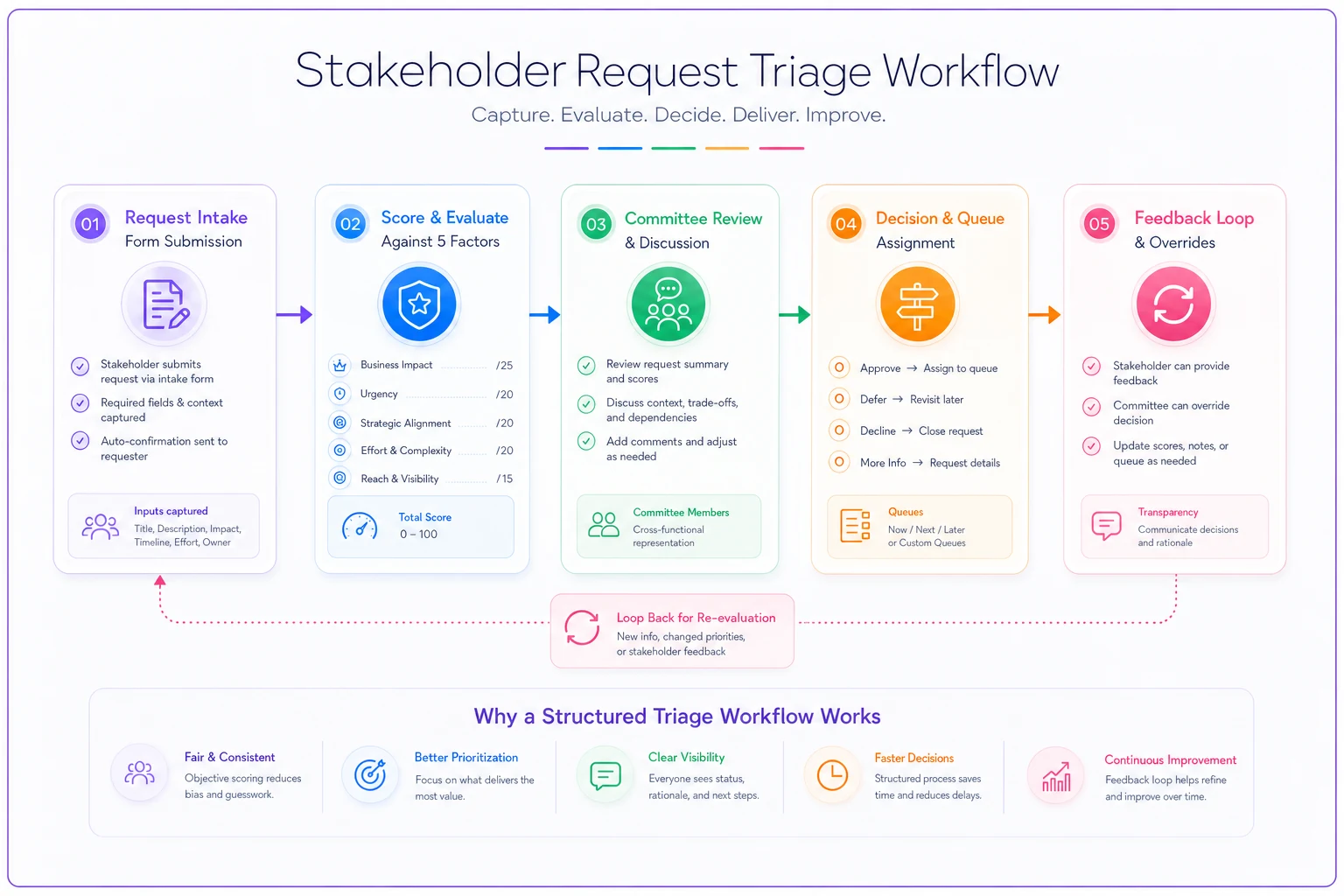
It shows how requests move from intake to scoring to committee review and then into the backlog or sprint queue.
Conversation scripts that shut down bias
Scoring models mean nothing if stakeholders can override them at will. You need conversation frameworks that redirect emotional arguments back to objective criteria.
Script 1: The Redirect to Criteria
Stakeholder: "This needs to be top priority. The CEO mentioned it in the all-hands." Response: "I understand the CEO's interest in this. Let's score it against our framework to see where it lands. Can you help me understand the business impact — how many customers does this affect, or what revenue is at stake?"
This acknowledges the political pressure while firmly redirecting to objective measures. You're not dismissing their concern — you're channeling it through the proper evaluation process.
Script 2: The Evidence Request
Stakeholder: "Customers are screaming for this feature. It's critical." Response: "That sounds concerning. Can you share the specific customer feedback? How many customers have requested this, and what's the impact on their operations? Having concrete data will help us score the urgency accurately."
Notice this doesn't challenge the claim directly. It asks for evidence that can be evaluated objectively. Most "critical" requests deflate pretty quickly when you ask for specifics.
Script 3: The Trade-off Clarification
Stakeholder: "We need to add this to the current sprint immediately." Response: "Looking at our capacity, adding this means stopping work on [current priority]. That project scores 18 on our framework and affects [specific metrics]. This new request scores 12. Are you comfortable with that trade-off, or should we revisit the scoring?"
Making trade-offs explicit forces stakeholders to confront the real cost of their request. They can't pretend resources are unlimited when you show them exactly what gets dropped.
Script 4: The Collaborative Scoring
Stakeholder: "This is definitely a 5 for business impact." Response: "Let's walk through the scoring criteria together. A 5 means direct revenue impact over $100k annually. Can you help me understand how this request reaches that threshold? If it's not quite there, we might be looking at a 3 or 4, which is still significant."
This makes the stakeholder your partner in accurate scoring rather than your adversary. They often self-correct when they see the specific criteria laid out in front of them.
Making the model stick: Enforcement mechanisms
A scoring model without enforcement is just expensive documentation. Here's how to make it operational:
Weekly Triage Meetings Every Monday, stakeholders submit requests through a standard form. The following morning, the triage committee — product, engineering, operations — scores each request. No exceptions, no offline negotiations.
Quarterly Calibration Sessions Every quarter, review the accuracy of your scoring. Did that "5 impact" project actually deliver $100k in value? Adjust scoring criteria based on real outcomes, not theoretical frameworks.
Public Scoring Dashboard Make all scores visible. When stakeholders see their request sitting at #7 with a score of 11, while #1 has a score of 19, the math speaks for itself. Transparency kills backdoor politicking.
Document overrides with who, why, and a measurable impact so calibration sessions have concrete evidence.
Exception Documentation Sometimes you'll need to override scores for legitimate reasons. Document every override: who made the decision, why, and what the impact was. Review these quarterly. If you're overriding constantly, the scoring model needs adjustment.
When scoring models break down (and what to do)
Even solid frameworks hit edge cases. Here's how to handle the common failure modes.
The Everything-is-a-5 Problem When stakeholders inflate every score to game the system, require evidence for any score above 3. Business impact of 5? Show the revenue projection. Urgency of 5? Document the specific deadline and consequence.
The Executive Override When leadership bypasses the entire process, don't fight it directly. Document the override and its downstream impact on other priorities. After a few months, present the data: "Executive overrides delayed these five projects, costing approximately $X in delayed revenue." Let the numbers do the arguing.
The Scope Creep When approved requests expand after scoring, implement change control. Any scope change triggers re-scoring. That "quick addition" might drop the resource efficiency score from 4 to 2, which changes the entire priority picture.
Building organizational muscle memory
The real goal isn't perfect scoring — it's consistent, bias-free decision making that eventually becomes automatic. That takes time and repetition.
Start with a pilot team. Pick one that's suffering from constant priority changes. Run the model for one month and document everything: time saved, conflicts avoided, clarity gained. Use that data to sell the broader rollout.
Track specific metrics:
-
Time from request to decision (should drop significantly)
-
Number of priority changes mid-sprint (should approach zero)
-
Stakeholder satisfaction scores (often improve even when people hear "no" more often)
-
Team velocity (typically increases as context switching drops)
One product team tracked this carefully. Before implementing structured stakeholder request prioritization: 3.2 priority changes per sprint, 47% of work completed. After three months with the scoring model: 0.4 changes per sprint, 78% completion rate. Hard to argue with those numbers.
The gains compound over time too. Once teams stop getting burned by last-minute priority flips, they start planning differently. Better estimates, more realistic commitments, less defensive padding in timelines. It's a slower change than people expect, but it's durable.
The technology multiplier
Disciplined process matters most, but the right operational software amplifies it. Modern AI-powered platforms can automate request intake, calculate scores based on your criteria, and maintain a full audit trail of every decision made.
Where AI automation genuinely helps is pattern recognition. When the system notices that marketing requests consistently score low on strategic alignment, it can flag this before submission and suggest adjustments. When engineering's effort estimates prove consistently off, the system can surface that data for calibration conversations rather than letting it quietly distort priorities for months.
The real leverage comes from centralizing all request data. Instead of spreadsheets, emails, and scattered Slack threads, everything lives in one place. Stakeholders can see their request status in real-time. Teams can pull historical data to improve scoring accuracy. Leadership gets actual visibility into where organizational attention is going — versus where they assume it's going.
That said, the technology supports the process, not the other way around. If you can't make prioritization work with a spreadsheet and a weekly meeting, no amount of sophisticated software will fix it. Start with the discipline, then add the tools.
The path forward
Broken stakeholder request prioritization isn't really a tools problem or even a process problem — it's a discipline problem. Most teams already know what they should prioritize. They just lack the framework and the willingness to enforce those priorities when a VP shows up with a hot take.
The scoring model gives you the framework. The conversation scripts give you the language. The enforcement mechanisms give you the structure. What's left is the organizational will to say no to decent ideas so you can actually finish the great ones.
Start with one request tomorrow. Pick your five scoring factors, build a simple scorecard, run one request through it. Build from there. Within a month, you'll wonder how decisions ever got made without it.
The alternative — letting the loudest voice win, the latest crisis dominate, and political capital determine priority — has one predictable outcome: your best people leave for organizations that actually know how to focus. And honestly, they'll be right to go.
Ready to boost your team's productivity?
Join 5,000+ teams using Workyly to streamline workflows, improve communication, and deliver projects faster.