
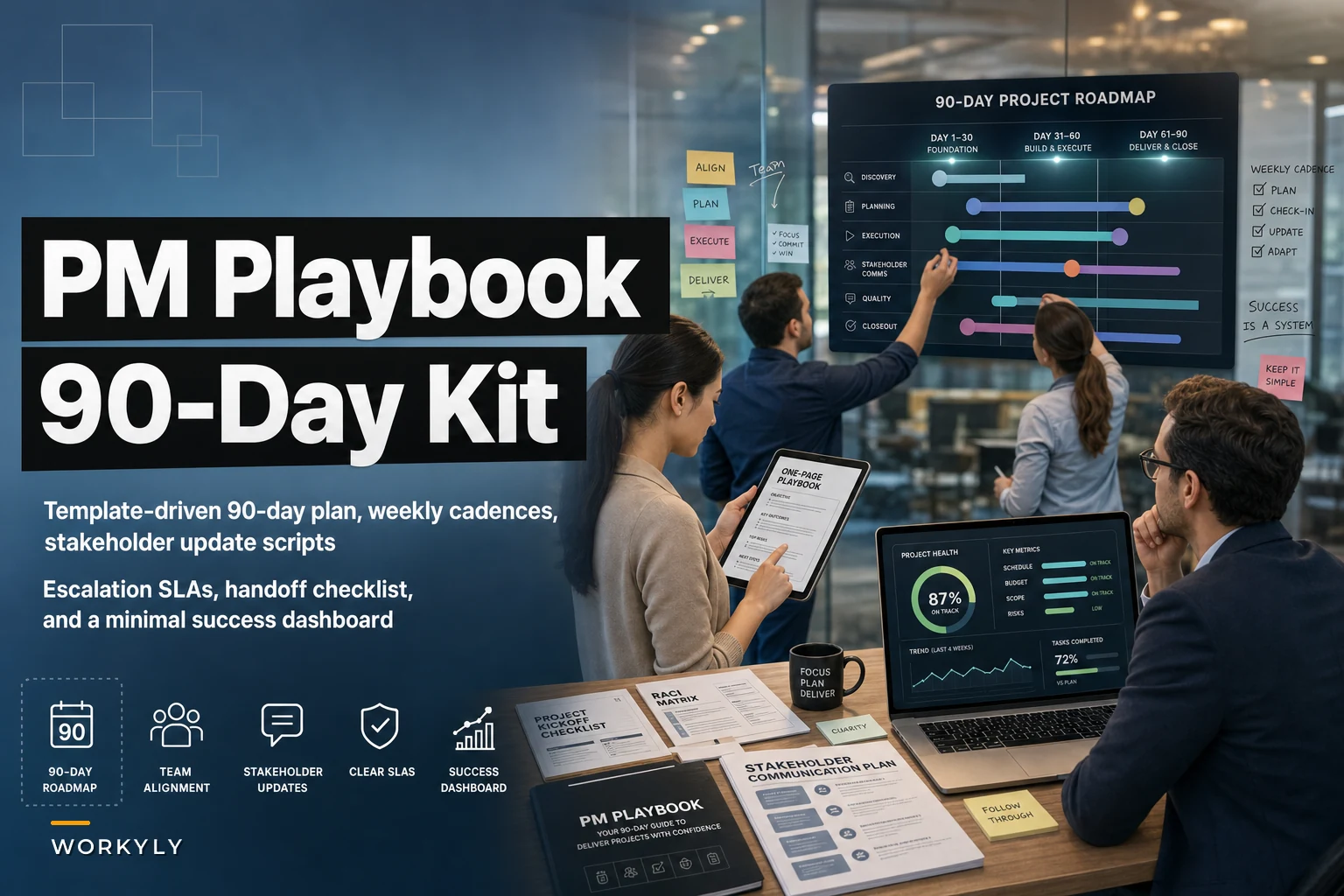

Most project plans look great on day one and get abandoned by day thirty. Not because the PM is lazy, but because the plan was a document instead of a cadence. A kickoff deck doesn't survive contact with four teams, a slipping vendor, and a stakeholder who keeps changing the acceptance criteria.
What holds a project together is a small set of repeating moves — who you talk to, when, with what artifact in hand, and what decision you force at each checkpoint. This playbook gives you a 90‑day backbone plus the rituals that outlast it. It's built so you can start Monday without asking anyone to reorganize the company.
I'm walking through it as a timeline, because that's how projects actually fail — in sequence, not all at once. The mistakes in week 2 are different from the ones in week 9, and the templates you need shift with them.
The 90‑day shape: three gates, not twelve weeks
Thinking in weeks makes you track activity. Thinking in gates makes you track decisions. The whole plan collapses into three gates, each roughly 30 days apart:
| Gate | Timing | The one question you must answer | Artifact that proves it |
|---|---|---|---|
| Gate 1 – Commitment | ~Day 10 | Do we agree on scope, owners, and what "done" means? | Charter + RACI + acceptance criteria |
| Gate 2 – Flow | ~Day 45 | Is work actually moving at the rate we promised? | Risk register + flow snapshot + dependency board |
| Gate 3 – Landing | ~Day 80 | Can we hand this off without it bouncing back? | Handoff checklist + verification sign‑off |
Everything between the gates is cadence. The gates are where you stop and make a call. The most common failure isn't missing a deadline — it's drifting past a gate without anyone deciding whether to keep going. Projects don't die from bad news. They die from unacknowledged bad news.
Days 1–10: Kickoff and the Commitment gate
The first ten days are about forcing agreement before anyone writes code, drafts copy, or orders inventory. This is the cheapest window you'll ever have to kill ambiguity.
Stop losing track of your priorities.
Workyly helps you organize, assign, and track every task efficiently.
- Centralized task management
- Real-time collaboration
- Intelligent workflow automation
No credit card required
What to actually produce
-
Project charter — problem statement, the measurable outcome, scope boundaries (including an explicit out‑of‑scope list), and the three constraints you're optimizing against. The out‑of‑scope list does more work than anything else on the page.
-
RACI — kept deliberately lean. For a project with four workstreams you want one Accountable name per workstream, period. If two names show up as Accountable for the same thing, you don't have a RACI, you have a future argument.
-
Acceptance criteria — written as testable statements, not adjectives. "Checkout loads fast" is a complaint waiting to happen. "Checkout page interactive under 2s on a mid‑tier phone" is a criterion.
-
Communication plan — a tiny grid
who gets what, how often, through which channel.
A workable communication grid looks like this:
| Audience | What they get | Cadence | Channel |
|---|---|---|---|
| Exec sponsor | 5‑line status + one decision needed | Weekly | |
| Core team | Board review + blockers | 2x/week | 15‑min standup |
| Dependent teams | Dependency changes only | As they change | Shared board |
| Broader org | Milestone hit/missed | At each gate | Channel post |
Most status noise comes from sending everyone the same update. Exec sponsors don't want your standup notes, and your core team doesn't need milestone framing. Segmenting by audience cuts your reporting time and, oddly, raises how seriously people take your updates.
The Commitment gate meeting (45 minutes, max)
-
Walk the charter outcome and scope boundaries (10 min)
-
Confirm each Accountable owner out loud, by name (10 min)
-
Read the acceptance criteria and get explicit yes/no on each (15 min)
-
Lock the risk register's top five starting risks (10 min)
If you can't get a verbal "yes, I own that" from every Accountable person in this meeting, you haven't passed the gate. Write down who hesitated. That hesitation is your first risk entry.
Days 11–45: Running cadence toward the Flow gate
Now the plan has to survive real work. This stretch is where most PMs either over‑meet or go dark, and both are failure modes.
The weekly rhythm that actually holds
-
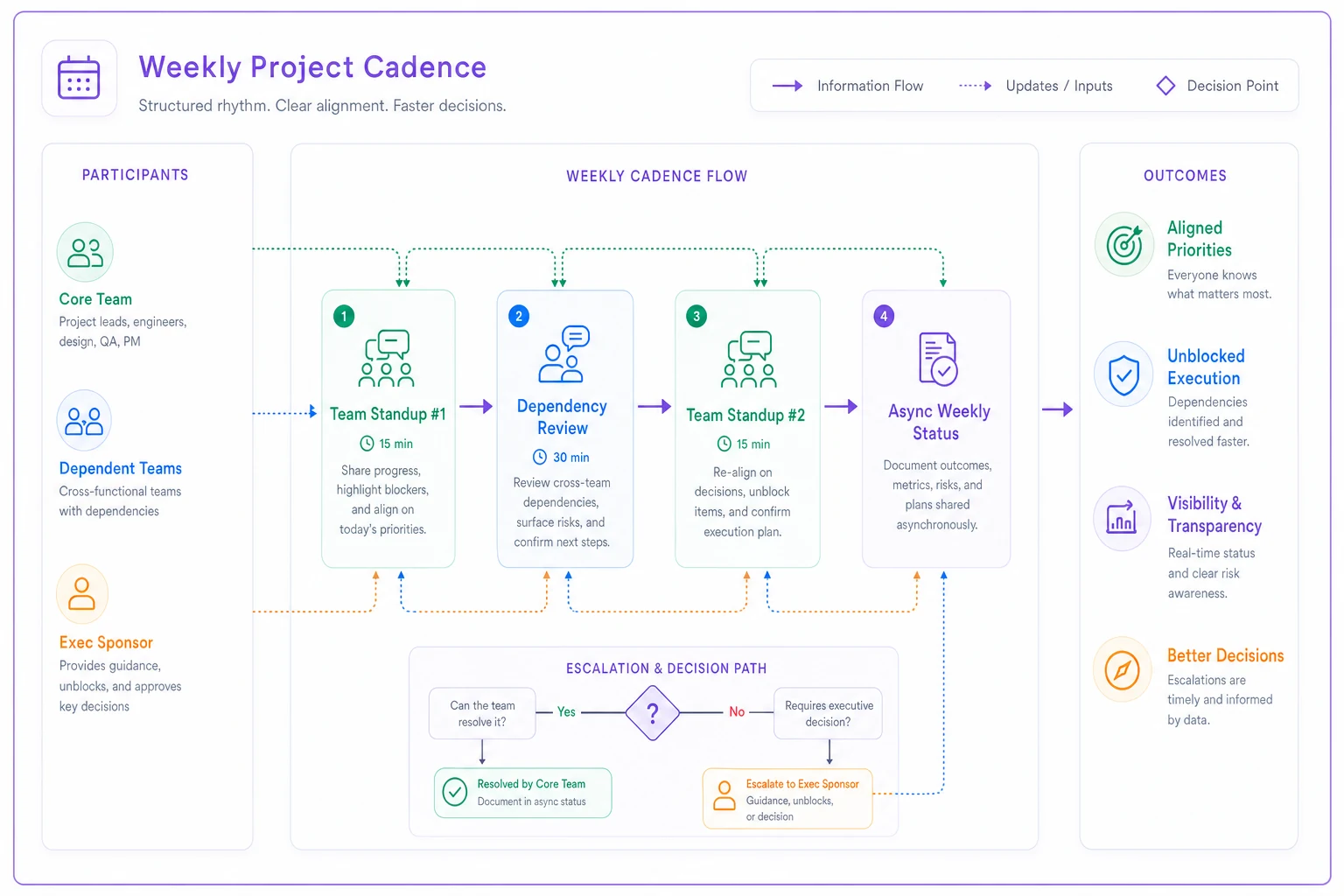
Two 15‑minute standups (not daily — daily standups on a 90‑day project become status theater by week three). Blockers and movement only.
-
One 30‑minute dependency review where you touch only items that cross team lines.
-
One async weekly status that you write, not meet about. Five lines: what moved, what's stuck, what decision I need, risk changes, next milestone date.
That async status is the single highest‑leverage artifact in the whole playbook. It forces you to confront whether the project actually moved this week, and it creates a written trail that saves you at the Gate 2 review.
A quick visual of this weekly cadence:
The risk register that doesn't rot
Most risk registers get opened once at kickoff and never touched again. A register only earns its place if it has three live columns beyond the risk itself:
-
Owner (a person, not a team)
-
Trigger (the observable signal that this risk is becoming real)
-
Next review date (so dead risks age out and hot ones resurface)
The trigger column is what separates a useful register from a graveyard. "Vendor may slip" is useless. "Vendor hasn't confirmed the staging environment by day 30" is something you can actually watch for. When a trigger fires, the risk becomes an escalation — which brings us to the part everyone gets wrong.
Use the trigger as the basis for an automated watch so risks don't silently age out.
Escalation paths: define them before you need them
The worst time to figure out how to escalate is the moment you need to. By then it feels political. Define the lanes during the calm of week two:
| Severity | Example | Who decides | Response window |
|---|---|---|---|
| Lane 1 | Blocker inside one team | Workstream owner | Same day |
| Lane 2 | Cross‑team dependency stalled | PM + both owners | 48 hours |
| Lane 3 | Scope, budget, or timeline at risk | Exec sponsor | 72 hours, scheduled |
An escalation isn't a complaint — it's a request for a decision with a deadline attached. When you frame it that way in writing — "I need a go/no‑go on X by Thursday or we lose the week" — escalations stop feeling like finger‑pointing and start functioning as a tool.
The Flow gate meeting (~Day 45)
This is a reality check, not a status update. Three questions:
-
Is the actual delivery rate matching what we committed at kickoff? (Pull the flow snapshot — completed work vs. planned, not a feelings‑based "we're on track.")
-
Which risks fired, and did we respond in the window we promised?
-
Does anything in scope need to change based on what we've learned?
If delivery is lagging, this is where you make the hard call: cut scope, add capacity, or move the date. Doing nothing is also a choice, and it's usually the wrong one. Projects rarely recover a 20% delivery gap in the back half by "trying harder."
If you want to connect your project‑level flow numbers to what leadership actually cares about, it's worth structuring that translation deliberately — the piece on cross‑level metrics architecture mapping flow metrics to executive KPIs covers how to avoid showing executives raw team metrics they can't act on.
Days 46–80: Pushing toward Landing
The middle third is where fatigue sets in and the original acceptance criteria start getting quietly reinterpreted. Your job here is to protect the definition of done you fought for on day 10.
Watch for scope creep that disguises itself as "clarification"
The dangerous requests in this phase don't announce themselves as new scope. They arrive as "just a small tweak" or "we always assumed this was included." A typical example: a stakeholder who signed off on "export to CSV" in week 1 now expects "export to CSV, Excel, and a scheduled email." Each sounds minor. Together they add two weeks.
The fix is procedural, not confrontational. Any change to accepted criteria goes through a one‑line change log with a stated cost: "Adding scheduled export = +4 days, moves Gate 3 from day 80 to day 84. Approve?" Make the tradeoff visible and let the sponsor own it. You're not saying no — you're pricing the yes.
Start the handoff conversation now, not at the end
Teams that wait until day 80 to think about handoff always bounce. Start lining up the receiving team's expectations around day 50. Who maintains this after launch? What do they need documented? What does their acceptance look like — because it's often different from the sponsor's.
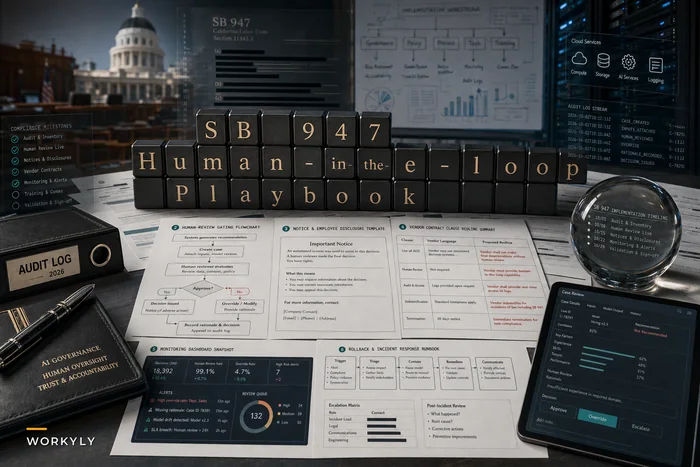
This matters even more when the handoff involves automated steps or any human‑approval requirement in the workflow. If part of what you're shipping includes automated decisions, the rules around keeping a human in the loop aren't optional niceties — the operational playbook for human‑in‑the‑loop requirements breaks down where those checkpoints legally and practically need to sit.
Days 81–90: The Landing gate and clean close
A project isn't done when the work is finished. It's done when someone else can own it and you can walk away without a pager.
The handoff checklist
-
- [ ] All acceptance criteria verified against the original wording (not the softened version)
-
- [ ] Receiving team has confirmed in writing they can operate it
-
- [ ] Documentation covers the "how do I fix it when it breaks" case, not just the happy path
-
- [ ] Open risks transferred with owners, or explicitly accepted and closed
-
- [ ] Decisions made during the project are written somewhere findable
-
- [ ] Access, credentials, and ownership formally reassigned
-
- [ ] A rollback or fallback path exists and has been tested at least once
-
- [ ] Final status sent to all four audiences in the comms grid
The item people skip most: written confirmation from the receiving team. Without it, "handoff" means "the PM stopped paying attention" and the work quietly rolls back to you three weeks later.
The close meeting
Keep it to 30 minutes. Confirm the checklist, capture the two or three things that genuinely surprised you during the project, and name what you'd do differently. Not a blame session — a short, honest extraction of what the next project should inherit.
When this playbook fits — and when it doesn't
When it makes sense
-
Cross‑functional projects running 2–4 months with three or more teams involved
-
Work with a real handoff at the end (to ops, to another team, to a client)
-
Situations where accountability is fuzzy and you need to force ownership early
When it's overkill
-
Solo work or a two‑person effort where the overhead costs more than it saves
-
Pure maintenance streams with no defined end — those need a flow system, not a gated plan
-
Research spikes where the whole point is that you don't know the outcome yet
Who should NOT run it as‑is
If your organization can't tolerate a PM saying "we missed the Flow gate, here's the decision I need" without it turning political, fix the culture first or the gates become theater. A gate you're not allowed to fail is just a calendar entry.
A real scenario
A regional marketing agency — around 35 people — kept blowing past client launch dates. Their projects averaged a planned 8 weeks and routinely landed at 11 or 12. The pattern was always the same: scope quietly grew, nobody escalated until the last week, and handoffs to the account team bounced because "done" was never written down.
They didn't buy new software or restructure. They adopted the three‑gate shape and the one‑line change log. The first measurable shift was at the Flow gate — they started catching delivery gaps around week 5 instead of week 10, which left actual room to cut scope or move the date on purpose.
Over the next two quarters, their average overrun dropped from roughly three weeks to under one, and handoff bounce‑backs became rare rather than routine. Nothing exotic happened. They just stopped drifting past decision points. The cost of the change was mostly a few uncomfortable gate meetings where someone had to say out loud that a project was behind.
The rituals that keep it alive after day 90
The playbook's a project tool, but the muscle underneath it is operational. If you find your gates slipping or your async statuses going stale across multiple projects, that's usually not a discipline problem — it's a system one. A quick productivity operating model audit is a reasonable way to figure out whether the cadence is failing because people won't follow it or because the process has too much friction to follow.
-
Weekly async status — five lines, non‑negotiable, written not met.
-
Risk register review — ten minutes, kill dead risks, surface hot ones by their triggers.
-
Gate decisions made out loud — a gate you pass silently isn't a gate.
-
Change log with a price tag — every scope change carries its cost in days.
Keep these four rituals and you can run this playbook on autopilot:
The value of a project manager playbook isn't the artifacts. Anyone can download a RACI template. The value is in the sequence — forcing commitment at day 10, forcing an honest flow check at day 45, and protecting the definition of done all the way to handoff. The templates just make those forcing moments cheap to run.
Start with the three gates this week. You don't need permission, a tool rollout, or an org change to put three decision points on the calendar and write a five‑line status. Everything else in the playbook is there to support those moments — and those moments are where projects are actually won or lost.
Ready to boost your team's productivity?
Join 5,000+ teams using Workyly to streamline workflows, improve communication, and deliver projects faster.