

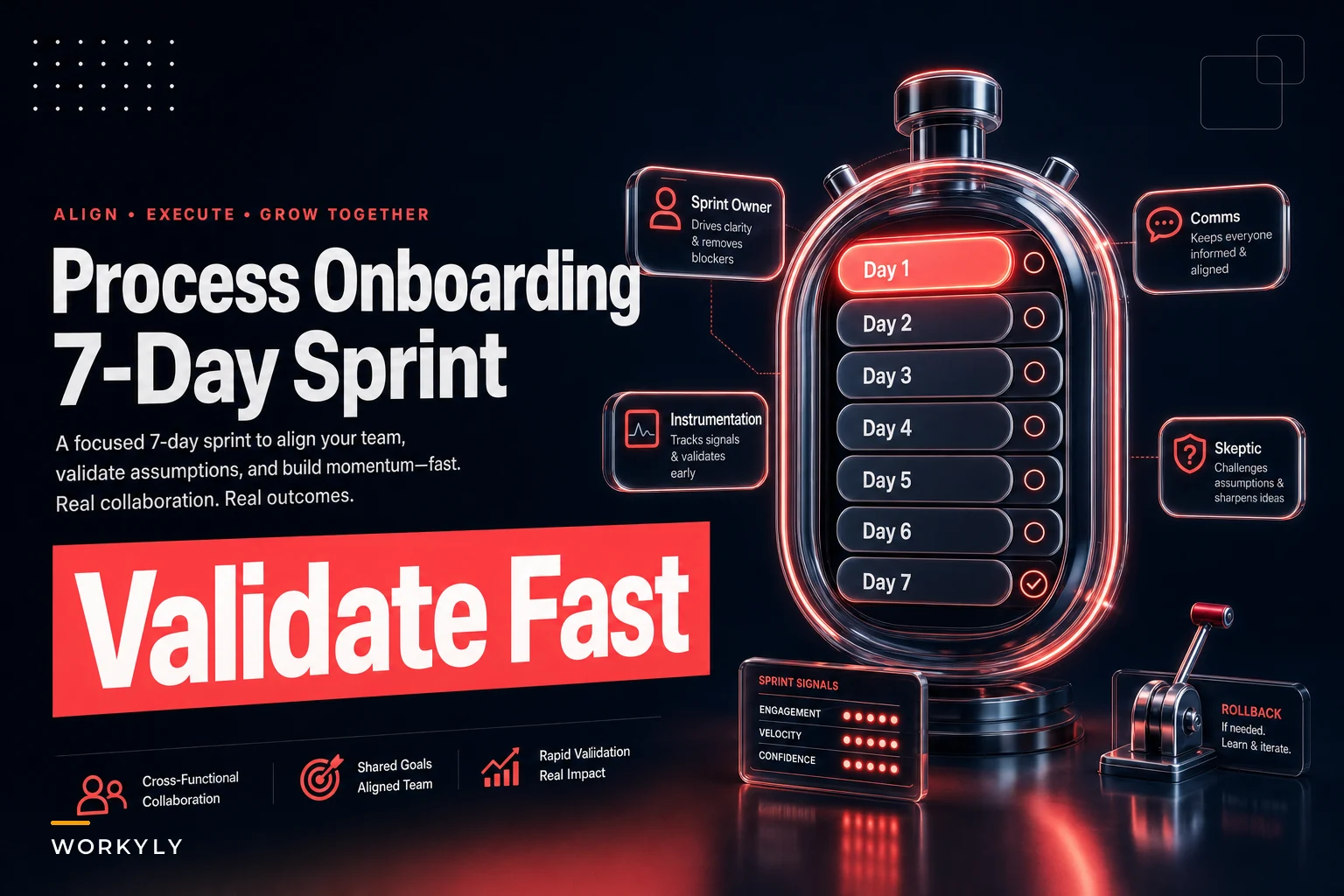

Most new processes don't die because they were bad ideas. They die because nobody picked a specific date to decide whether they worked. The rollout drifts. Half the team adopts it, half ignores it, and three weeks later someone asks "are we still doing the Tuesday thing?" and nobody really knows.
A process onboarding sprint targets that exact failure mode — where a routine gets introduced with enthusiasm and then slowly evaporates because nobody looked at the evidence. Seven days. Enough instrumentation to know if it's working, not so much that you spend the whole week building measurement infrastructure instead of actually running the process. Clear owners. Pre-written messages so communication doesn't become something you reinvent daily. And rollback triggers agreed before you start, so pulling the plug is a decision, not an argument.
This isn't a change-management framework. It's a tight validation loop for one specific routine — a new standup format, a handoff checklist, an intake step, a review gate — where you want an honest yes/no in a week.
Why one week, and why most rollouts skip the deadline
The one-week window is doing real work here. It's short enough that people will tolerate trying something new, and short enough to hold their attention. Stretch the validation window to a month and two things happen: novelty wears off, and the results get contaminated by everything else changing around the process.
The pattern that comes up repeatedly is a team introducing a routine with an open-ended "let's try this for a while." A while has no end date, which means there's no moment where anyone is actually accountable for the verdict. The process enters a kind of limbo — not officially adopted, not officially killed, just slowly forgotten while everyone reverts to old habits under deadline pressure.
A sprint forces the opposite. Day 7 has a meeting on the calendar where someone says "keep, adjust, or kill" and points at data. That single forcing function does more for adoption than any amount of internal evangelism.
The other reason a week works: you can pre-write everything. Seven days of messages, one instrumentation setup, one role sheet. Front-load the thinking so the sprint itself runs almost on autopilot.
What "minimal instrumentation" actually means
The mistake most teams make is over-instrumenting. Someone decides that to validate the new handoff process they need a dashboard tracking twelve metrics, and building it takes longer than the sprint itself. By the time the data's flowing, everyone's lost interest.
Stop losing track of your priorities.
Workyly helps you organize, assign, and track every task efficiently.
- Centralized task management
- Real-time collaboration
- Intelligent workflow automation
No credit card required
Minimal instrumentation means picking two or three signals you can capture without new tooling — ideally by hand. For a one-week sprint, a shared spreadsheet with three columns beats a fancy analytics integration every time.
Pick your signals like this: one adoption metric (did people actually do it), one outcome metric (did it help), and optionally one friction metric (what did it cost).
| Process being validated | Adoption signal | Outcome signal | Friction signal |
|---|---|---|---|
| New pre-standup async update | % of team posting before 9am | Standup length in minutes | Time spent writing the update |
| Handoff checklist between design/dev | % of handoffs using the checklist | Rework requests after handoff | Extra minutes per handoff |
| Ticket triage tagging step | % of tickets tagged at intake | Time-to-assignment | Tagging time per ticket |
| Weekly written status instead of meeting | % submitting on time | Questions asked async vs meeting | Minutes to write status |
These are all countable by a human in under a minute a day. If your instrumentation requires more than a five-minute daily entry per person, you've over-built it for a one-week test.
One thing worth flagging: capture a rough baseline before day 1. You don't need three months of history. Even a single honest estimate — "standups currently run about 25 minutes" or "we get maybe four rework requests a week from bad handoffs" — gives you something to compare against. Without a baseline, your day-7 numbers are just numbers.
Use a shared spreadsheet with three columns to log signals quickly so daily entry stays under five minutes.
If your instrumentation requires more than a five-minute daily entry per person, you've over-built it for a one-week test.
Role assignments: four people, no committee
Sprints stall when everyone owns them, which means nobody does. Assign four roles up front. On a small team one person can hold two, but the roles should still be named out loud.
-
Sprint owner — makes the keep/adjust/kill call on day 7. This is the one non-negotiable role. Someone's name goes here.
-
Instrumentation keeper — owns the tracking sheet, nudges people to log, and pulls the numbers together. Usually about 10 minutes a day.
-
Comms driver — sends the pre-written daily messages and handles "wait, how does this work again?" questions.
-
Skeptic — this is the role people skip, and it's a mistake. Assign someone to actively look for reasons the process is failing. Their job is to surface friction that the enthusiastic majority will politely ignore.
The skeptic role deserves a note. The person who introduced the new process is emotionally invested in it working, which quietly biases the whole evaluation. Naming an official skeptic gives someone permission to say "this is slowing me down" without seeming like they're just resisting change. That honesty is exactly what you need by day 7.
The person who introduced the new process is emotionally invested in it working, which quietly biases the whole evaluation. Naming an official skeptic gives someone permission to say "this is slowing me down" without seeming like they're just resisting change. That honesty is exactly what you need by day 7.
The day-by-day sprint
Here's the actual seven-day structure. The heavy work happens on day 0 (prep) and day 7 (verdict). The middle days are deliberately light.
-
Day 0 — Setup (before the sprint starts). Write the one-paragraph description of the new process. Set up the tracking sheet with your two or three signals. Record the baseline. Assign the four roles. Draft the seven daily messages. Agree the rollback triggers (next section) and write them somewhere everyone can see them. This is where 80% of your effort goes.
-
Day 1 — Launch. Comms driver sends the kickoff message
what we're trying, why, for how long, what "done" looks like, and where to log. Keep the process itself as small as possible. If people have to relearn their whole workflow, adoption tanks.
-
Day 2 — First friction check. Instrumentation keeper logs adoption. The skeptic collects any "this is annoying because..." comments. Don't fix anything yet — you're gathering, not reacting. Resist the urge to tweak the process on day 2; you'll contaminate your own results.
-
Day 3 — Midpoint pulse. Quick async check
is adoption above your rollback floor? If half the team hasn't touched the new process by day 3, that's data, not a reason to panic-message everyone. Note it.
-
Day 4 — Steady state. Ideally the quietest day. If the process is going to work, this is where it starts feeling normal. Keep logging.
-
Day 5 — Outcome check. Now look at your outcome signal, not just adoption. People might be doing the process without it actually helping. Both matter, and they're different questions.
-
Day 6 — Assemble the picture. Instrumentation keeper pulls the week's numbers into one view. Skeptic writes three sentences on the biggest friction point. Comms driver reminds everyone the verdict meeting is tomorrow.
-
Day 7 — Verdict. 30-minute meeting. Sprint owner presents baseline vs. week's numbers, the skeptic's notes, and makes the call: keep as-is, keep with a specific adjustment, or kill. Whatever the decision, it gets communicated same day. No "let's think about it" — that's just putting the process back in limbo.
A visual of the week can help keep roles and steps clear.
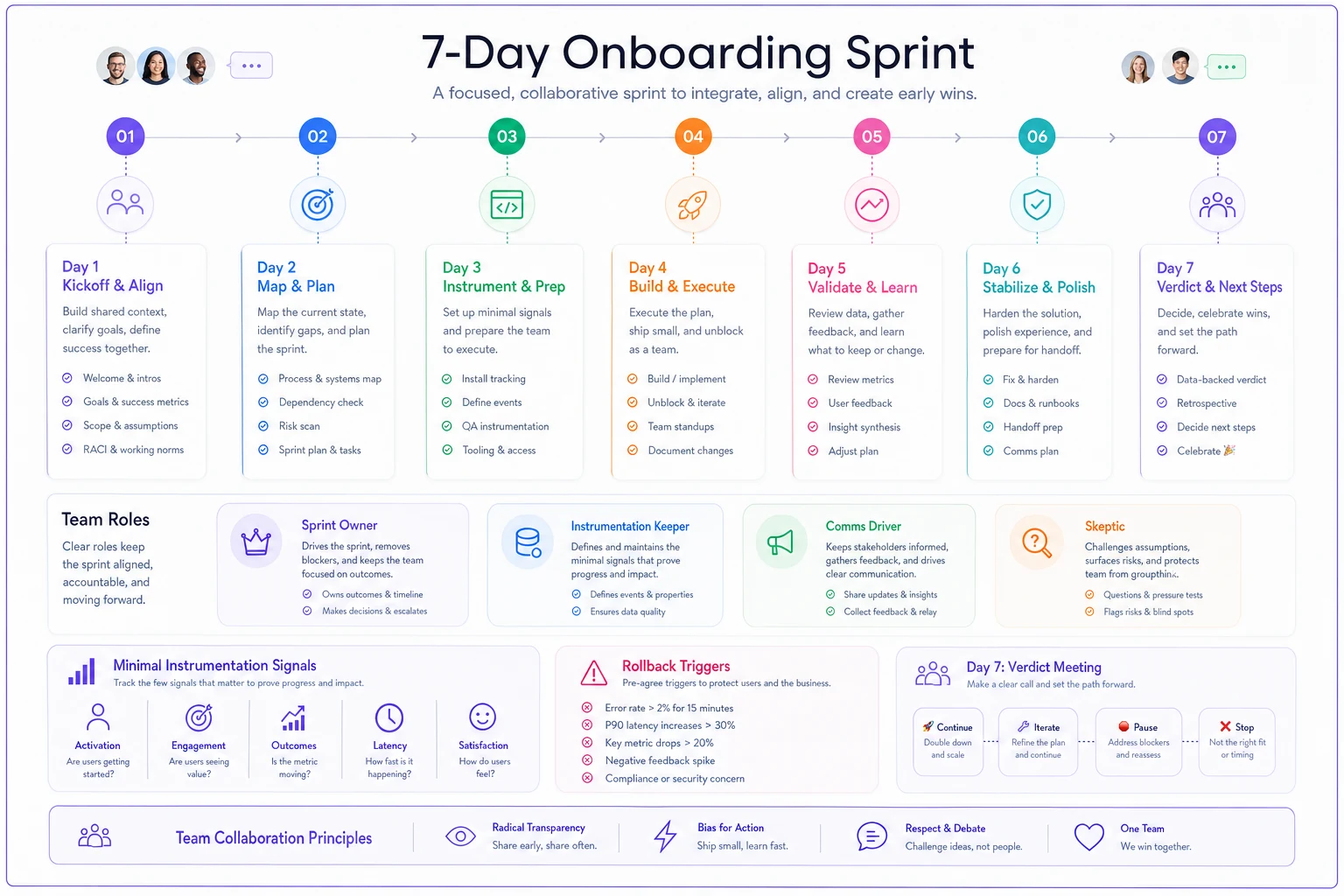
The compression of everything into day 7 is the whole point. Everyone knows the deadline going in, which changes how seriously they engage during the week.
Rollback triggers: decide before you're emotionally invested
This is the part almost everyone skips, and it's the part that makes the sprint safe to run. A rollback trigger is a pre-agreed condition that, if hit, ends the sprint early or forces a kill on day 7 — decided before the sprint starts, when nobody's ego is on the line.
The value is as much psychological as operational. On day 4, when the process is struggling but the person who championed it is arguing "just give it more time," a pre-written trigger settles the debate. You're not trading opinions; you're checking a condition everyone agreed to when things were calm.
Good triggers are specific and observable:
-
Adoption floor "If fewer than 60% of the team is using the process by day 3, we stop and diagnose before continuing."
-
Harm ceiling "If the new triage step adds more than 10 minutes to any urgent ticket, we roll back immediately." (Safety and customer-facing triggers should be instant, not day-7.)
-
Outcome flatline "If our outcome signal hasn't moved at all by day 5, default to kill unless someone makes a strong case."
-
Cost trigger "If the friction signal exceeds the time saved, kill regardless of adoption."
Write these as literal if-then statements. Vague triggers ("if it's not working we'll stop") are worthless because "working" becomes an argument. The point is to remove the argument before it starts.
One practical note: separate instant rollback triggers from day-7 kill defaults. Anything that risks customers, safety, or breaking existing work should trigger an immediate stop. Everything else can wait for the verdict meeting.
Communication templates you write once
The comms driver shouldn't be inventing messages daily. Draft these on day 0. They can be rough — they just need to exist so nobody's staring at a blank message box mid-sprint.
Kickoff (Day 1): > Starting today, we're trialing [process] for one week. Why: [one sentence]. How: [two sentences max]. Log it here: [link]. On [day 7 date] we decide keep/adjust/kill based on the numbers. Questions to [comms driver].
Midpoint nudge (Day 3): > Day 3 of the [process] trial. Current adoption: [X%]. Verdict meeting is [day/time]. If something's slowing you down, tell [skeptic] — that feedback is the point, not a complaint.
Verdict (Day 7): > Decision on [process]: [KEEP / ADJUST / KILL]. Here's what the week showed: [2–3 lines of numbers]. [If keep: this is now standard, here's where it lives. If adjust: here's the one change. If kill: thanks for testing, we learned X.]
Having these ready means the sprint doesn't depend on someone feeling articulate on a busy Thursday.
A real scenario: a 9-person marketing agency and a new brief handoff
A small agency kept losing time to incomplete creative briefs. Account managers would hand briefs to designers, designers would start work, then hit missing info — brand assets, deadlines, approval chain — and bounce it back. Rework was eating maybe 5–6 hours a week across the design team.
They ran a process onboarding sprint on a required six-field brief checklist. Setup took one afternoon: a shared sheet tracking two signals — percentage of briefs submitted with all six fields, and number of bounce-backs. The baseline was rough but honest: about four bounce-backs the prior week, and roughly a third of briefs arriving complete.
Rollback triggers: adoption floor of 60% by day 3, and a friction kill if the checklist added more than a few minutes per brief. Roles took five minutes to assign — design lead as skeptic, an account manager as comms driver.
By day 3 adoption sat around 70%, above the floor. By day 5, bounce-backs had dropped to one for the week. The friction signal came in low — account managers said the checklist took about two extra minutes but saved a full back-and-forth email thread, so it netted positive. Day 7 verdict: keep, with one adjustment (a seventh field for approval contact, which the skeptic flagged as the most common missing piece).
The honest part: it wasn't a dramatic transformation. Rework didn't hit zero. But they got a clear, evidence-backed yes in a week, and the process stuck because everyone had watched the numbers move rather than being told it was mandatory. That's the real difference — adoption through evidence, not decree.
When this makes sense — and when it doesn't
A sprint is the right tool when the process is small, reversible, and self-contained. A new standup format, a checklist, an intake tag, a status-update habit — things one team can adopt or drop without dependencies elsewhere.
It's a bad fit for changes that need infrastructure just to attempt. If validating the process requires building integrations, migrating data, or two days of training, a one-week sprint won't give you a clean read — you'll spend the week on setup and get no useful signal.
It's also wrong for anything you can't actually roll back. Reorganizing a database, changing a customer-facing commitment, restructuring roles — these aren't sprint material because there's nothing for the rollback trigger to grab onto.
Who should skip this entirely: teams that structurally can't make a decision on a deadline. If your organization cannot produce a verdict on day 7, a sprint just produces a well-instrumented process that still drifts into limbo. Fix the decision-making problem first.
Where this connects to the rest of your operating rhythm
A process onboarding sprint pairs naturally with a couple of habits worth having. The verdict meeting on day 7 works far better when its decisions actually convert into tracked actions rather than good intentions — the same discipline behind a retrospective-to-action system that guarantees follow-through. And if the process you're validating is meeting-related, the sprint runs cleaner when you've already got a way to convert meetings into clear asynchronous action items so the trial isn't buried inside another synchronous ritual.
The tracking side can be as simple as a spreadsheet, and for a one-week test it usually should be. If you're running these sprints often enough that manually chasing daily logs gets tedious, a lightweight workflow platform can handle the nudges and roll up adoption numbers automatically — but that's a convenience, not a prerequisite. Don't let tooling become the reason you delay a sprint you could start Monday.
The point
Processes don't fail to stick because they were bad ideas. They fail because nobody created a moment where someone looked at real evidence and made a call. A seven-day sprint manufactures that moment: minimal signals so you have data, named roles so someone's accountable, pre-written messages so communication runs itself, and rollback triggers written down while everyone's still calm.
Pick one small routine you've been meaning to try. Write the paragraph, set up the sheet, name the four people, draft the messages, agree the triggers. Start Monday. By the following Monday you'll have an honest answer instead of another process quietly rotting in limbo.
Ready to boost your team's productivity?
Join 5,000+ teams using Workyly to streamline workflows, improve communication, and deliver projects faster.