

Most teams implement WIP limits wrong because they copy what worked for someone else. Engineering reads about Kanban, sets everything to 3, and watches deployment frequency drop. Marketing tries the same limit and suddenly campaigns miss deadlines. Design refuses limits entirely, claiming creative work can't be constrained, then wonders why nothing ships.
The problem isn't WIP limits themselves. It's treating every team like they operate the same way.
Why universal WIP limits break down across different teams
A software development team working on a payment integration needs deep focus. Their work involves understanding complex APIs, writing secure code, handling edge cases. Context switching between three payment processors at once means none of them work properly. Their natural WIP limit might be 1 or 2 items per developer.
Marketing teams operate completely differently. They're waiting on approvals, coordinating with vendors, reviewing analytics, scheduling posts. A social media manager might have a campaign in design review, another being scheduled, content being written for next week, and performance data being analyzed from last month. Force them into a WIP limit of 2 and campaigns stop moving.
Design creates another pattern entirely. A designer might sketch concepts in the morning, wait for feedback, jump into revisions on a different project, then return to the original when something clicks. Their work naturally cycles between active creation and background processing.
These aren't preferences or personality differences. They're fundamental differences in how work flows through each discipline.
The hidden cost of wrong-fit WIP limits
An operations consultancy I worked with tried implementing uniform WIP limits across their teams. Every person got 3 active items maximum. Clean, simple, manageable.
Stop losing track of your priorities.
Workyly helps you organize, assign, and track every task efficiently.
- Centralized task management
- Real-time collaboration
- Intelligent workflow automation
No credit card required
-
Engineering started padding estimates by 40% to avoid taking on new work
-
Marketing began labeling everything as "research phase" to bypass the board
-
Customer success created a shadow spreadsheet for "pre-work items"
-
Design simply ignored the system
The teams weren't being rebellious. The system forced them to choose between following rules or delivering results. When those conflict, people build workarounds. Every workaround adds friction, reduces visibility, and defeats the original purpose of having WIP limits.
Their project completion rate dropped from around 85% on-time to barely hitting 60%. Not because people worked less, but because the artificial constraints created bottlenecks where none existed before.
Engineering teams: Deep work and deployment cycles
Engineering WIP limits need to account for code review cycles, testing phases, and deployment windows. A developer might be actively coding one feature while another sits in review and a third waits for QA feedback.
The effective limit isn't just active coding tasks — it's total cognitive load across all stages. A senior engineer handling complex architecture might max out at 1 active development item plus 2 in review. A junior developer doing bug fixes might handle 3 active items plus 1 in review.
Stack type matters too. Frontend developers often manage more parallel items because changes are visual and testable in isolation. Backend developers working on data models or API changes need more focus per item because mistakes cascade through the entire system.
For engineering teams:
-
Active development
1-2 items per person
-
Code review
2-3 items per person
-
Waiting for deployment
No limit
-
Bug fixes
Separate swim lane with 1 item limit
This configuration assumes a team doing product development. Infrastructure teams need different limits entirely. DevOps might carry higher limits for routine tasks but tighter limits for system changes.
Marketing: campaigns, content, and coordination chaos
Marketing work rarely follows a linear path. A single campaign involves copywriting, design coordination, vendor management, performance tracking, budget monitoring, and stakeholder approval. These tasks overlap, pause, and restart based on external dependencies.
A content marketer might have:
-
2 blog posts in various stages of writing
-
3 social campaigns being scheduled
-
1 webinar in planning
-
4 pieces awaiting approval
-
2 campaigns being analyzed
For marketing teams:
-
Active creation (writing/designing)
2-3 items
-
Coordination/scheduling
4-5 items
-
Analysis/reporting
2 items
-
Awaiting approval
No limit but flag after 5 days
The key is separating creative work from administrative work. They require different types of attention and often happen in parallel anyway.
Design: Creative cycles and the revision trap
Designers face a unique challenge with WIP limits because their work has natural incubation periods. A logo concept might need to sit for a day before the designer sees what's wrong with it. Forcing them to finish one project before starting another ignores how creative problem-solving actually works.
But unlimited WIP creates its own problems. I've watched design teams with 15 active projects per designer where nothing ships for months because there's always "just one more revision" to make.
For design teams:
-
Active design/creation
2 items
-
Revision rounds
3 items
-
Concept/exploration
1 item
-
Final production
2 items
-
Archive after 3 rounds of revision
That last rule matters more than people realize. After three rounds, the project either ships or gets formally restarted as a new initiative. This stops the zombie projects that consume design capacity without ever actually concluding.
Building your experiment framework
Most teams implement WIP limits without any plan to measure whether they're working. You need baseline metrics before changing anything, clear success criteria, and a realistic timeline for evaluation.
Use anonymous short surveys to capture team stress levels during the baseline to avoid bias.
-
Items started vs. completed
-
Average cycle time per item type
-
Number of context switches per day
-
Items blocked or waiting
-
Team stress levels (yes, actually ask)
Pick one team for your initial experiment. Don't roll out WIP limits everywhere at once — you need something to compare against.
Experimentation roadmap
Week 1-2: Baseline
Measure everything without changes. Count how many items each person touches daily. Track how long items sit in each stage. Note when and why work gets blocked.
Week 3-4: Initial limits
Implement conservative limits — higher than you think necessary. For engineering, maybe 3 active items. For marketing, perhaps 6. For design, try 4. The goal isn't optimization yet, just experiencing the constraint.
Week 5-6: Adjustment
Based on weeks 3-4, adjust limits up or down. If engineers consistently hit their limit and then have idle time, reduce it. If marketers can't meet deadlines, increase theirs.
Week 7-8: Team-specific tuning
Now customize by role within teams. Senior engineers might handle different limits than juniors. Content marketers might differ from performance marketers.
Document everything. Which limits caused stress? Which improved focus? Where did workarounds emerge?
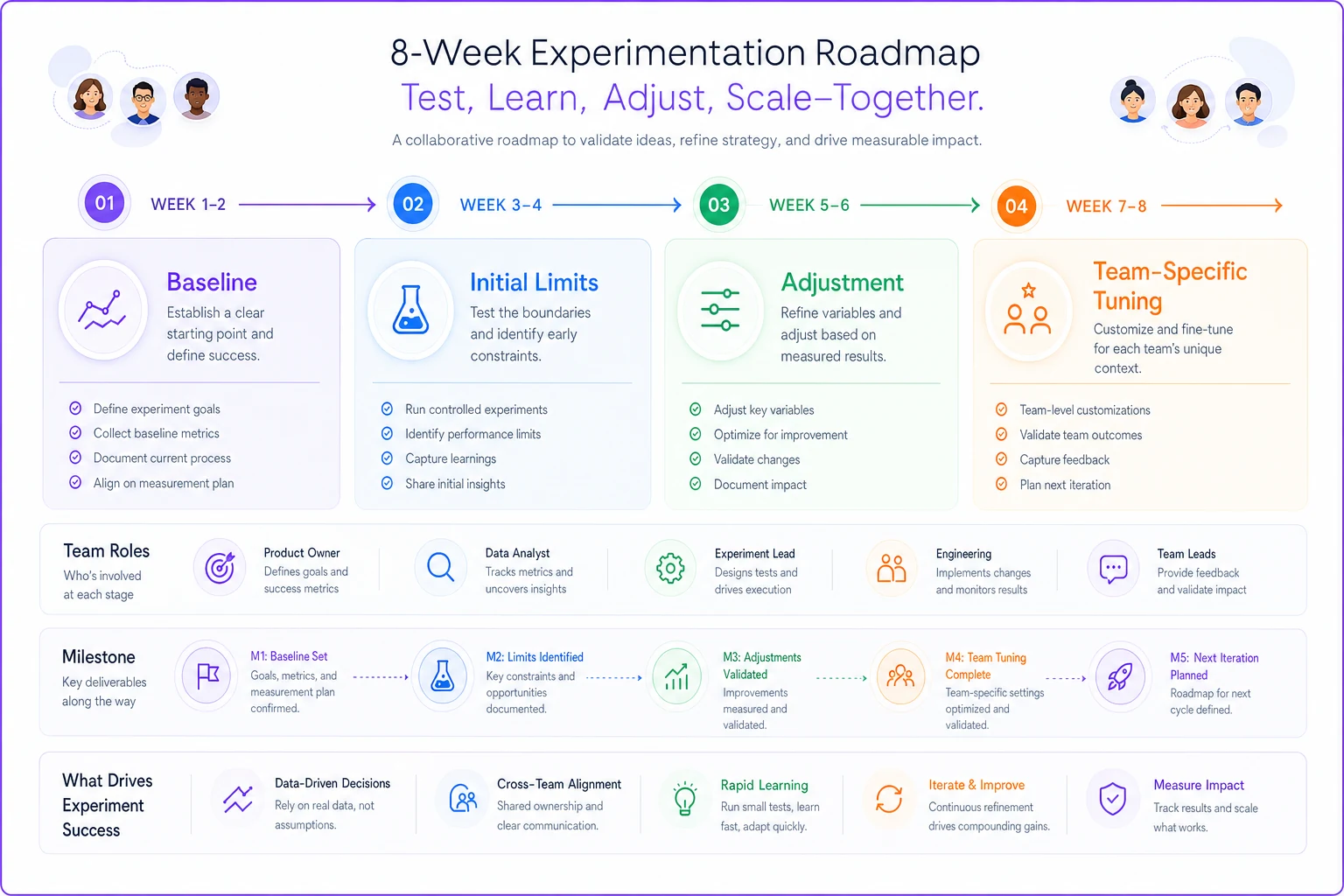
A simple visual like this helps teams align on the experiment steps and milestones.
Metrics that actually indicate impact
Cycle time tells you if work moves faster, but it doesn't tell you if it's the right work. Here's what to measure:
Throughput metrics:
-
Items completed per week (not started)
-
Percentage of items finished vs. abandoned
-
Time from start to deployment/publication
-
Number of revision cycles
Quality metrics:
-
Defect rates for engineering
-
Campaign performance for marketing
-
Client revision requests for design
-
Internal rework percentage
Team health metrics:
-
Context switches per day
-
Overtime hours
-
Number of "urgent" requests
-
Team satisfaction scores
Business metrics:
-
Feature adoption rates
-
Campaign ROI
-
Design-to-development handoff time
-
Customer satisfaction scores
A successful WIP limit implementation shows improvement across multiple categories, not just speed.
Warning signs your limits need adjustment
Watch for these patterns:
Limits too low:
-
Work consistently finishes early in the sprint
-
Team members actively seeking tasks
-
Increased "research" or "planning" time
-
Downstream teams starved for work
Limits too high:
-
Nothing reaches completion
-
Constant context switching
-
Quality issues increase
-
Team burnout symptoms
Wrong type of limit:
-
Shadow boards appear
-
Creative relabeling of work stages
-
Limits ignored without consequence
-
Work flows around the system
Watch for these patterns:
Customization examples that worked
A SaaS company with around 40 employees implemented team-specific WIP limits based on actual workflow analysis:
| Team/Role | Limits |
|---|---|
| Engineering (8 people) - Backend | 1 active, 2 review, unlimited blocked |
| Engineering (8 people) - Frontend | 2 active, 2 review, 1 experimental |
| Engineering (8 people) - DevOps | 1 critical, 3 routine, 2 improvements |
| Marketing (5 people) - Content | 3 writing, 4 editing, unlimited scheduled |
| Marketing (5 people) - Growth | 2 experiments, 3 analyses, 4 optimizations |
| Marketing (5 people) - Brand | 2 campaigns, 3 assets, 1 strategy |
| Design (3 people) - Product | 2 active, 2 revisions, 1 exploration |
| Design (3 people) - Marketing | 3 active, 4 revisions, 2 templates |
-
Engineering deployment frequency increased from twice monthly to weekly
-
Marketing campaign completion rate jumped from 70% to 90%
-
Design handoff time dropped from 8 days average to 4 days
-
Cross-team satisfaction scores improved across all three departments
The key wasn't the specific numbers. It was that each team's limits matched their actual workflow patterns rather than some arbitrary standard copied from a blog post.
Making WIP limits sustainable with the right operational foundation
Manual WIP limit tracking usually falls apart around week three. People forget to update boards, work happens outside the system, and limits quietly become suggestions rather than constraints.
This is where operational software makes the difference between theory and practice. Work management platforms with AI automation can track WIP automatically, alert when limits are exceeded, and surface adjustment suggestions based on completion patterns. Instead of manually moving cards or updating spreadsheets, the system tracks work states across email, chat, and project tools.
The automation handles the tedious parts — counting active items, flagging violations, generating reports — which lets teams focus on actual work rather than managing the management system. More importantly, it provides the data to prove whether your WIP limits are working. Tracking cycle time manually means someone spending hours in spreadsheets every week. Automated tracking happens continuously, giving you real-time visibility into whether your experiments improve throughput or just create new bottlenecks.
Your next steps for implementing team-specific WIP limits
Stop treating WIP limits like universal constants. Engineering isn't marketing. Marketing isn't design. Design isn't customer success. Each team needs limits that match their work patterns, not arbitrary numbers from a methodology book.
Start with observation, not theory. Watch how work actually flows through your teams before setting any limits. Run controlled experiments with clear metrics. Adjust based on evidence.
Most importantly, remember that WIP limits are tools for improvement, not rules for compliance. When teams create workarounds, that's data telling you the limits don't match reality. Listen to it.
The goal isn't perfect adherence to limits. It's sustainable delivery of quality work. Sometimes that means an engineer carries 4 items during a critical sprint. Sometimes marketing runs 10 parallel campaigns during a product launch. Sometimes design breaks every limit to meet a deadline.
Build flexibility into your system. Measure what matters. And the best WIP limit is ultimately the one your team actually follows because it makes their work better, not because a process demands it.
Build flexibility into your system. Measure what matters. And the best WIP limit is ultimately the one your team actually follows because it makes their work better, not because a process demands it.
Ready to boost your team's productivity?
Join 5,000+ teams using Workyly to streamline workflows, improve communication, and deliver projects faster.