

Delivery teams don't usually get stuck because the work is hard. They get stuck because what landed in their lap was incomplete, and nobody noticed until they were already three days deep. The marketing brief had no sample data. The "finished" requirements doc referenced a spreadsheet that got renamed. The acceptance criteria were a Slack thread. By the time the gap surfaces, someone has already built the wrong thing, and now you're paying twice.
This is the specific failure mode worth fixing: a non-engineering person (marketing, ops, sales, finance, a department lead) hands work to a delivery team (engineering, design, data, whoever actually ships) without the minimum set of artifacts that make the work buildable. The fix isn't a 40-field intake form. It's a short, enforced artifact list plus a 10-minute check that happens before anyone commits to the work.
The anatomy of a bad handoff
A typical broken handoff looks deceptively complete. There's a doc. There's a title. There might even be a deadline. What's missing is everything that lets the delivery team verify they understood correctly before building.
-
The requester knows what they want but describes the outcome ("I need a dashboard showing campaign performance") without the boundaries (which campaigns, what date range, what counts as a conversion).
-
"Done" is never defined, so the delivery team's version of done and the requester's version of done never match until review — which is the most expensive possible moment to discover a mismatch.
-
No real data is attached. The team builds against assumptions, then the actual data has nulls, weird formats, and three edge cases that break the logic.
-
The requester is unreachable during build, so every ambiguity becomes a guess.
None of these are engineering problems. They're handoff problems. And they're why a two-day task quietly becomes a six-day task with a tense review meeting in the middle.
The short artifact list (keep it to four things)
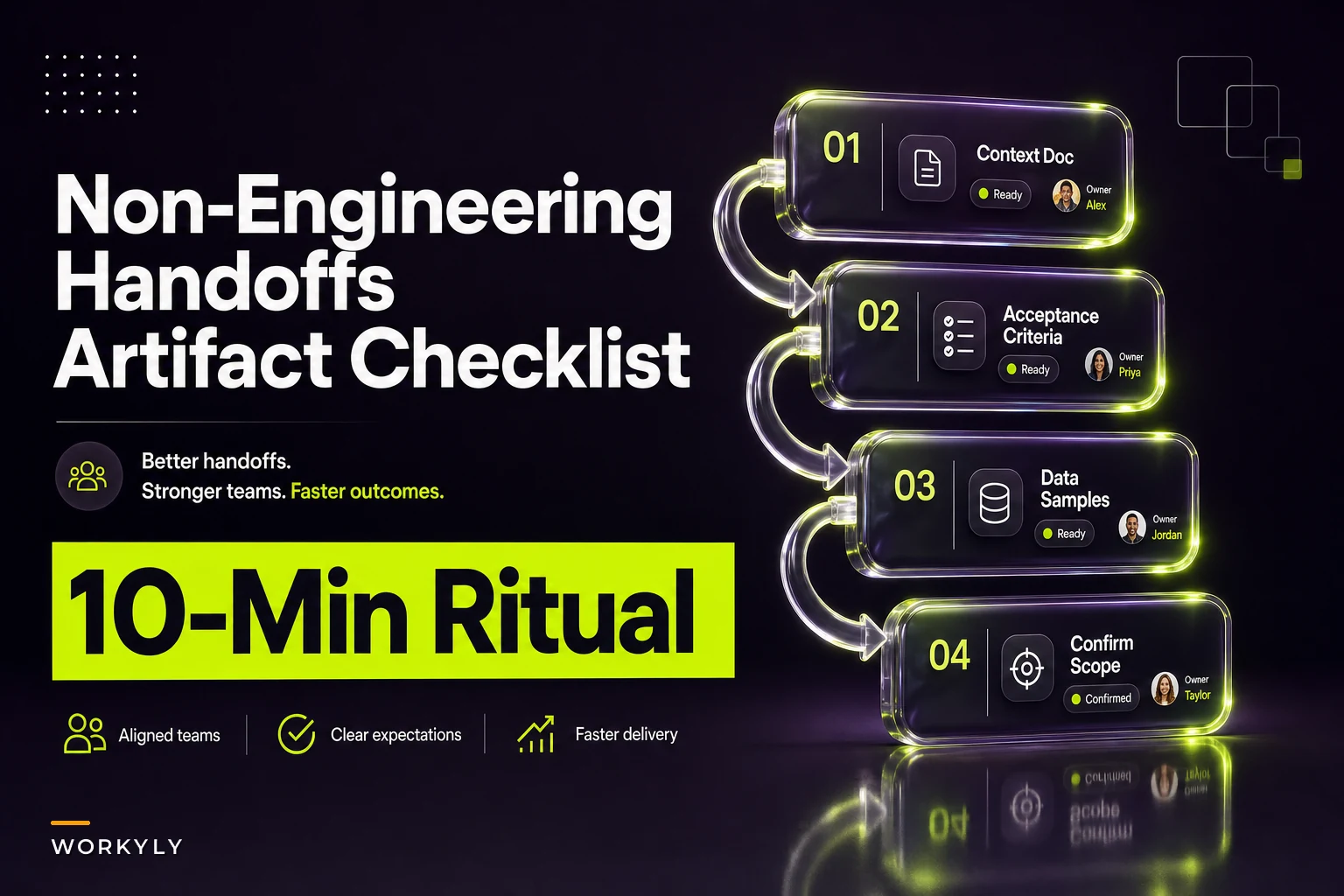
The temptation is to demand a ten-section template. Don't. Nobody fills those out properly, and the ones who do fill them with filler. What's needed is the minimum set that makes work validatable. Four artifacts cover most non-engineering handoffs:
Stop losing track of your priorities.
Workyly helps you organize, assign, and track every task efficiently.
- Centralized task management
- Real-time collaboration
- Intelligent workflow automation
No credit card required
-
A context doc (half a page, max). Why this work exists, who it's for, and what decision or action it enables. Not a novel — just enough that the delivery team understands the point. The point matters because when they hit an ambiguity, they can resolve it toward the actual goal instead of guessing.
-
Acceptance criteria written as checkable statements. Not "make it good." Instead: "The report filters by region and updates when the source sheet changes" or "The email renders correctly in Outlook and mobile Gmail." Each line should be something a person can literally mark pass/fail.
-
Real data samples, not described data. This is the one people skip and the one that saves the most time. Attach the actual export, the actual customer list (anonymized if needed), the three screenshots of the current broken state. Described data hides the edge cases; real data exposes them before they become rework.
-
Scope boundaries — explicitly what's NOT included. "This does not include historical data before January" or "This handles English only for now." The out-of-scope list prevents the slow expansion where the delivery team builds extra things they assumed were wanted, or the requester assumes things were included that weren't.
That's it. If someone can't produce these four, the work isn't ready to hand off — which is itself useful information.
| Artifact | What it prevents | Time to produce |
|---|---|---|
| Context doc | Building toward the wrong goal | 5–10 min |
| Acceptance criteria | "Done" disagreements at review | 10 min |
| Real data samples | Edge-case rework mid-build | 2 min (it's an export) |
| Scope boundaries | Silent scope creep both directions | 5 min |
The whole package takes the requester under 30 minutes. The rework it prevents routinely costs days.
The 10-minute validation ritual
Having the artifacts isn't enough. Someone has to actually look at them before the work starts. This is where most teams fall down — the doc exists, nobody reads it closely, and the gaps surface later anyway.
The 10-minute flow:
-
Minutes 0–2
Read the context doc and state the goal back.
The receiver says, in their own words, what this work is for. If the requester winces, you just caught a misunderstanding for free. -
Minutes 2–5
Walk the acceptance criteria line by line.
For each one, the receiver asks: "Can I clearly tell if this passes?" Any criterion that's vague gets rewritten on the spot or flagged. -
Minutes 5–8
Open the actual data sample.
Not the description — the file. Look for the obvious landmines: empty fields, inconsistent formats, more rows or columns than expected, values that contradict the acceptance criteria. -
Minutes 8–10
Confirm scope boundaries and name who's reachable during build.
The requester confirms they'll answer questions within a set window (say, same business day) so ambiguities don't stall the work.
The entire point is to move the discovery of gaps from review time (expensive, late, emotionally loaded) to handoff time (cheap, early, no ego attached). A gap found in minute 4 of a validation ritual costs a sentence. The same gap found in review costs a rebuild.
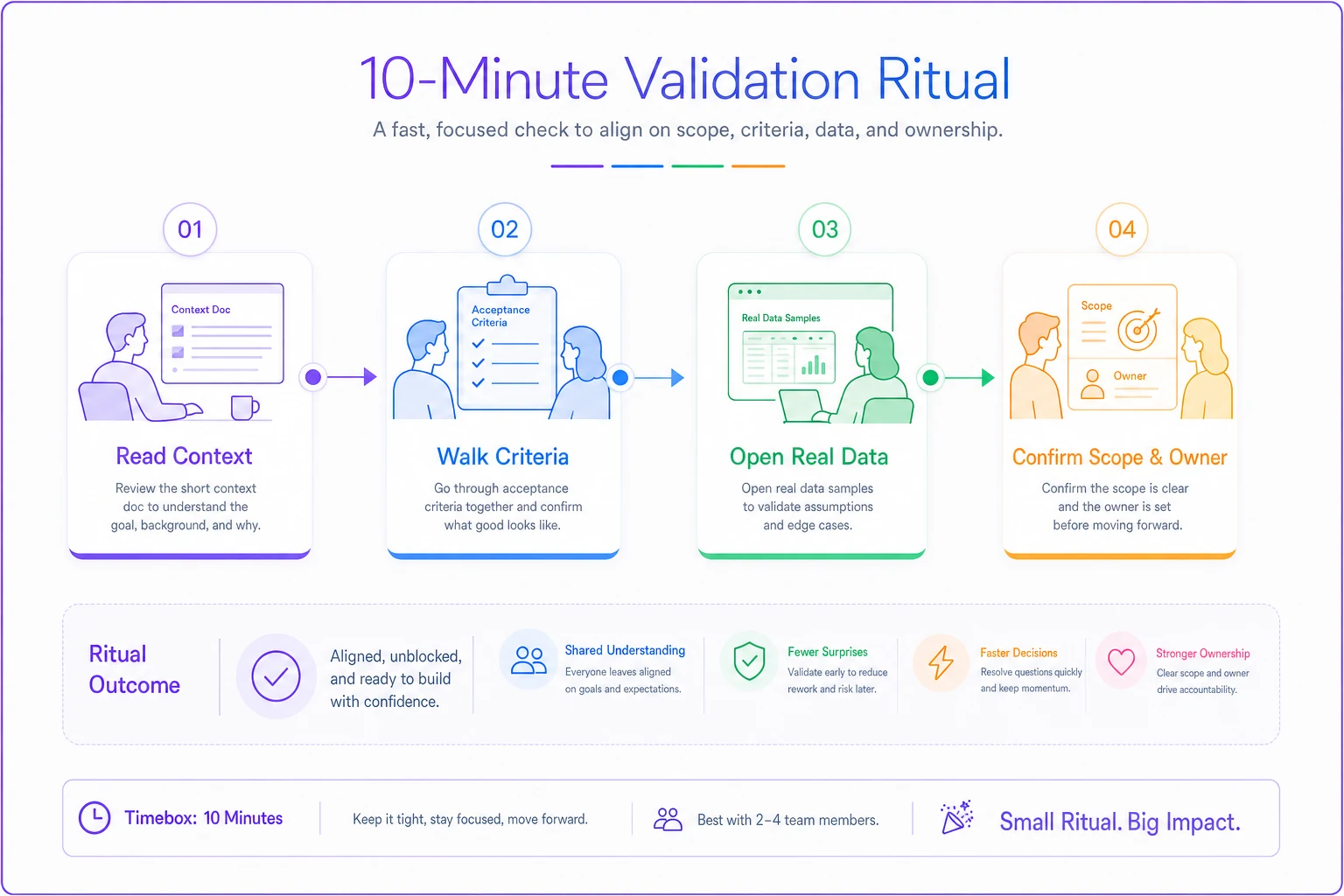
A simple visual of the four-step ritual helps teams run it consistently.
One thing worth noting: teams that run this ritual quickly discover that the acceptance criteria review catches the most issues, not the data check. People are much worse at defining "done" than they think. Reading the criteria aloud forces precision that silent reading never does.
Return and rejection rules (the part everyone avoids)
The uncomfortable part. The ritual only works if the receiving team is allowed to send incomplete work back. Without that, the ritual degrades into a formality — people nod through it to be polite, build on a shaky foundation anyway, and the whole thing collapses.
Clear rejection triggers:
-
No real data sample attached → returned. Not negotiable, because this is the single biggest source of mid-build rework.
-
Acceptance criteria that can't be marked pass/fail → returned for rewrite.
-
Context doc missing the "why" → returned, because the team can't resolve ambiguities without it.
-
No reachable owner during the build window → paused until one is assigned.
The key is distinguishing a return from a rejection. A return means "this needs two more things, send it back when ready" — the work is valid, the package isn't complete. A rejection means "this shouldn't be built at all right now" — wrong priority, wrong timing, or it belongs to a different team. Mixing these up creates resentment; separating them keeps things clean.
A soft version that works well in practice: the receiver returns the handoff with a short note listing exactly what's missing and roughly how long it'll take the requester to fix. "Missing: data sample + two vague criteria. ~15 min to resolve." That specificity turns a return from a wall into a to-do list.
When this makes sense — and when it's overkill
This isn't for every piece of work. Applying a four-artifact checklist and a validation ritual to a one-line copy change is bureaucratic theater, and people will route around it the first chance they get.
When it makes sense:
-
Work that takes more than roughly half a day to deliver.
-
Anything where the requester and builder sit in different functions and don't share daily context.
-
Work where getting it wrong is expensive to redo — data pipelines, customer-facing assets, anything with downstream dependencies.
-
Recurring request types that keep generating the same rework (if you've eaten the same misunderstanding three times, formalize it).
When it's a bad idea:
-
Tiny, reversible tasks where the cost of the ritual exceeds the cost of a mistake.
-
Tight-knit teams where the requester is literally sitting next to the builder and can clarify in real time all day.
-
One-off experiments where the point is to move fast and throw away the result anyway.
Who should NOT roll this out: teams that won't enforce the return rules. If management overrides every return because "we need it now," the ritual becomes paperwork that slows good handoffs without stopping bad ones. Either commit to the return rules or don't bother. A half-implemented gate is worse than no gate.
A real scenario
A mid-sized ecommerce operation — around 25 people, small in-house data and design team — kept hitting the same wall. Marketing would request reports and campaign landing pages; the delivery team would build them; review would blow up because "that's not what I meant."
Their rework rate was ugly. Roughly 4 out of every 10 handoffs needed significant redo — not tweaks, but rebuilds of core logic or layout. A typical report request that should've taken a day was averaging closer to two and a half once you counted the back-and-forth. The delivery team was burning maybe a third of its week on work it had technically already finished once.
They introduced the four-artifact list and the 10-minute ritual. No new software at first — just a shared doc template and a rule that the receiver ran the ritual before accepting anything.
The data-sample requirement did the heavy lifting. Marketing had been describing data ("pull the Q3 campaign numbers") instead of attaching it, and the actual exports were full of inconsistent naming and missing attribution that broke every report. Once the real file had to show up at handoff, those edge cases got caught in minute 6 of the ritual instead of hour 10 of the build.
Within about two months, rework on these handoffs dropped to somewhere around 1 in 10. Reports that used to take two and a half days were landing in a day or a day and a half. Nobody worked harder — the gaps just stopped reaching the build phase. One unexpected side effect: marketing started writing better requests on their own, because getting work returned twice taught them faster than any training ever did.
Making the ritual stick
The failure mode for any process like this is quiet erosion. It works for three weeks, then someone's in a hurry, skips it, nothing explodes immediately, and the exception becomes the norm.
Track returns as data, not drama.
-
Keep the artifacts genuinely minimal. The moment the template grows to eight sections, people start gaming it. Protect the four.
-
Make the ritual visible. A simple shared board or intake list where handoffs sit in a "needs validation" state before they're accepted keeps the step from being skippable. Teams that formalize how work enters the queue — the same discipline you'd apply when you turn ad-hoc requests into a scalable intake with SLA tiers — find the validation step slots in naturally.
-
Track returns as data, not drama. Count how often handoffs get returned and for what. If "missing data sample" is 60% of returns, that's a targeted coaching opportunity, not a reason to shame anyone.
-
Protect the receiving team's capacity to run it. If the delivery team is already drowning, the ritual gets skipped. This is really a workload-shape problem, and it connects to why you shouldn't set WIP limits blindly — a team with no slack can't run a 10-minute gate, which is exactly how bad handoffs slip through.
Where a shared workflow or intake platform helps is in making the state visible: a handoff can't quietly move from "requested" to "in progress" without passing the validation step, and the missing artifacts are logged rather than lost in a chat thread. Less about automation, more about removing the ability to accidentally skip the step.
The bottom line
Most handoff rework isn't caused by sloppy people or hard problems. It's caused by work moving forward before anyone confirmed it was understood. The four artifacts force that confirmation to be possible, and the 10-minute ritual forces it to actually happen. The return rules are what give the whole thing teeth.
Start with the data-sample requirement if you only change one thing — it's the cheapest to enforce and catches the most. Then add the acceptance-criteria read-aloud, because people are far worse at defining "done" than they believe. Everything else is refinement. The goal is boring: fewer surprises at review, fewer rebuilds, and a delivery team that spends its time building the right thing once.
Ready to boost your team's productivity?
Join 5,000+ teams using Workyly to streamline workflows, improve communication, and deliver projects faster.