

Most delivery failures between technical and non-technical teams don't look like failures. They look like a marketing team waiting on an API that "should be done by Friday," an engineering team that genuinely thought Friday meant code complete, not deployed, and a project manager playing translator in the middle, forwarding Slack threads and asking everyone to "just hop on a quick call."
The quick call is the tell. When two teams can't move work between them without a meeting, the problem isn't communication — it's that they're running on different operating systems with no contract defining what crosses the boundary between them.
This is the gap a hybrid technical non-technical delivery playbook is supposed to close. Not by forcing both sides onto the same tools or ceremonies — that almost never works — but by agreeing on what gets handed off, in what shape, and on what schedule. Everything else can stay different.
The real problem: two teams, two definitions of "done"
Engineering teams tend to run in sprints, think in tickets, and define completion in states: merged, deployed, verified. Non-technical teams — marketing, ops, sales enablement, legal — run in calendars, think in deliverables, and define completion as "the thing is live and I can see it."
Neither is wrong. But the boundary between them is where things rot.
A typical example: a product marketer needs a feature flag enabled for a launch on the 15th. She asks engineering on the 3rd. Engineering estimates it as a two-point ticket and slots it into the next sprint, which ends on the 16th. Nobody did anything wrong by their own system. The launch still slips, and the retro blames "poor communication" — when the actual issue was two incompatible definitions of a date colliding with no contract to reconcile them.
The friction almost never comes from the work itself. It comes from the interface — the undocumented space where one team's output becomes another team's input. Because nobody owns that interface, it gets patched with meetings.
Why this happens almost everywhere
Teams optimize their own operating system in isolation. Engineering adopts a solid sprint cadence. Marketing builds out a campaign calendar. Each works great internally. Then they're asked to deliver something together, and the seams show up fast.
Stop losing track of your priorities.
Workyly helps you organize, assign, and track every task efficiently.
- Centralized task management
- Real-time collaboration
- Intelligent workflow automation
No credit card required
-
Different time units. One team plans in two-week sprints, another in monthly campaigns, a third in quarterly OKRs. A dependency that's "next sprint" to one team is "three weeks out, maybe" to another.
-
Different artifacts. Engineering trusts tickets and PRs. Non-technical teams trust docs, decks, and threads. Neither reads the other's native format closely, so information gets re-explained in meetings.
-
Different definitions of acceptance. When there's no shared checklist for what "ready to hand off" means, every handoff becomes a negotiation.
-
No owner for the boundary. Dependencies between teams are everyone's problem and therefore nobody's job.
The default fix most organizations reach for is more coordination — standing syncs, a weekly cross-team meeting, a Slack channel with sixty people in it. It feels like progress. It mostly just moves the cost from "things break" to "everyone's calendar is full," which is a worse trade than it looks because it doesn't scale.
What breaks at scale
With two teams, you can get away with meetings. One person holds the context in their head and reconciles the two systems manually. It's fragile but survivable.
Add a third and fourth team and the coordination cost stops being linear. Every new team that touches a delivery adds another interface, another definition of done, another cadence to reconcile. The PM who used to run two sync meetings a week is now running six, and most of the content of those meetings is just status — people reading out where things stand because there's no shared place to look.
The scenario that reveals the breakdown usually looks something like this. A company has grown to maybe five delivery teams. A single customer-facing launch needs engineering, design, legal review, marketing, and customer support readiness. There's no single artifact tracking the launch — there are five tools and a shared doc nobody updates. The launch date exists in everyone's head slightly differently. Two days before go-live, support finds out the help docs reference a feature that got descoped three weeks earlier — a decision made in an engineering standup that never crossed the boundary.
Nobody hid anything. The decision just had nowhere to travel. This is the failure mode of the all-meetings approach: information that doesn't come up in a meeting doesn't move, and you can't meet about everything.
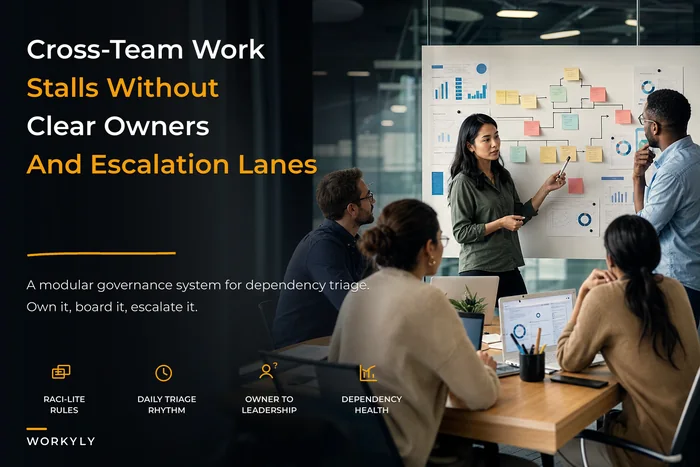
If you've dealt with this at the dependency level, the structural fix for ownership gaps is worth reading separately — we went deep on it in the modular blueprint for cross-team dependency governance. This article is about the layer above that: how teams actually hand things to each other.
The core idea: contracts at the boundary, not conformity inside it
The mistake most integration attempts make is trying to make the teams the same. Standardize the tooling. Standardize the ceremonies. Force marketing into Jira or push engineering into the campaign calendar. This fails because you're asking teams to abandon a system that works for them internally to solve a problem that only exists at the edges.
-
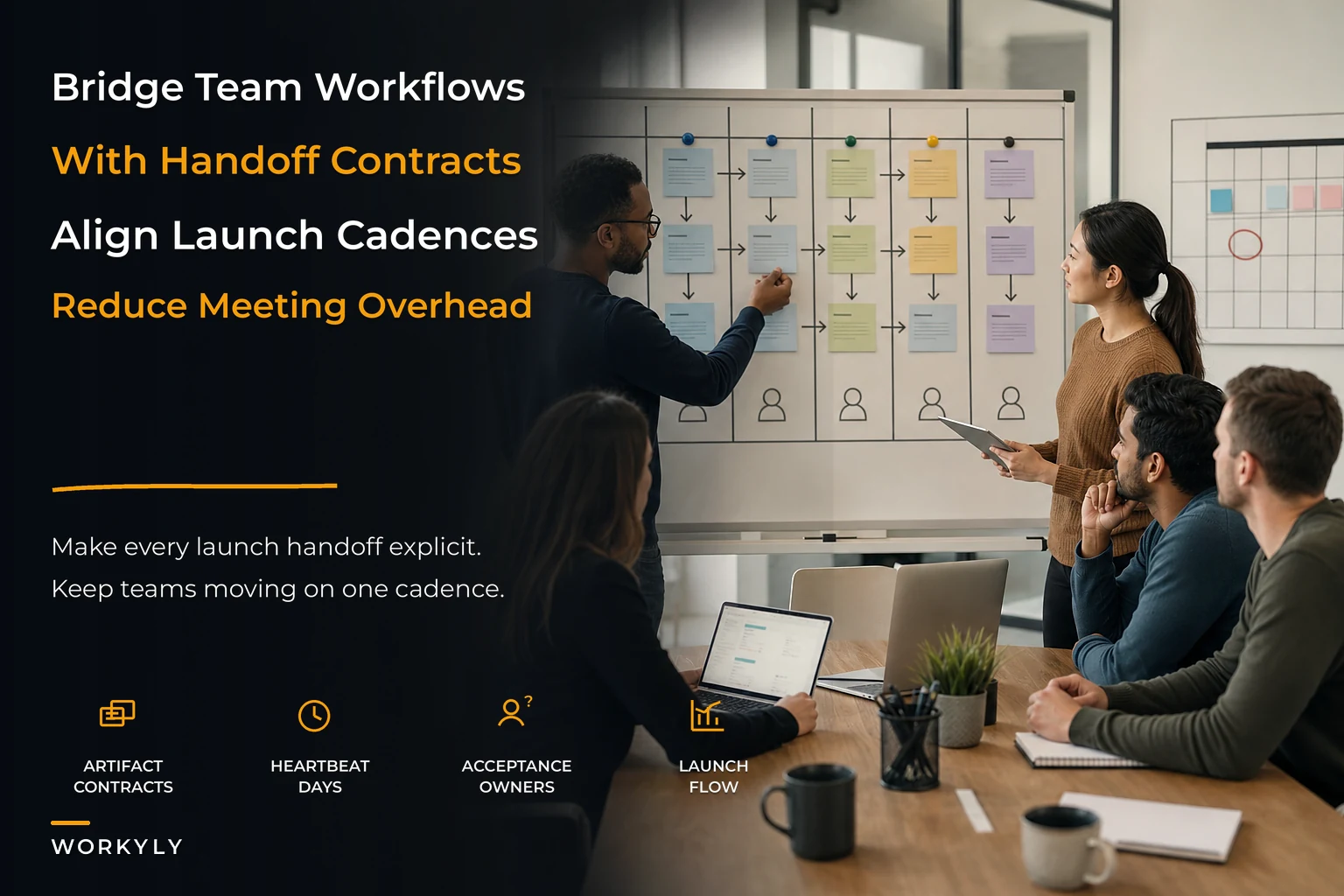
Shared artifact contracts — what, specifically, gets handed off and in what shape.
-
Aligned cadences — not identical schedules, but synchronized decision points where handoffs can actually happen.
-
Acceptance templates — a short, explicit checklist that defines "ready to receive" so handoffs stop being negotiations.
Then you connect these with a thin glue layer — a small set of shared conventions and a single place to see cross-team state — that you roll out in phases rather than all at once.
Shared artifact contracts
An artifact contract is a one-time agreement on the handoff object. For an engineering → marketing handoff on a feature launch, it might specify: the feature is "handed off" when there's a staging link, a one-paragraph description of what changed from the user's perspective, a list of anything descoped, and a verified deploy date — not estimated, verified.
Have the receiving team draft the artifact contract — they know what they actually need to consume.
The power here is that it kills the re-explanation loop. Marketing no longer needs a meeting to understand what engineering built, because the contract requires engineering to describe it in terms marketing can use. Engineering doesn't get interrupted to explain, because the explanation is part of the deliverable.
Worth noting: the best artifact contracts tend to be written by the receiving team, not the sending team. The people who consume the handoff know what they actually need. The people who produce it tend to specify what's easy to produce.
Aligned cadences
You don't need every team on the same sprint length. You need their decision points to line up often enough that handoffs don't wait in limbo.
In practice this means picking a shared "heartbeat" — usually biweekly or monthly — where each team commits to what it will have ready to hand off by the next checkpoint. Teams keep their internal cadence; they just agree on a shared moment where cross-team commitments get made and checked.
| Dimension | All-meetings coordination | Contract + cadence approach |
|---|---|---|
| How status moves | Verbally, in syncs | Through shared artifacts, async |
| Cost of adding a team | Grows faster than linear | Roughly linear |
| Definition of "done" at boundary | Negotiated each time | Fixed by acceptance template |
| Where decisions live | In people's heads / threads | In a visible shared record |
| Failure mode | Info that didn't come up is lost | Missing artifact is obvious |
| PM's role | Translator and status-chaser | Contract-keeper and escalation |
The right column isn't meeting-free. It's meeting-light. You still meet to make real decisions and resolve genuine conflicts. You stop meeting to read status out loud.
Acceptance templates
This is the piece most teams skip, and it's also the one that removes the most friction. An acceptance template is a short checklist the receiving team uses to confirm a handoff is actually complete before they start work on it.
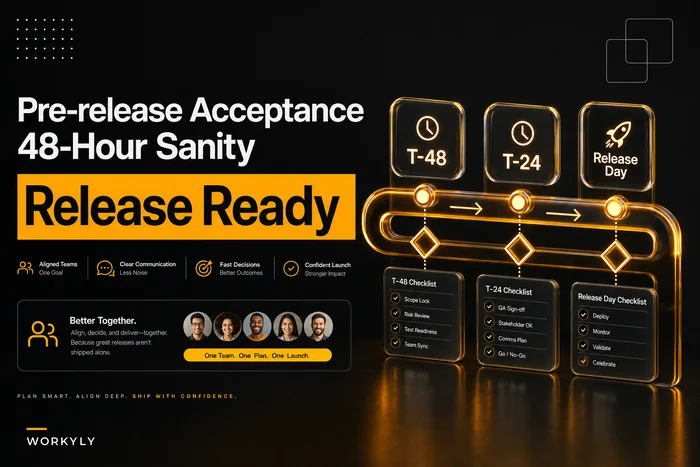
If this sounds familiar, it's a close cousin of a pre-release acceptance checklist — the difference is that acceptance templates apply at every internal boundary, not just the final release gate. A handoff that fails the checklist gets handed back immediately, with the specific missing item named, rather than silently accepted and discovered broken later.
The discipline of handback is what makes it work. Without it, teams accept incomplete handoffs to avoid friction, then eat the cost downstream. A handback isn't rude — it's what keeps the contract meaningful.
The phased glue layer
You don't roll all of this out at once. Trying to install contracts, cadences, and acceptance templates across five teams simultaneously is how you end up with a process document nobody follows.
-
Map the real handoffs first. Spend a week documenting where work actually crosses team boundaries — not the org chart, the actual flow. You'll usually find two or three high-traffic handoffs that cause most of the pain.
-
Write contracts for the two worst handoffs only. Pick the boundaries generating the most emergency meetings. Have the receiving team draft the artifact contract. Keep it to one page.
-
Pick a shared heartbeat. Agree on a single recurring cross-team checkpoint. Everyone commits what they'll hand off by the next one.
-
Add acceptance templates where handbacks are already happening. If a handoff keeps bouncing back informally, that's exactly where a checklist earns its keep.
-
Give the boundary an owner. One person per key interface who maintains the contract and handles escalations — not a translator, a keeper.
-
Expand only after the first contracts stick. Add the next handoff once the first two are running without meetings. If they're not sticking, fix them before expanding.
The sequencing matters more than the components. Teams that try to standardize everything on day one get resistance and abandon the effort. Teams that fix one painful handoff, show it works, and expand from there tend to make it permanent.
A workflow, start to finish
Here's how a single feature launch moves through the system once it's running, without a standing launch meeting.
Engineering completes the feature and fills out the artifact contract: staging link, user-facing description, descope list, verified deploy date. This lands in the shared cross-team board on the heartbeat day. Marketing picks it up and runs the acceptance template — are all four items present and accurate? One item is missing (the descope list), so it gets handed back with a one-line note. Engineering adds it within the hour. Marketing accepts, pulls the user-facing description straight into the launch copy, and schedules against the verified deploy date. Legal sees the same board, picks up the review artifact, and runs its own acceptance check. Support sees the finalized feature description and updates the help docs against the same source of truth everyone else used.
No one met. The descope decision that used to get lost in a standup is now a required field in the handoff contract, so it physically cannot disappear. The launch date exists in exactly one place.
Coordination is embedded in the artifacts and the cadence, not dependent on someone remembering to bring it up.
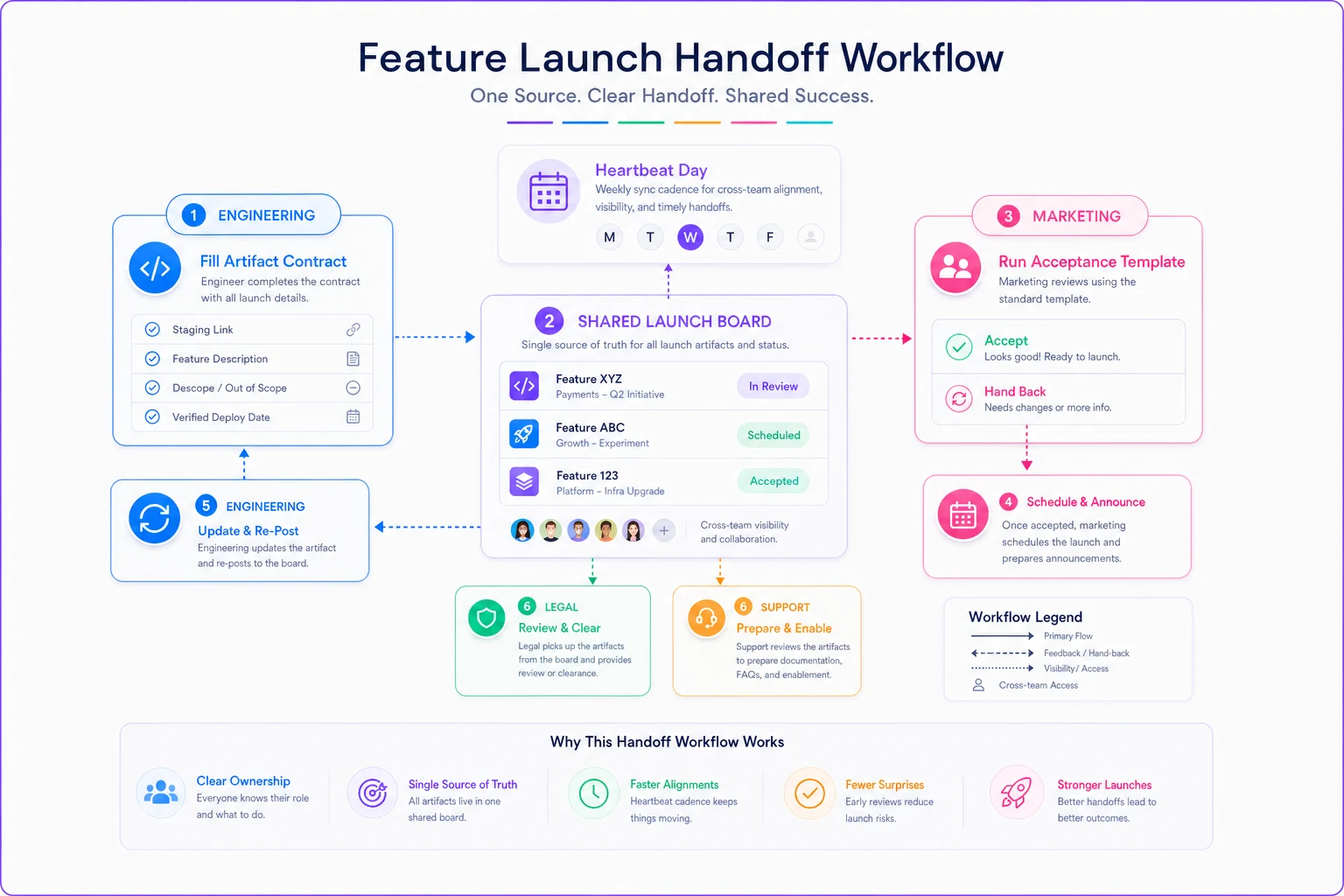
This diagram shows the simple flow and where handbacks can occur.
When this makes sense — and when it doesn't
This makes sense when you have three or more teams that regularly deliver together, when handoffs cause recurring surprises, and when your PMs are spending more time relaying status than resolving actual decisions. It's especially worth it when the teams genuinely need different internal systems — a creative team and an engineering team shouldn't run identically, and this approach lets them not have to.
This is a bad idea when you only have two teams and one good relationship holding things together. The overhead of formal contracts isn't worth it yet; a shared doc and a weekly 20-minute sync will outperform a process you don't need.
Who should not do this: teams where the real problem is unclear priorities, not unclear handoffs. If leadership keeps changing what matters every two weeks, no amount of handoff contracts will save you — you'll just have very well-documented thrash. Fix the priority instability first.
A real scenario
A mid-sized e-commerce company — around 40 people, three delivery teams (engineering, merchandising, and a small marketing group) — was shipping roughly two site changes a month and treating each one like a fire drill. Every launch had a standing coordination meeting plus two or three emergency calls. The PM estimated she spent close to half her week just moving information between teams.
The recurring failure was always the same category: something decided in one team never made it to the others. A price change merchandising made never reached engineering's caching logic. A feature marketing promoted had quietly been pushed a sprint.
They didn't reorganize anything. They mapped the handoffs, found that most of the pain lived in two interfaces (engineering ↔ merchandising and engineering ↔ marketing), and wrote one-page artifact contracts for both — drafted by the receiving sides. They set a biweekly heartbeat and added an acceptance checklist on the merchandising → engineering handoff, which was the one bouncing back most often.
Over the following couple of months the standing meeting shrank from weekly to biweekly, the emergency calls mostly stopped, and the PM got back something like a day a week. The number that actually mattered: launches that slipped due to a missed cross-team decision dropped from most of them to roughly one across that whole stretch. Not zero — but a very different operation.
The shift in how to think about this
The instinct, when teams don't coordinate well, is to add coordination. More meetings, more syncs, more status updates. Past a certain size, that instinct is exactly backwards. Meetings are a way of moving information through people, and people are the bottleneck.
A hybrid delivery playbook moves that information through artifacts and schedules instead. It lets each team keep the operating system that works for it internally, and focuses all its effort on the one place that actually matters — the boundary where work crosses from one team to another. Define that boundary with a contract, give it a shared cadence and a clear acceptance gate, and most of the meetings you were running stop being necessary.
The teams don't need to become the same. They just need to agree on what they hand each other, and when.
Ready to boost your team's productivity?
Join 5,000+ teams using Workyly to streamline workflows, improve communication, and deliver projects faster.