


Most teams don't have a blocker problem. They have a blocker-tracking problem. The thing that stalls a project is rarely the blocker itself — it's that the blocker sat in a Slack thread for nine days, got half-acknowledged in a standup, then quietly died in someone's memory until the deadline exploded.
The fix isn't a bigger meeting. It's a smaller one. A 15-minute weekly ritual with hard constraints, a severity score that actually means something, auto-assign rules that remove the "who owns this?" negotiation, and a 72-hour verification check so blockers don't get marked "done" when they're really just "ignored again."
This is the whole blocking ticket triage ritual. One agenda. One timer. One follow-up loop.
Why blockers rot in the first place
Most blockers don't die from being hard. They die from ambiguity.
The pattern that keeps showing up: someone raises a blocker in standup. Everyone nods. Nobody is explicitly assigned. The implicit assumption is that "the team" will handle it, which means nobody does. By the time it resurfaces, the person who could have unblocked it in 20 minutes is now on vacation, and the dependency has cascaded into three other tickets.
-
No severity language. "This is blocking me" means wildly different things coming from a junior dev versus a tech lead. Without a shared scale, everything sounds either catastrophic or ignorable.
-
No clear owner at the moment of raising. Blockers get "discussed" but not "assigned." Discussion feels like progress. It isn't.
-
No verification that the fix actually landed. Someone says "yeah I handled that" and it gets closed. Three days later it's still broken, but now it's invisible because the ticket is green.
A weekly triage ritual works precisely because it attacks all three at once — in a timebox so short that people can't turn it into a debate.
The 15-minute constraint is the whole point
Give blocker triage 45 minutes and it becomes a problem-solving session. People start fixing things in the room, pulling in context, arguing about root cause. That's valuable work, but it's not triage. Triage is routing, not solving.
Stop losing track of your priorities.
Workyly helps you organize, assign, and track every task efficiently.
- Centralized task management
- Real-time collaboration
- Intelligent workflow automation
No credit card required
The 15-minute cap forces a specific behavior: score, assign, set a deadline, move on. Actual fixing happens after the meeting, by the assigned owner, on their own time.
Think of it like an ER. The triage nurse doesn't perform surgery. They sort by severity and send you to the right place. Good blocker triage does the same thing — fast, decisive, slightly ruthless.
The fixed agenda (don't improvise this)
-
Minutes 0–2 Pull up every open blocker. No new discussion yet, just read the list.
-
Minutes 2–8 Score each one using the severity rubric (below). Say the number out loud. No debate longer than 30 seconds per item.
-
Minutes 8–12 Apply auto-assign rules. Each blocker gets exactly one owner and a deadline.
-
Minutes 12–14 Review anything flagged by last week's 72-hour verification that failed re-check.
-
Minute 14–15 Confirm the list is clean. End on time, every time.
The part people skip is #4. That's also the one that actually prevents rot.
A severity rubric that forces a decision
The score exists to answer one question: how fast does this need an owner, and at what deadline? Not "how annoying is it." Blocking-severity isn't about frustration — it's about how many people or deliverables are frozen.
Here's a scoring model that's simple enough to use out loud but specific enough to prevent inflation:
| Score | Label | What it means | Assign deadline | Verify window |
|---|---|---|---|---|
| 4 | Critical | Multiple people fully stopped; delivery date at risk this week | Same day | 24h |
| 3 | High | One person fully stopped, or a dated commitment is slipping | 24h | 72h |
| 2 | Moderate | Someone working around it but losing real time daily | 48h | 72h |
| 1 | Low | Annoying, slows things slightly, has a workaround | Next triage | None |
The trick is anchoring severity to who is stopped and whether a date is threatened, not to how loud the person raising it is. A calm senior engineer whose silence is blocking three teammates outranks a vocal panic about a cosmetic bug.
One pattern worth naming: teams tend to inflate everything to a 3 or 4 because "high priority" feels safer than admitting something can wait. Push back hard on this. If everything is critical, your triage is just a list again. A healthy week usually has one or two 3s, a handful of 2s, and a long tail of 1s.
Auto-assign rules remove the worst part of triage
The slowest moment in any triage is the silence after "so… who's taking this?" Nobody volunteers for a blocker because owning one feels like inheriting someone else's problem.
Auto-assign rules kill that silence by deciding ownership before the meeting, based on category. Write the rules once and let them run.
-
Infra / environment / CI blockers → platform owner, or the person who last touched that config.
-
Cross-team dependency → the person who holds that relationship, full stop. If you don't have one, that's a structural gap worth fixing — the kind of thing a cross-team dependency governance model is built to prevent.
-
Decision / approval blockers → the person with decision rights, never the person waiting on the decision.
-
Unclear requirements → the product owner for that surface area.
-
"I don't know who owns this" → the triage facilitator owns it temporarily and their only job is to find the real owner within 24h.
That last rule matters more than it looks. The "unknown owner" bucket is where blockers go to die. Making the facilitator the default owner — just for routing, not fixing — guarantees it doesn't fall through.
Here's a simple visual of how the auto-assign decision flows during triage.
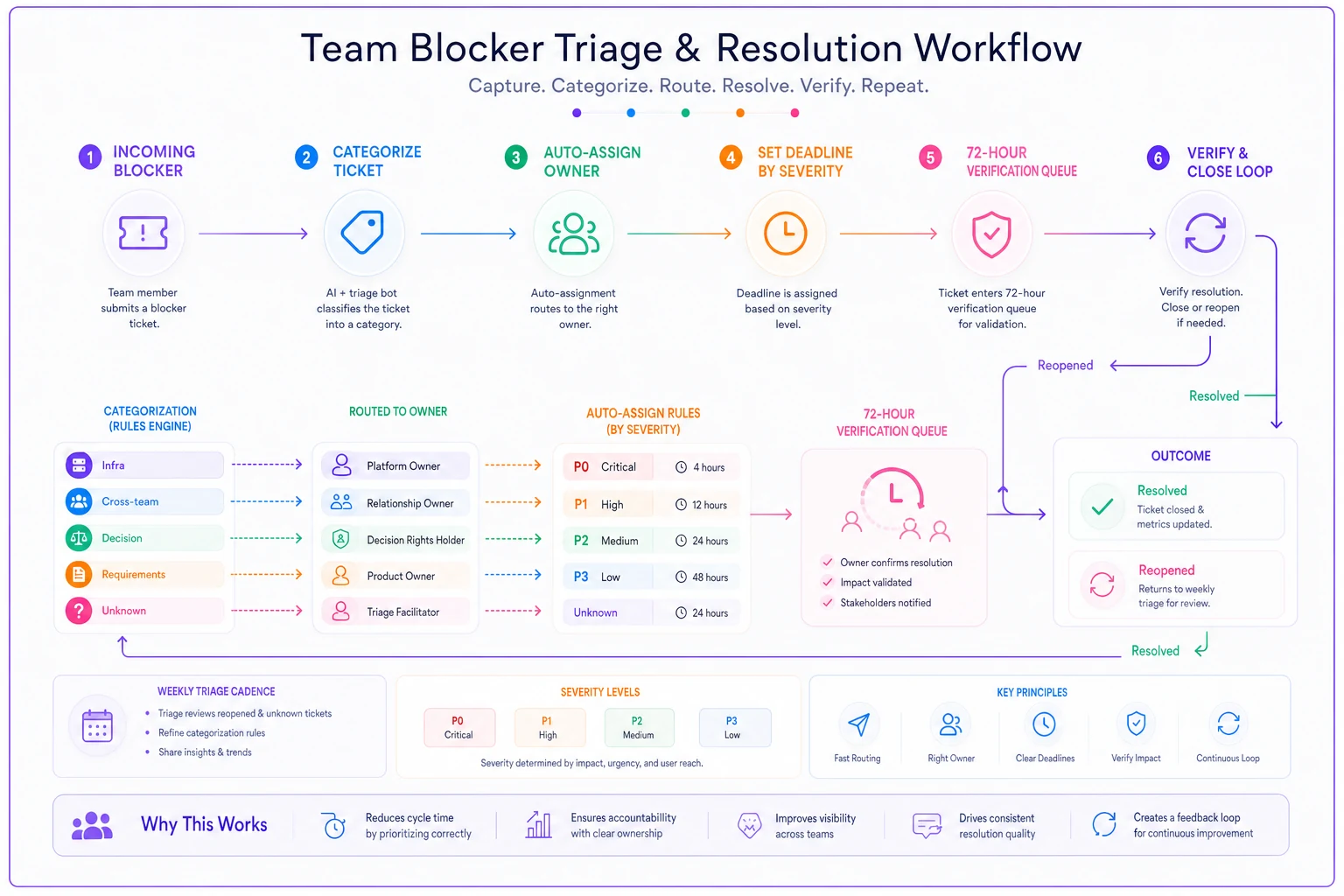
What these rules do is turn "who wants this" into "the rules already decided." No negotiation, no awkward volunteering, no blocker left ownerless.
The 72-hour verification loop is the part everyone skips
A blocker gets assigned, the owner says "done," the ticket closes, and nobody checks whether it's actually unblocked. This is the quiet failure that undoes most triage systems.
In practice, "done" and "unblocked" are different events. An owner might push a config change Tuesday and genuinely believe it's fixed, but the person who was blocked doesn't test it until Thursday — and finds it's half-working. By then the ticket is closed and invisible.
-
When a blocker is marked resolved, it does not close. It flips to "pending verification."
-
The person who was originally blocked — not the fixer — confirms it's actually resolved within 72 hours.
-
If they confirm, it closes.
-
If 72 hours pass with no confirmation, or they report it's still broken, it automatically reopens and lands back on the next triage agenda at its original severity.
This single rule changes behavior across the whole team. Owners stop marking things done prematurely because they know a silent close doesn't exist anymore. And the blocked person gets a clear, low-effort job: just confirm.
The same logic shows up in a delivery risk triage worksheet, where mitigations aren't trusted until someone re-checks them on a short clock. Verification-first thinking is a common thread in almost every operational ritual that actually sticks.
A real scenario: a 9-person product team drowning in "resolved" blockers
A mid-sized SaaS company had a product team of nine running two-week sprints. Their standups had quietly turned into blocker-recitation sessions — 25 to 30 minutes most mornings, with the same two or three dependencies coming up day after day.
When they looked back over a quarter, the numbers were ugly: roughly a third of blockers marked "resolved" had been reopened or re-raised within two weeks. People were closing tickets optimistically, then hitting the same wall again. They estimated somewhere around 6–8 engineer-hours a week lost just to repeated context-switching on blockers that never truly died.
They switched to a Friday 15-minute triage with the severity rubric, auto-assign rules, and the 72-hour verification flip. The first couple of weeks were noisy — a bunch of "resolved" items auto-reopened because the blocked person never confirmed them. That was the system working, not failing.
By week five or so, the reopen rate had dropped below 10%. Standups shrank back to actual status updates because blockers were being handled in the dedicated ritual instead of bleeding into every morning. Nothing dramatic — just a steady reduction in the drag of unresolved dependencies and fewer surprises at sprint end.
Where lightweight tooling actually helps
You can run this entire ritual with a spreadsheet and a timer, and plenty of teams should start exactly there. The constraint and the discipline matter more than the tool.
That said, two parts get tedious fast when done by hand: the auto-assign routing and the 72-hour reopen logic. Remembering to flip a ticket back open after three silent days is exactly the kind of small, recurring task humans forget.
Configure a simple workflow rule to auto-reopen tickets after 72 hours of no verification and send a single verification reminder to the blocked user—this removes the manual follow-up without changing how people make decisions.
Operational software with simple workflow automation earns its place here — not to run the triage for you, but to handle the boring mechanics: route a new blocker to the right owner based on category, nudge the blocked person to verify, and auto-reopen anything that goes silent past the window. The judgment stays with the team; the follow-through stops depending on memory.
The goal isn't to automate the thinking. It's to make sure the one step everyone forgets — verification — actually happens without relying on someone being disciplined enough to remember it every single time. That's a low bar, and yet it's the one most teams consistently trip over.
When this ritual makes sense (and when it doesn't)
It makes sense when:
-
You have recurring blockers that resurface after being "resolved."
-
Standups have degraded into blocker triage that eats the whole meeting.
-
Dependencies cross teams and ownership is routinely unclear.
It's a bad idea when:
-
Your team is tiny (two or three people) and blockers get resolved in a hallway conversation anyway. The overhead isn't worth it.
-
You're in an active incident. Incidents need real-time response, not a weekly cadence.
-
You don't yet have clear decision rights. If nobody can own a category, auto-assign rules just route blockers to a dead end. Fix ownership first.
Who should NOT run this: teams that will use severity scoring as a political weapon — inflating scores to jump the queue. If your culture rewards the loudest voice, the rubric gets gamed and turns into noise. Fix the incentive before you add the ritual.
The one habit that makes it stick
Closure and verification are two different events, and you have to treat them that way. Almost every lingering blocker you've ever had was something someone genuinely believed was fixed.
Keep the meeting at 15 minutes. Score out loud. Let the rules assign ownership. And never let a blocker close itself — make the person who was stuck confirm they're actually free. Do that for a month and the "wait, I thought we fixed that" conversations mostly disappear.
Keep the meeting at 15 minutes. Score out loud. Let the rules assign ownership. And never let a blocker close itself — make the person who was stuck confirm they're actually free. Do that for a month and the "wait, I thought we fixed that" conversations mostly disappear.
Ready to boost your team's productivity?
Join 5,000+ teams using Workyly to streamline workflows, improve communication, and deliver projects faster.