



The July FOMC minutes, released on August 19, changed the tone of Q4 planning almost overnight. According to Reuters' coverage of the minutes, policymakers grew more worried about sticky inflation and kept a September hike firmly on the table. The official minutes reinforced a higher-for-longer posture that finance teams read very quickly.
What matters for delivery teams isn't whether the hike actually happens. The signal is enough. The moment a CFO reads "higher for longer," the internal calculus shifts. Cloud spend gets a second look. That open req you were counting on gets quietly parked. Next year's discretionary project budget stops being a promise and becomes a negotiation.
And you, as the PM or team lead, inherit all of it. Not the macro story — the fallout. So what does rate-hike project prioritization actually look like when the pressure lands on your team specifically, and how do you protect delivery without turning your roadmap into a graveyard of half-finished initiatives?
The mistake almost everyone makes first
When budget pressure hits, the instinct is to cut projects. Kill the two lowest-priority initiatives, announce it in the all-hands, feel like you did something decisive.
That's usually the wrong first move. Cutting whole projects rarely frees the capacity you think it does. In real operations, work isn't cleanly bucketed. The engineer on "Project B" — the one you just killed — was also the only person who understood the auth migration that three other projects depend on. Kill the project, keep the hidden dependency, save almost nothing meaningful in spend.
Teams that survive tightening cycles well don't cut projects. They cut commitments. There's a real difference. A project is a container. A commitment is a promise you made about scope, date, and quality. When you renegotiate commitments instead of deleting containers, you keep optionality and stop the bleeding faster.
The second mistake: treating this as a one-time triage exercise. A rate signal isn't a single event you respond to and move on from. It's a shift in the operating environment. Teams that do one big reprioritization meeting and then go back to normal are the ones scrambling again in six weeks when the next budget memo lands.
What actually changes when borrowing gets expensive
Before you reprioritize anything, it helps to understand what your leadership is now optimizing for — because it genuinely is different than it was in a cheap-money environment. When capital is cheap, companies fund growth bets and tolerate longer payback windows. When capital is expensive, the org quietly re-weights toward:
Stop losing track of your priorities.
Workyly helps you organize, assign, and track every task efficiently.
- Centralized task management
- Real-time collaboration
- Intelligent workflow automation
No credit card required
-
Faster payback over larger eventual upside
-
Retention and expansion revenue over net-new acquisition bets
-
Cost avoidance that shows up this fiscal year
-
Anything that reduces headcount dependency
This reweighting is the most useful thing to internalize, because it tells you how to defend your roadmap items. A feature that saves the support team 15 hours a week suddenly outranks a flashy net-new initiative that won't pay back for 18 months — even if the net-new thing is technically "more strategic." The definition of strategic just moved.
PMs who lose roadmap battles during tightening usually lose them because they're still pitching on the old value system. They walk into the funding review talking about market opportunity and TAM, while the person across the table is quietly scoring everything on months-to-payback. You're answering a question nobody's asking anymore.
A prioritization frame that survives budget scrutiny
Scrap complex weighted scoring models for this exercise. Under pressure, you want something you can defend in a five-minute hallway conversation. The frame below sorts every roadmap item into four honest buckets:
The discipline here isn't the buckets — it's forcing every item into exactly one, with a named owner who agrees to the label. What kills roadmaps in a downturn is ambiguity: half-funded projects that nobody officially paused, still consuming attention and calendar while producing nothing.
| Bucket | Definition | Rate-hike treatment |
|---|---|---|
| Protect | Directly tied to committed revenue, contractual obligations, or compliance | Fund fully. Compress timeline, not scope. |
| Prove | Strong payback story but not yet contractually committed | Keep alive at reduced burn; instrument hard to prove value fast |
| Park | Real value, wrong timing — payback too far out | Formally pause with a written restart trigger |
| Purge | Low confidence, unclear owner, or momentum already gone | Kill cleanly and reclaim the capacity |
One thing to watch: the Park bucket is where discipline usually breaks. Parking without a written restart trigger is just slow death. If you can't articulate the specific condition that would revive an initiative — "when the enterprise contract closes" or "when we free up two backend engineers in Q1" — it doesn't belong in Park. It belongs in Purge, and you should be honest about that.
If you can't write a concrete restart trigger for a parked item, move it to Purge rather than let it linger.
The discipline here isn't the buckets — it's forcing every item into exactly one, with a named owner who agrees to the label. What kills roadmaps in a downturn is ambiguity: half-funded projects that nobody officially paused, still consuming attention and calendar while producing nothing.
The capacity math nobody wants to do
Reprioritization only works if you actually know your real, deliverable capacity — not your theoretical headcount.
Most teams overcommit because they plan against 100% of their people's time and then act surprised when reality delivers somewhere around 60%. During a hiring freeze, that gap becomes lethal. You can't backfill burnout. You can't hire your way out of a bad estimate.
This is exactly the moment to stop planning at full theoretical load and start planning with honest buffer bands — the approach we walked through in planning team capacity with buffer bands. The short version: assign each team a realistic delivery band (something like 65–75% of nominal capacity for committed work) and treat everything above that as reserve for the inevitable interruptions. In a tightening cycle, that reserve is what lets you absorb an emergency cost-savings ask from leadership without detonating your existing commitments.
Here's how this plays out in practice. A mid-sized fintech product team — around 9 engineers across two squads — was running at roughly 95% planned utilization heading into the summer. When the hiring freeze hit and one engineer left, they lost that capacity with no backfill coming. Because they'd planned at full load, there was no slack to absorb it. Two committed features slipped, one by nearly three weeks, and the team spent the following month in constant triage mode.
The fix wasn't heroic. They rebuilt the next quarter's plan against a 70% delivery band, moved four items from Protect to Park, and killed two Purge items outright. Delivery predictability recovered within a couple of sprints — not because they worked harder, but because they stopped promising capacity they never actually had.
A 6-step reprioritization sprint you can run this week
If the rate signal has your leadership nervous, don't wait for a formal budget cut to force the conversation. Get ahead of it.
-
Pull every active and planned initiative into one list. No side spreadsheets, no "oh and there's also this thing." Everything on one surface.
-
Assign each to Protect / Prove / Park / Purge with a named owner in the room who agrees to the label. Disagreement here is the point — surface it now.
-
Write restart triggers for everything in Park. If you can't write one, reclassify to Purge.
-
Recalculate committed capacity against a realistic band, not nominal headcount. Subtract known departures, on-call load, and support rotation.
-
Rebuild the Protect timeline against that real number. If Protect alone exceeds your band, you have a leadership conversation to escalate — better now than at the deadline.
-
Document the decisions and the reasoning. This is your defense document when someone asks in November why Project X got paused.
Running this process makes the tradeoffs visible before someone else makes them for you. It also gives you something most teams don't have going into a budget review: a pre-sorted roadmap with named owners and documented rationale.
Visualize this as a simple workflow you can share with leaders — a one-page flow from list to classification to capacity check to documentation.
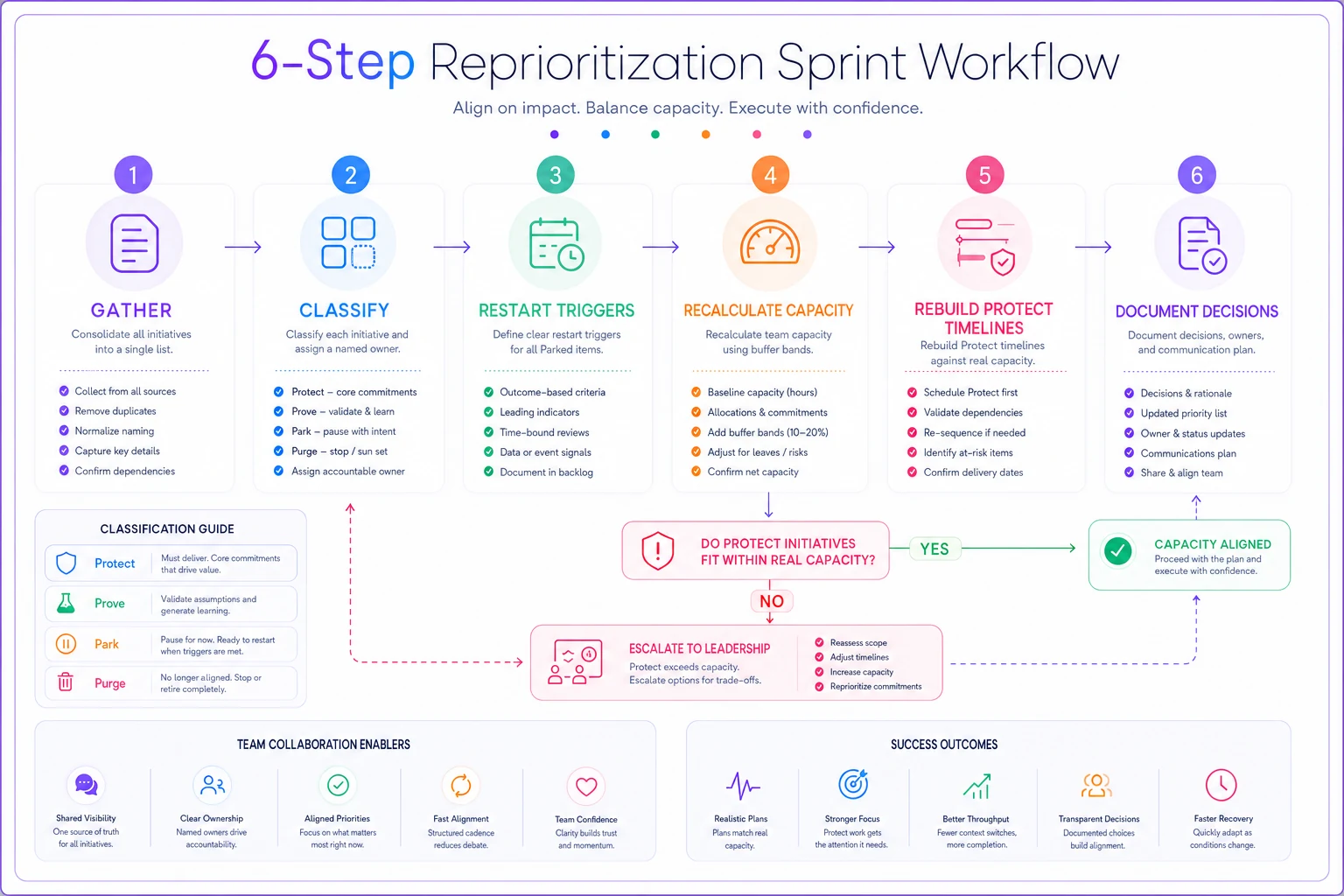
It also gives you something most teams don't have going into a budget review: a pre-sorted roadmap with named owners and documented rationale.
When aggressive cutting is a bad idea
Cutting hard feels responsible during a scare, but there are situations where it backfires badly.
Killing a project to save $8k in cloud spend while triggering three weeks of re-planning churn is a net loss that doesn't show up on any spreadsheet. Some efficiency projects are also the most fundable work in a downturn — don't reflexively purge them because they're "internal." And if morale is already fragile, a hiring freeze plus visible project carnage plus no communication is a reliable way to turn a budget scare into voluntary attrition, which costs far more than the projects you cut.
Teams that navigate tightening cycles well treat cuts surgically, not theatrically. Loud, sweeping cuts signal panic. Quiet, well-reasoned reprioritization signals control.
Who this framing is not for
If your roadmap is already lean — every item genuinely tied to committed revenue, no zombie projects, capacity honestly buffered — you don't need a dramatic reprioritization sprint. You need to hold the line and resist leadership's instinct to make you cut something just to look responsive. Sometimes the right move is a clear, defensible "here's why everything we're doing already survives your new criteria."
If you're a team lead without visibility into the actual budget conversations, don't wait for perfect information. Run the Protect/Prove/Park/Purge exercise anyway. Walking into the eventual budget meeting with a pre-sorted, defensible roadmap changes the entire dynamic — you become the person offering options instead of the person receiving cuts.
The real work is staying reprioritized
The rate signal will fade from the headlines long before its effects clear your organization. Budget scrutiny in a higher-for-longer environment isn't a moment — it's a background condition that keeps applying pressure through every planning cycle.
The actual skill isn't running one great triage session. It's building the habit of continuously knowing which commitments are Protect versus Park, maintaining real capacity numbers instead of aspirational ones, and being able to defend every roadmap decision in the language your leadership now cares about: payback, retention, and cost avoided this year.
Do that consistently, and the next budget memo doesn't catch you scrambling. It catches you already sorted — which, when everyone else is panicking, is its own kind of advantage.
Ready to boost your team's productivity?
Join 5,000+ teams using Workyly to streamline workflows, improve communication, and deliver projects faster.