

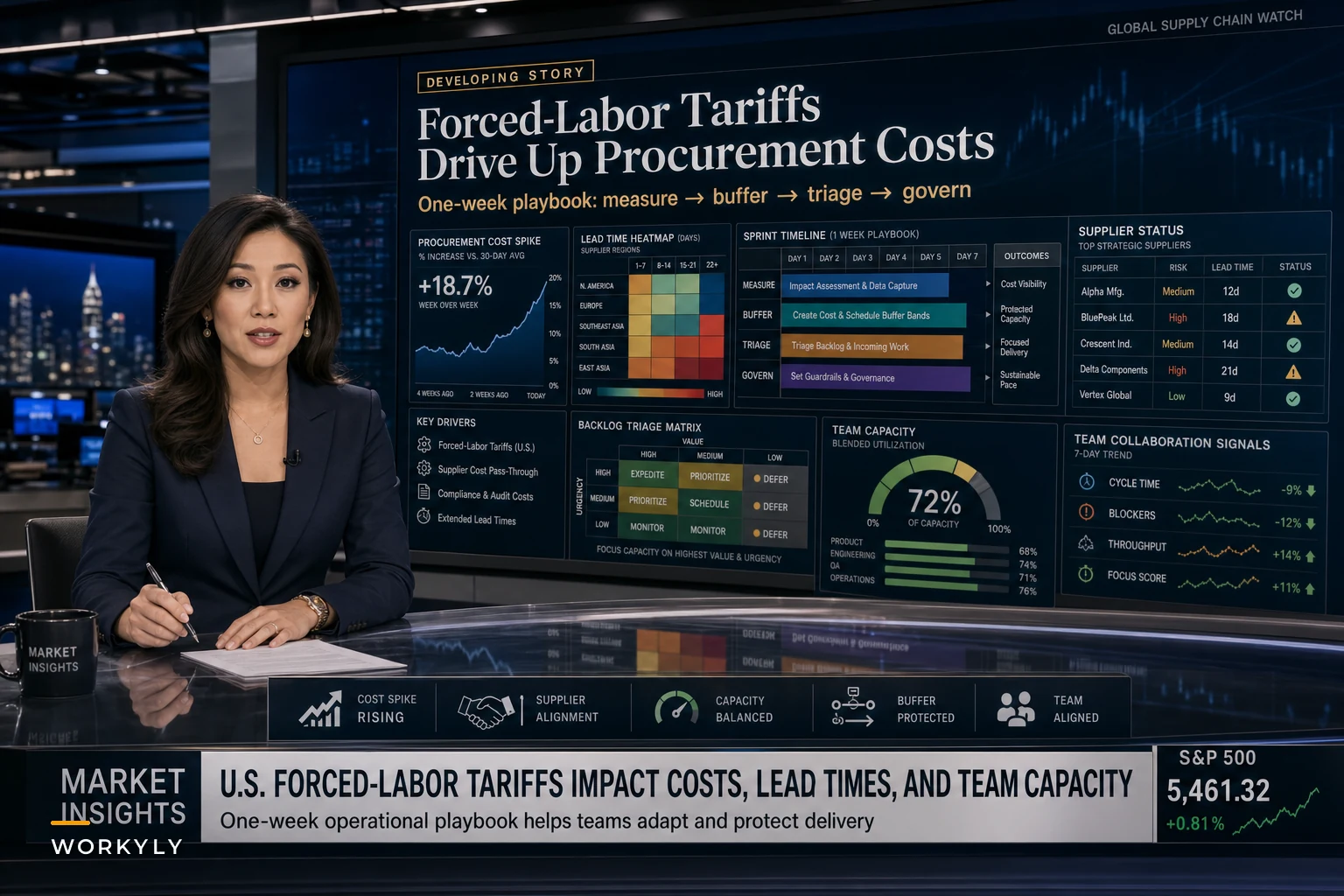

The new Section 301 tariffs that took effect July 24 aren't just another trade headline. According to Reuters, the U.S. Trade Representative slapped 10–12.5% duties on goods from 60 trading partners as part of forced-labor investigations. For product managers and ops leads, that means Q3 roadmaps that looked solid two weeks ago are now up in the air.
I watched something similar play out at a hardware startup last year when aluminum prices spiked roughly 40% over three weeks. Their product team kept pushing releases like nothing had changed while procurement scrambled to find new suppliers. By week four, they were sitting on around $180k in undeliverable commitments and had three enterprise customers threatening to walk.
The real problem wasn't the price increase. It was that nobody adjusted team capacity to match the new operational reality.
The Hidden Capacity Drain Nobody Calculates
When procurement costs jump, the instinct is to treat it as a finance problem. More budget pressure, tighter margins, some uncomfortable board conversations. But the actual damage usually shows up in three less obvious places.
First, your product managers start burning 15–20% of their week on emergency replanning. They're in procurement meetings, vendor calls, and cost-reduction brainstorms instead of managing their sprints. One PM I worked with tracked her time during a similar crunch — she spent 23 hours over two weeks just recalculating unit economics for different sourcing scenarios.
Second, every delayed component creates a cascade of micro-decisions. Do you partially ship? Wait for everything? Switch suppliers mid-production? Each decision spawns follow-up meetings. A medical device company I observed went from 12 weekly operational meetings to 31 during their tariff adjustment period. That's 19 extra hours of collective team time, every week.
The third drain is the worst because it's invisible: context switching fatigue. Engineers are halfway through Feature A when procurement flags that Component X is delayed. They pivot to Feature B. Two days later Component X clears but Component Y is stuck in customs. Back to Feature A — except now they've lost context and need time to get back up to speed. Multiply that across a team for six weeks and you've quietly destroyed your velocity.
Why Standard Capacity Planning Falls Apart
Most teams run capacity planning like it's 2019. They allocate 80% of time to planned work, reserve 20% for maintenance, and then wonder why things collapse when external shocks hit.
Stop losing track of your priorities.
Workyly helps you organize, assign, and track every task efficiently.
- Centralized task management
- Real-time collaboration
- Intelligent workflow automation
No credit card required
What actually happens when tariffs spike procurement costs: your sprint suddenly has four competing priorities. The roadmap says ship Feature Set 1. Finance says cut costs 15% immediately. Operations says find alternative suppliers. Customer Success says do whatever it takes to keep Enterprise Client X happy.
Traditional capacity models assume stable inputs. They assume your team knows what they're working on next week and that priorities hold relatively steady within a quarter. When the USTR announces tariffs affecting 60 trading partners, those assumptions fall apart fast.
That software company I mentioned earlier tried to push through using their standard two-week sprint model. By week six, velocity had dropped 40% despite everyone putting in extra hours. The constant replanning and context switching had ground them down.
Building Emergency Response Capacity Without Destroying Delivery
Teams that survive supply shocks without imploding their roadmaps tend to do something counterintuitive — they plan for chaos before it arrives.
A consumer electronics company I worked with built what they called "flex bands" into their capacity model. Instead of allocating 100% of team time, they deliberately kept 25–30% unallocated during volatile periods. Not slack time — pre-designated crisis response capacity.
When their main chip supplier got hit with sanctions, they activated flex capacity immediately. Product managers shifted 25% of their time to vendor management. Engineers moved 20% to rapid prototyping with alternative components. QA allocated 30% to testing new configurations.
Because these allocations were pre-planned, nobody panicked. Everyone already knew how much time they could spend on crisis response versus core delivery.
Define activation triggers and communicate them in your quarterly planning so flex bands are treated as pre-approved capacity.
The key is defining triggers beforehand. This connects directly to systematic capacity planning with buffer bands — you need clear thresholds for when to activate emergency capacity. For this team, it was:
-
Any supply cost increase over 10%
-
Any component delay over 7 days
-
Any customer escalation about delivery
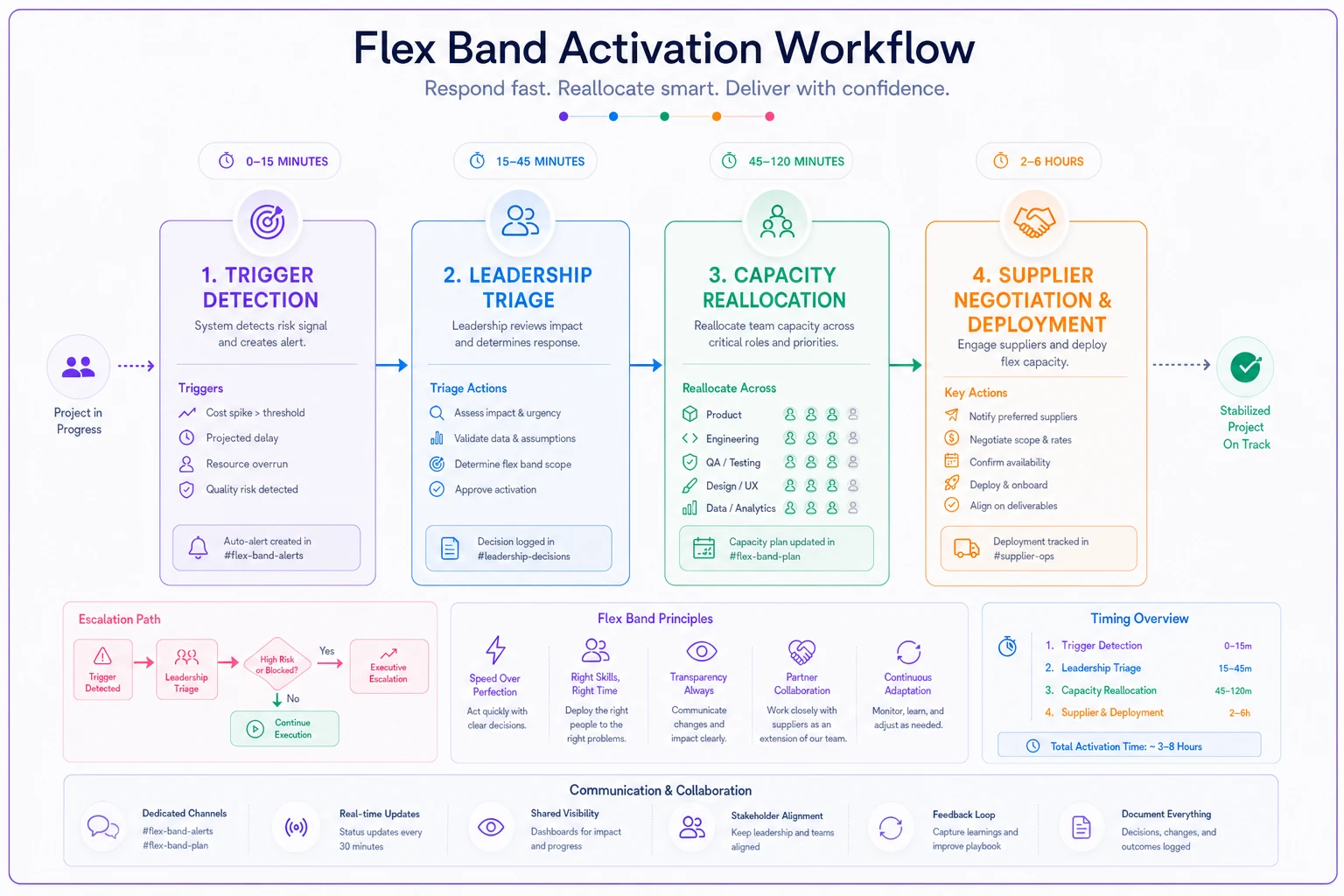
This diagram shows the activation flow for flex bands and how responsibility shifts across teams during a crisis.
The Procurement Triage System That Actually Works
Most triage systems fail because they try to evaluate everything equally. During supply chain disruption, you need asymmetric evaluation criteria.
Here's the framework that's held up across multiple operational crises:
Category 1: Revenue Protection (must ship)
-
Items directly tied to contracted deliveries
-
Components for your top 20% of customers
-
Anything with financial penalties for delays
Category 2: Strategic Preservation (try to ship)
-
New feature launches with marketing commitments
-
Competitive differentiation projects
-
Technical debt that blocks Category 1 items
Category 3: Deferrable Value (can delay)
-
Internal tools and improvements
-
Nice-to-have features
-
Experimental initiatives
A B2B SaaS platform used this when their procurement costs jumped around 18%. They had 47 initiatives in flight. Instead of trying to protect everything, they immediately froze Category 3, slowed Category 2 by 50%, and fully protected Category 1.
They maintained 100% of contracted deliveries, kept about 60% of strategic projects on track, and only fully dropped 30% of planned work. Without the triage system, they would've partially failed across everything — which is somehow worse than making clean cuts.
Creating Supplier Flexibility Metrics Before You Need Them
Teams always say they'll figure out alternatives when supply problems hit. But when tariffs land, you often have 48–72 hours to make decisions before delays start cascading.
The smarter move is maintaining a Supplier Flexibility Score for every critical component or service. It doesn't need to be complicated:
-
Lead Time Buffer - Current lead time versus industry standard - How much cushion exists in your timeline - Seasonal or geographic factors
-
Alternative Source Readiness - Number of qualified alternative suppliers - Time to onboard a new supplier - Cost differential for alternatives
-
Inventory Position - Weeks of coverage on hand - Pipeline inventory in transit - Minimum order quantities
| Metric | Details |
|---|---|
| Lead Time Buffer | Current lead time versus industry standard How much cushion exists in your timeline Seasonal or geographic factors |
| Alternative Source Readiness | Number of qualified alternative suppliers Time to onboard a new supplier Cost differential for alternatives |
| Inventory Position | Weeks of coverage on hand Pipeline inventory in transit Minimum order quantities |
An industrial equipment manufacturer tracked these scores quarterly. When tariffs hit their primary steel supplier, they knew within a few hours that they could shift 40% of volume to a domestic supplier, stretch inventory for six weeks on another 30%, and only needed to absorb the cost increase on the remaining 30%.
Without those metrics already calculated, they would've spent weeks analyzing options while deliveries sat.
The Communication Cascade That Prevents Panic
When costs spike and delays hit, every stakeholder wants different information at the same time. Customers want delivery dates. Finance wants margin impact. The board wants strategic framing. Your team wants to know what this means for them.
The communication cascade needs to be pre-scripted, not improvised:
-
Hour 1–4
Internal Assessment
- Ops lead pulls supplier flexibility metrics - Finance runs margin impact scenarios - Product identifies affected deliveries -
Hour 4–8
Leadership Alignment
- Present three scenarios: best/likely/worst - Get approval on triage categories - Lock resource reallocation plan -
Hour 8–24
Stakeholder Communication
- Customer Success contacts affected accounts - All-hands explains impact and plan - Board gets a one-page strategic summary -
Day 2–7
Execution Tracking
- Daily standup on mitigation progress - Supplier negotiation updates - Customer temperature checks
A robotics startup ran this playbook during their tariff response. Instead of weeks of confusion and conflicting messages, they moved from impact assessment to action plan in under 24 hours. Their customers actually appreciated the speed and directness.
Converting Crisis Response Into Operational Muscle
Companies that come out stronger after supply shocks don't just survive them — they systematize the response so next time is easier.
One thing that consistently works: the After-Action Automation Review. Not a typical retrospective. A specific analysis of which crisis responses could be automated or turned into repeatable workflows.
Take supplier switching. During a crisis, someone manually pulls alternative supplier lists, compares pricing, checks quality certifications, calculates switching costs, estimates timeline impact. That entire workflow can be built into operational software. AI-powered platforms now handle supplier comparison, automatic reorder triggers based on cost thresholds, and predictive modeling of supply chain risk. You set your parameters once and the system monitors continuously.
Same goes for capacity reallocation. It doesn't need to be a massive spreadsheet exercise every time there's a disruption. Modern work management platforms with AI automation can model different capacity scenarios, flag when utilization is heading somewhere unsustainable, and suggest work distribution adjustments based on past performance data.
The goal isn't to automate away human judgment. It's to automate the information gathering and initial analysis so people can focus on actual decisions instead of data wrangling.
The 30-Day Tariff Response Roadmap
If you're reading this in late July 2026, you need a plan in place fast. Here's the sequence that works:
-
Week 1
Damage Assessment
- Map every affected supplier and component - Calculate true landed cost increases - Identify delivery risks by product line - Pull your supplier flexibility scores -
Week 2
Triage and Reallocation
- Categorize all work by revenue protection level - Activate flex capacity bands - Reassign team members to crisis response - Lock Q3 priorities with leadership -
Week 3
Supplier Negotiations
- Approach alternative suppliers with volume commitments - Negotiate burden sharing with existing suppliers - Explore regional sourcing options - Lock new agreements -
Week 4
Stabilization
- Update all delivery timelines - Communicate final impact to customers - Document new supplier relationships - Build monitoring dashboards
The companies that get through this share three traits: they start immediately, they make hard triage calls early, and they document everything so the next crisis is less painful.
When Good Intentions Make Things Worse
The biggest mistake teams make during supply chain disruption is trying to protect everyone from the impact. They don't want to disappoint customers, scare employees, or signal weakness to competitors.
So they make heroic promises they can't keep. They tell customers everything's fine while scrambling internally. They hold onto aggressive roadmaps while procurement costs eat into margins. They push their teams past the point of sustainable effort.
A furniture manufacturer tried this when lumber tariffs hit. They absorbed a 22% cost increase for three months hoping prices would normalize. They kept all delivery commitments by running overtime. They told customers nothing had changed.
By month four, they'd burned through their cash reserves, lost three senior engineers to burnout, and had to push through emergency price increases anyway. Several customers canceled contracts — not because of the price increase itself, but because they felt blindsided by the sudden communication after months of silence.
The teams that navigate these situations better do the opposite. They communicate impact early, set realistic expectations, and bring stakeholders into the tradeoff decisions. Customers can handle honest difficulty. What they can't handle is being kept in the dark until things are already broken.
Making Peace With the New Normal
Supply chain volatility isn't going away. Between ongoing trade disputes, climate disruptions, and geopolitical instability, the relatively stable procurement environment of the 2010s is probably not coming back.
The teams handling this well have stopped treating disruptions as exceptions. They've built systematic responses, kept flex capacity in their planning models, and invested in operational software that can handle complexity without requiring heroic manual effort each time.
More importantly, they've accepted that detailed long-range planning has real limits in this environment. Instead of rigid five-year roadmaps, they run adaptive quarterly cycles. Instead of fixed supplier relationships, they maintain optionality. Instead of locked team structures, they practice reallocation as a normal operation, not an emergency measure.
The July tariffs are just the latest test. Teams with systematic capacity management, clear triage frameworks, and operational workflows that don't depend entirely on manual coordination will adapt and keep shipping. The ones still running everything through spreadsheets and hoping the next quarter is calmer will be in the same position again by Q4.
The window to build these systems is when things are relatively stable — not during the next crisis, which in the current environment is rarely more than a few months out.
The July tariffs are just the latest test. Teams with systematic capacity management, clear triage frameworks, and operational workflows that don't depend entirely on manual coordination will adapt and keep shipping. The ones still running everything through spreadsheets and hoping the next quarter is calmer will be in the same position again by Q4.
The window to build these systems is when things are relatively stable — not during the next crisis, which in the current environment is rarely more than a few months out.
Ready to boost your team's productivity?
Join 5,000+ teams using Workyly to streamline workflows, improve communication, and deliver projects faster.