

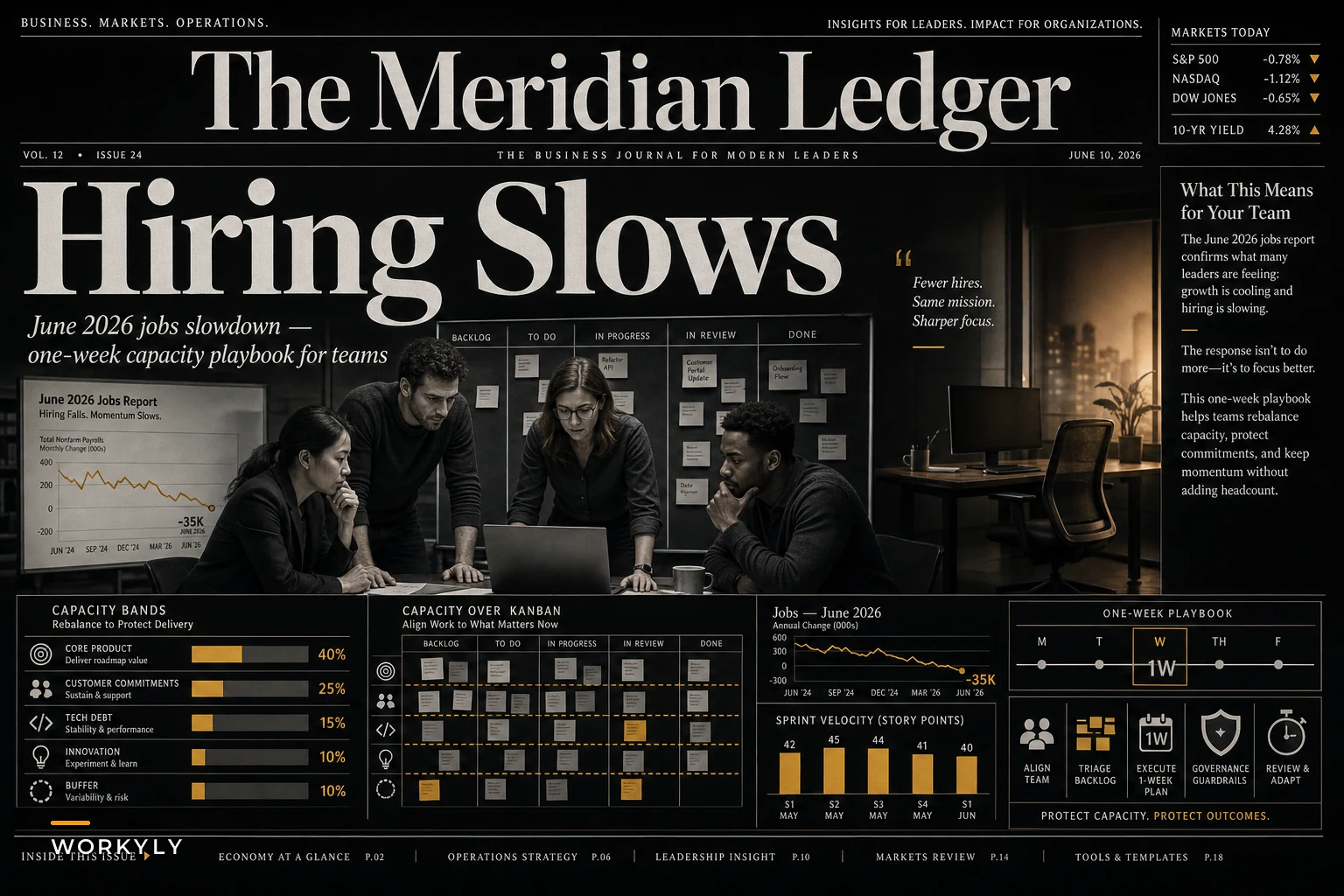

The June jobs report just dropped a reality check on every product org still operating like it's 2021. With payrolls rising just 57,000 according to CNBC — well below the expected 185,000 — and prior months revised downward, the hiring party is effectively over. Finance teams are already updating their models, and those "approved headcount" slots you were counting on for Q3? They're about to disappear.
The Capacity Crunch Nobody Talks About
Most teams handle hiring freezes badly because they treat it like a short-term inconvenience instead of an operational reality that needs systematic adjustment. They keep the same roadmap. They maintain the same sprint commitments. They tell themselves those two senior engineers will definitely get approved "next quarter." Meanwhile, the existing team starts burning out trying to cover for phantom headcount that was never going to materialize anyway.
The actual problem isn't the freeze itself — it's that most capacity planning assumes linear growth. You built your Q3 roadmap assuming you'd have 12 engineers by July. You committed to features based on having a dedicated DevOps person. Your timelines factored in that product marketing hire who was supposed to handle launch coordination. When those assumptions break, everything downstream breaks with them.
What makes this particularly brutal is that hiring slowdowns almost never come with corresponding reductions in expectations. Sales still needs those enterprise features. Marketing still wants that integration shipped. The board still expects the same growth trajectory. You end up trying to deliver 120% of the work with 75% of the planned resources.
Why Traditional Capacity Planning Breaks During Constraints
Standard capacity planning falls apart during hiring freezes for three structural reasons that tend to compound each other.
Stop losing track of your priorities.
Workyly helps you organize, assign, and track every task efficiently.
- Centralized task management
- Real-time collaboration
- Intelligent workflow automation
No credit card required
First, it assumes stable team composition. Most planning exercises calculate velocity based on current team output, then project forward assuming similar productivity. But when you can't backfill the engineer who just left for a startup, or when contractor budget gets cut mid-quarter, your baseline assumptions become fiction. One team had built their entire H2 roadmap around a data engineer hire — when that req got frozen, three quarters of their analytics initiatives became impossible to deliver.
Second, traditional planning ignores the hidden capacity tax that comes with constrained resources. When you're down two developers, the remaining team doesn't just absorb 25% more work. They also spend time context-switching between unfamiliar codebases, re-explaining requirements because there's no dedicated owner, and dealing with quality issues that come from rushing. The actual productivity hit lands closer to 40–45% in practice.
Third, most capacity models treat all work as equivalent when reality is far messier. That feature your enterprise customer wants might require deep knowledge of your legacy authentication system that only two people understand. The API migration everyone agrees is critical needs someone who knows both the old Python codebase and the new Go services. When you can't hire specialists, certain categories of work become disproportionately expensive — or just impossible.
Recalibrating Without Burning Out Your Team
Teams that successfully navigate headcount constraints don't just work harder. They restructure how they plan and execute — shifting from resource-optimized planning to constraint-based delivery, which is a meaningfully different way of operating.
Start by killing the zombie initiatives. Every organization has projects that keep consuming resources despite being strategically dead. The experimental feature that never got adoption but still needs maintenance. The integration one customer requested that nobody else uses. The internal tool that was supposed to save time but created more overhead than it solved. During normal times you can afford to let these limp along. During a hiring freeze, they're a luxury you don't have.
One fintech team went through this exercise and found roughly 23% of their engineering capacity was going toward features used by less than 2% of customers — not maintaining them, but actively building new capabilities for them because "we already invested so much." They sunset five features across two sprints and immediately freed up enough capacity to accelerate their core payment processing work.
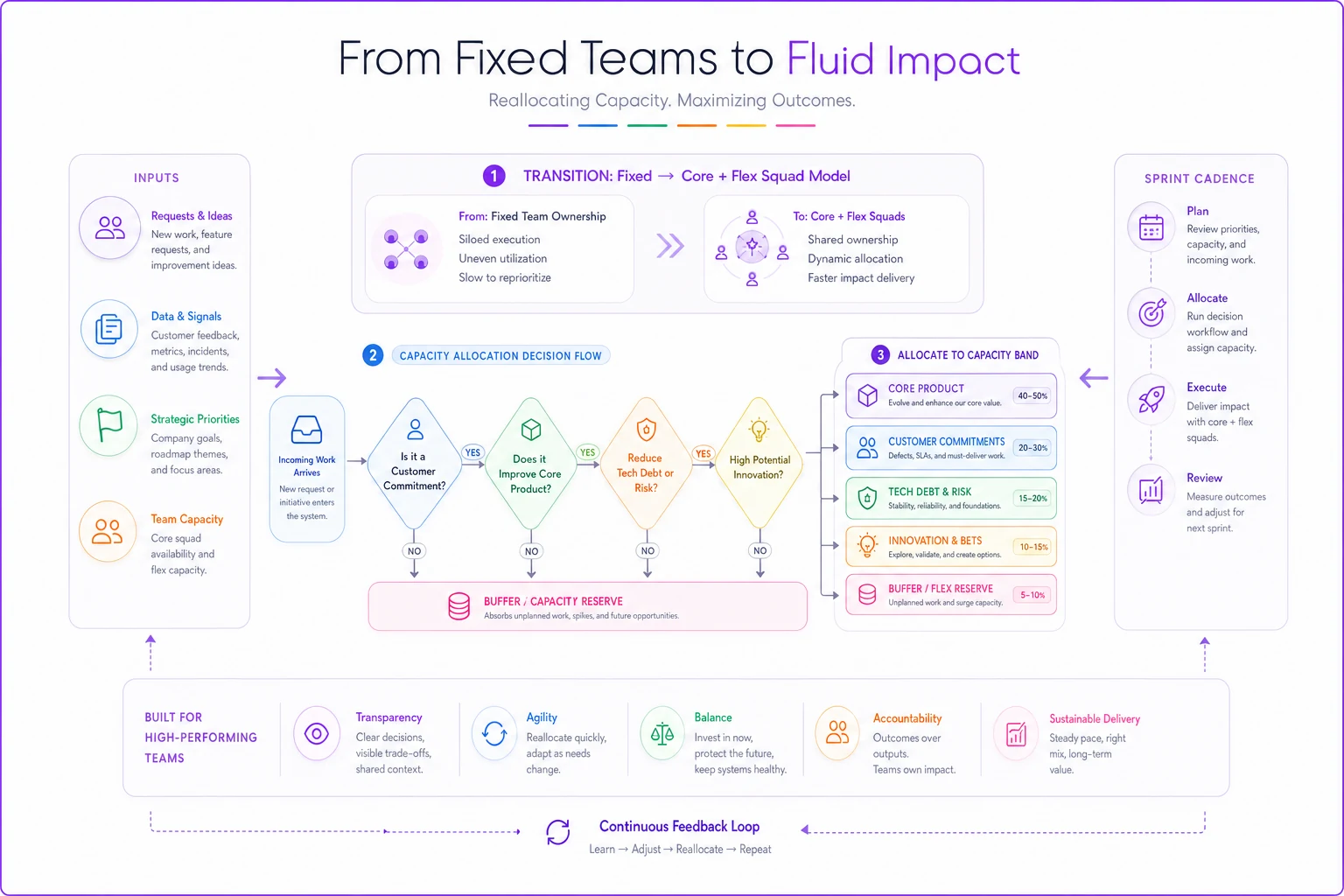
Next, move away from fixed capacity allocations toward capacity bands. Traditional planning assigns people to projects — Jennifer owns the checkout flow, Marcus handles API development. This breaks when Jennifer is suddenly covering for a departed teammate and Marcus gets pulled into production issues. Capacity bands create flexibility by defining ranges of commitment rather than fixed numbers.
Here's how one product team restructured their capacity planning after headcount got frozen:
| Capacity Category | Band Range | Notes |
|---|---|---|
| Core product | 40–50% | Must maintain |
| Customer commitments | 25–30% | Contractually obligated |
| Tech debt | 15–20% | Prevents future slowdown |
| Innovation | 10–15% | Only if capacity allows |
| Buffer | 15–20% | Unplanned work always happens |
The ranges and explicit buffer matter. When someone gets sick or leaves, you compress the innovation band first, then tech debt if needed — but core product and customer commitments stay protected. This prevents overcommitment without requiring you to have everything figured out in advance.
When someone gets sick or leaves, compress the innovation band first, then tech debt to protect customer commitments.
The team found this approach dramatically reduced the mid-sprint scrambles that had been burning everyone out. Having pre-agreed bands meant fewer arguments about priorities when something unexpected hit.
The Uncomfortable Prioritization Decisions
Hiring freezes force conversations that everyone avoids during good times. Which customers actually matter? What features genuinely drive revenue? Which technical debt will actually bite you versus what engineers want to fix because the code offends them aesthetically?
Most teams discover they've been running on informal prioritization that breaks under pressure. Enterprise sales has been promising custom features. Product managers have been sneaking "quick wins" into every sprint. Engineers have been refactoring systems that work fine. When capacity shrinks, all these informal commitments collide at once.
Create explicit prioritization criteria tied to business reality — not another scoring framework, but specific filters. One approach: map every piece of work to revenue protection, revenue growth, or risk reduction. If it doesn't clearly fit one of those three, it waits.
A B2B SaaS company applied this filter after their freeze started and found roughly 35% of their engineering work couldn't be tied to any of those categories. It was labeled "strategic" or "innovative" or "improving developer experience" — potentially valuable, but not essential under resource constraints. They paused everything in that bucket and found capacity they didn't realize existed.
Building Systematic Flexibility
Teams that handle constraints well don't just cut work — they restructure how work gets done. Fixed team ownership of fixed domains is efficient when headcount is stable. When people leave or reqs get frozen, that model becomes fragile fast.
Consider variable team structures instead. Keep core teams small — two or three people who deeply understand a system — then augment with rotating capacity from a shared pool. This prevents the bus factor problem while maintaining flexibility when priorities shift.
One engineering org restructured from eight fixed teams to four core teams plus two "flex squads" that rotated every sprint. The flex squads handled whatever was most critical that week — joining a core team for a major feature push, clearing operational backlog, addressing tech debt. This created roughly 25% variable capacity without any additional headcount.
Visualizing the capacity reallocation flow helps teams agree decisions quickly.
Graduated delivery commitments are another underused lever. Not every feature needs to ship at full polish on day one. Create explicit tiers — MVP, standard, polished — and consciously choose which tier each piece of work gets. Core product functionality might always ship polished, but that internal admin tool? MVP is probably fine and ships three times faster.
A marketplace platform used this approach and found they could ship considerably more by consciously choosing MVP delivery for internal tools and experimental features, reserving full polish for customer-facing core functionality. The key word is consciously — it only works if the decision is explicit and agreed upon upfront, not something you quietly decide when you're already behind.
Protecting Delivery While Preventing Burnout
The biggest risk during headcount constraints isn't missed deadlines — it's losing the people you have. Every hiring freeze eventually ends, but if you've burned out your best engineers in the meantime, recovery gets much harder.
Set maximum utilization at 75%, not the theoretical 100% that looks good on a spreadsheet. Yes, this means less total output. But it also means your team can sustain the pace for months instead of weeks, and you have buffer when someone gets sick or quits unexpectedly.
Rotate high-stress work. Production support, customer escalations, legacy system maintenance — these become demoralizing when they turn into permanent assignments. During normal times you might have dedicated people for these roles. During constraints, rotating them weekly or bi-weekly prevents burnout from concentrating on the same person every time.
-
Assign high-stress rotations in two-week cycles
-
Track overtime hours and flag anything above a few hours per week
-
Monitor context switches — more than three per day becomes counterproductive
-
Review sustainability metrics weekly, not just velocity and story points
When these metrics exceed reasonable thresholds, something needs to give. Either cut scope, adjust timelines, or find ways to reduce the burden. Ignoring the signals is how you lose senior engineers at exactly the moment you can least afford it.
Leveraging Automation When You Can't Leverage Headcount
When you can't add people, the only other option is eliminating work — not by cutting features, but by automating the operational overhead that quietly consumes more capacity than most leaders realize.
The highest-leverage automation during constraints isn't always the obvious stuff. CI/CD pipelines matter, but most teams already have those. The real drains hide in coordination work — status updates, capacity tracking, project reporting, dependency management. A senior engineer spending two hours per week updating spreadsheets and attending sync meetings just to keep stakeholders informed is losing roughly 5% of their available capacity before they've written a line of code.
This is where proper capacity planning with buffer bands becomes genuinely critical. When you can systematically track and visualize capacity, you stop wasting time in meetings debating who has bandwidth. AI-powered operational platforms can automatically track utilization, flag overcommitment, and suggest rebalancing without constant manual updates from your leads.
One engineering team automated their entire capacity reporting workflow — pulling data from Jira, calculating utilization, identifying bottlenecks, generating weekly reports. Each team lead recovered roughly three hours per week. Across eight teams, that's 24 hours of senior engineering time recovered every single week. During a hiring freeze, that's functionally equivalent to gaining half a person without any headcount approval.
The New Reality of Constraint-Based Planning
The Reuters report noting unemployment at 4.2% might suggest a tight labor market, but cooling job growth tells a different story — companies are pulling back even when talent is technically available. This probably isn't a temporary blip.
Product and engineering leaders who adapt their planning models now will have a real advantage. While competitors struggle with overcommitment and burnout, teams with flexible capacity models, automated operations, and systematic prioritization will keep delivering — not everything, but the things that actually matter.
Start with a capacity audit. Not what you theoretically have, but what you actually have after accounting for meetings, context switches, and operational overhead. Build explicit buffers. Create variable team structures. Automate the coordination work that burns capacity without producing anything. And have the uncomfortable prioritization conversations now, before pressure forces rushed decisions that are harder to walk back.
Your team can maintain meaningful delivery velocity during a hiring freeze. But only if you stop planning like the freeze is temporary and start operating like it might be the new normal — because given the current economic signals, it very well might be.
Ready to boost your team's productivity?
Join 5,000+ teams using Workyly to streamline workflows, improve communication, and deliver projects faster.